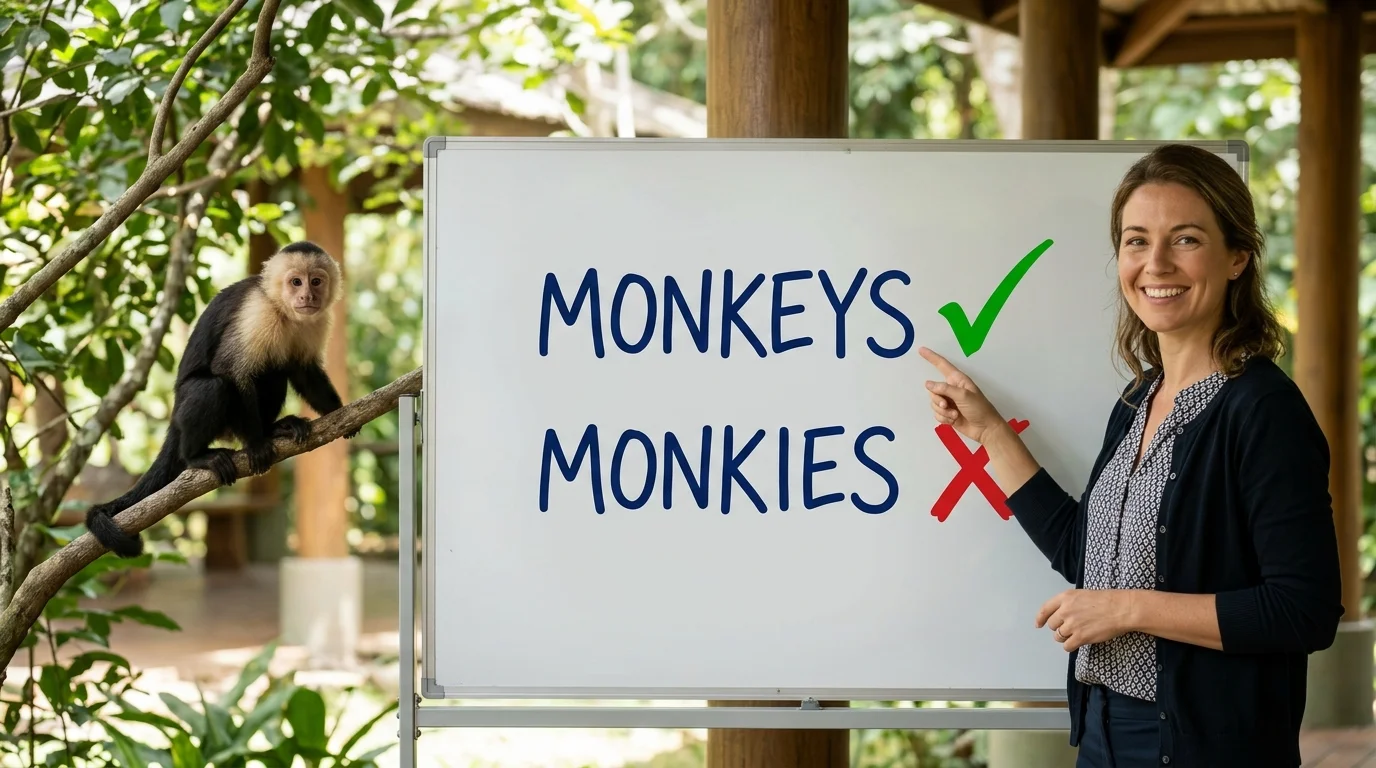
English spelling can sometimes be confusing, especially when a word ends in -y. You might know the word monkey, but when you want to talk about more than one monkey, should you write monkeys or monkies? Both forms may look reasonable at first. However, only one is the standard plural spelling in modern English.
This confusion happens because English has a spelling rule that changes the ending of some words when we make them plural. For example, we write baby as babies and city as cities. Naturally, you might expect the same rule to apply to monkey. Nevertheless, the word follows a different pattern because of the letter that comes before its final y.
Understanding this spelling difference helps students, teachers, writers, bloggers, and anyone who wants to communicate clearly in English. Whether you live in the United Kingdom or the United States, you should use the same standard spelling. In addition, learning why the correct form works will help you spell other words more confidently.
Quick Answer: Monkeys or Monkies?
Monkeys is the correct plural spelling of monkey. The spelling monkies is incorrect in standard British and American English.
Use monkey when referring to one animal and monkeys when referring to two or more. For example, “A monkey climbed the tree” describes one animal, while “Three monkeys climbed the tree” describes several animals.
The key rule is simple: when a noun ends in a vowel followed by y, you generally add -s to make it plural. Because monkey ends in ey, its plural is monkeys, not monkies.
Meaning of the Correct Form: Monkeys
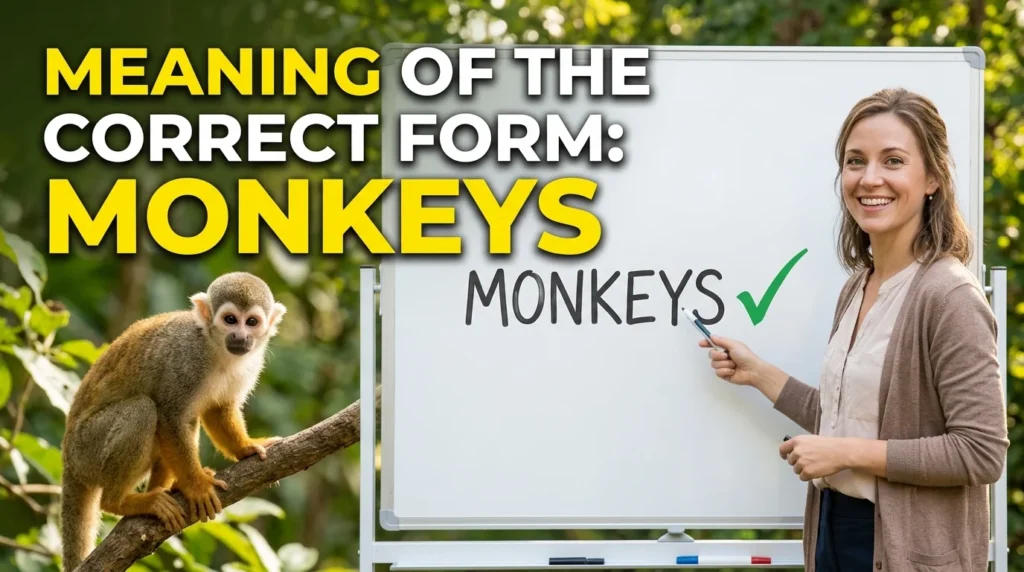
The word monkeys is the correct plural form of monkey. A monkey is a type of primate, an animal known for its intelligence, social behaviour, and ability to climb. Monkeys live in different parts of the world, including Africa, Asia, and Central and South America.
When you talk about one of these animals, use the singular noun monkey. However, when you refer to two or more, use the plural noun monkeys. You do not need to change the final y to i because the word ends in a vowel followed by y.
For example:
- Singular: A monkey is sitting on a branch.
- Plural: Two monkeys are sitting on a branch.
- Singular: The monkey is eating a banana.
- Plural: The monkeys are eating bananas.
Notice that the spelling changes only by adding s to the end. The rest of the word stays exactly the same.
Why Is Monkeys the Correct Spelling?
English nouns generally follow different pluralisation patterns depending on their final letters. One common rule applies to nouns ending in a consonant followed by y. In these cases, you usually change the y to i and add -es.
For instance:
- Baby → Babies
- City → Cities
- Puppy → Puppies
- Story → Stories
However, when a noun ends in a vowel followed by y, you generally keep the y and add -s.
Examples include:
- Boy → Boys
- Toy → Toys
- Key → Keys
- Day → Days
- Monkey → Monkeys
Since the letter e comes immediately before the final y in monkey, the word follows the second rule.
Is Monkeys Correct in British and American English?
Yes. Monkeys is the standard spelling in both British English and American English. There is no difference between the two varieties when forming the plural of monkey.
British writers may use words such as colour and behaviour, while American writers generally use color and behavior. Nevertheless, both use monkeys when referring to multiple animals.
Here are examples for both audiences:
British English:
- The monkeys at the wildlife park were playing together.
- Several monkeys live in the forest.
- The children watched the monkeys during their school trip.
American English:
- The monkeys at the zoo were playing together.
- Several monkeys live in the forest.
- The children watched the monkeys during their school field trip.
Therefore, you can confidently use monkeys in schoolwork, professional writing, blog posts, emails, and everyday conversations in either country.
Meaning of the Incorrect Form: Monkies
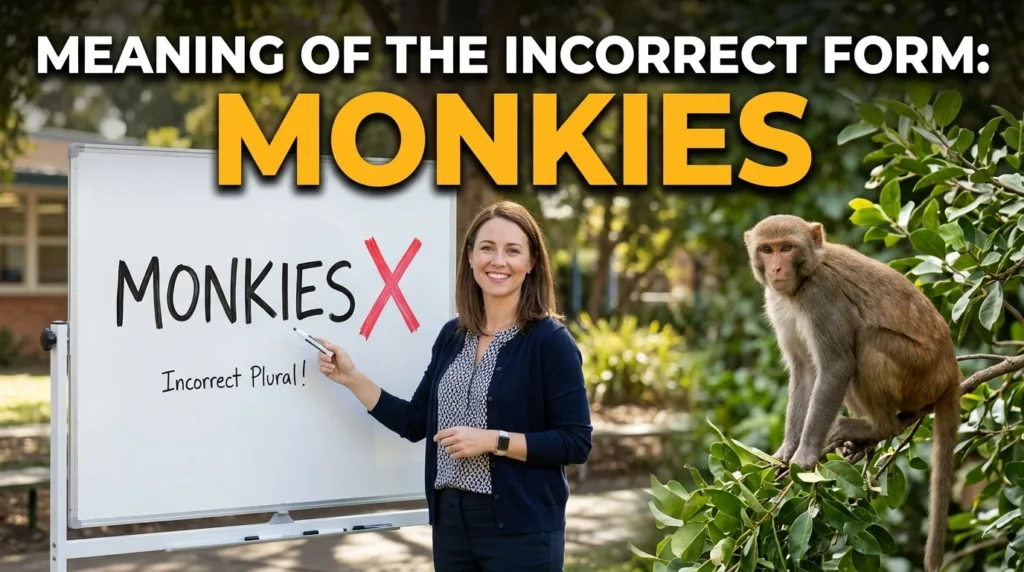
The spelling monkies is a common mistake, but it is not the standard plural form of monkey. People often write it because they apply the consonant-plus-y rule to a word that actually follows the vowel-plus-y rule.
For example, someone who knows that puppy becomes puppies might assume that monkey should become monkies. Although this guess makes sense at first, it does not follow the correct spelling pattern for this word.
Compare these sentences:
- Incorrect: Three monkies climbed the tree.
- Correct: Three monkeys climbed the tree.
- Incorrect: We saw several monkies at the zoo.
- Correct: We saw several monkeys at the zoo.
- Incorrect: The monkies were eating fruit.
- Correct: The monkeys were eating fruit.
In each example, changing monkies to monkeys fixes the spelling mistake.
Why Do People Write Monkies?
There are several reasons why people make this error.
1. They remember the wrong plural rule.
Many learners memorise examples such as baby/babies and lady/ladies. Consequently, they may apply that pattern to every word ending in y, even when the preceding letter is a vowel.
2. They rely on how the word looks.
The spelling monkies may look logical to someone who is familiar with words such as ponies. However, English spelling depends on established word patterns rather than visual similarity alone.
3. They type quickly.
During online conversations, social media posts, or informal writing, people sometimes make spelling errors without noticing them. A spell-checker may identify monkies as incorrect, but not every writing tool catches every mistake.
4. They learn the rule without learning its exceptions.
English has several spelling patterns, and learners sometimes remember only one part of a rule. Learning both the consonant-plus-y and vowel-plus-y patterns makes it easier to choose the right plural form.
5. They confuse spelling with pronunciation.
The plural monkeys sounds like the singular word with an additional final /z/ sound. Because the spelling difference is small, a writer might focus on the sound rather than the correct written form.
Remember that monkies is a spelling mistake, not an alternative British or American spelling.
Monkeys vs Monkies: Key Differences
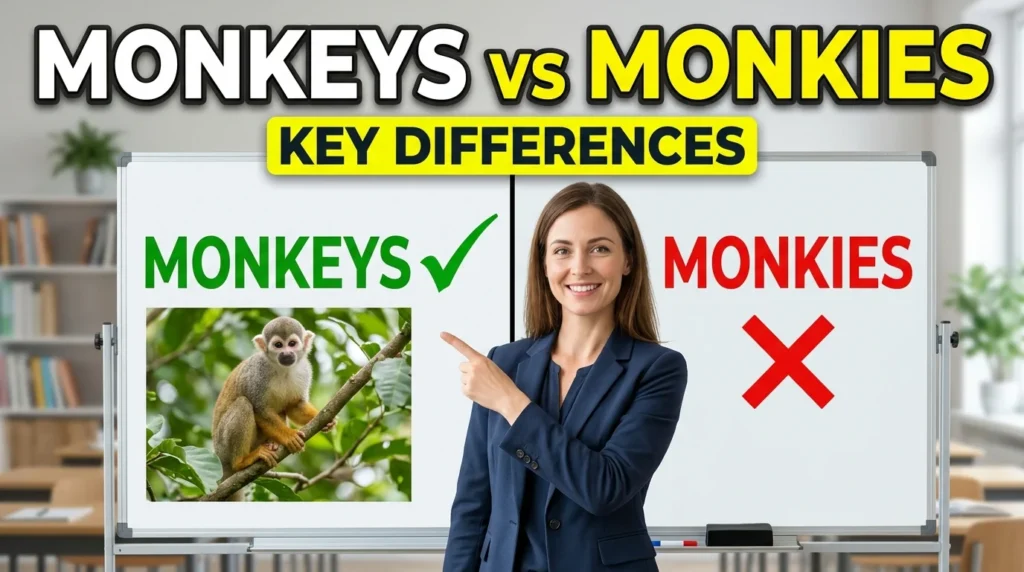
The difference between monkeys and monkies is straightforward. One is the accepted plural spelling, while the other is a common misspelling.
| Feature | Monkeys | Monkies |
| Spelling status | Correct | Incorrect in standard English |
| Singular form | Monkey | Intended to be monkey |
| Meaning | More than one monkey | No standard plural meaning |
| British English | Correct | Incorrect |
| American English | Correct | Incorrect |
| Grammar pattern | Vowel + y: add -s | Incorrectly applies another pattern |
| Suitable for formal writing | Yes | No |
| Suitable for school assignments | Yes | No |
The Main Spelling Rule
To understand the difference, look at the letter immediately before the final y.
If a noun ends in a consonant + y, you generally change y to i and add -es.
Examples:
| Singular | Correct plural |
| Baby | Babies |
| City | Cities |
| Puppy | Puppies |
| Lady | Ladies |
| Country | Countries |
| Cherry | Cherries |
On the other hand, if a noun ends in a vowel + y, you generally keep the y and add -s.
| Singular | Correct plural |
| Monkey | Monkeys |
| Boy | Boys |
| Key | Keys |
| Toy | Toys |
| Day | Days |
| Donkey | Donkeys |
| Journey | Journeys |
The word monkey belongs to the second group because the final y follows the vowel e.
Does British English Use a Different Rule?
No. British and American English follow the same spelling rule for this word. Although the two varieties differ in the spelling of some words, monkey is not one of them.
For instance, British English commonly uses travelling, while American English commonly uses traveling. Similarly, British English often uses centre, while American English uses center. These differences do not affect the plural spelling of monkey.
You should write:
- British English: The monkeys are playing in the garden.
- American English: The monkeys are playing in the yard.
The spelling remains unchanged. Only the surrounding vocabulary may vary according to the context.
Common Mistakes People Make With Monkeys
Even though the rule is simple, learners can make several mistakes when writing this word. Understanding these errors will help you avoid them in everyday English.
Mistake 1: Changing Y to I Automatically
The most common mistake is assuming that every noun ending in y changes to -ies.
Incorrect: The zookeeper fed the monkies.
Correct: The zookeeper fed the monkeys.
The correction works because monkey ends in a vowel followed by y. Therefore, you add s without changing the final letters.
Mistake 2: Using Monkies in School Assignments
Students sometimes write monkies in essays, worksheets, examinations, or science projects. Although readers can usually understand the intended meaning, the spelling remains incorrect.
Incorrect: Monkies are intelligent animals.
Correct: Monkeys are intelligent animals.
If you are writing an assignment about animal behaviour, wildlife conservation, or primates, always check the spelling before submitting your work.
Mistake 3: Using Monkies in Blog Posts
Bloggers and website owners should pay attention to spelling because readers expect clear, professional content. Repeated spelling errors can distract readers and reduce confidence in the quality of an article.
For example:
Incorrect: Five Interesting Facts About Monkies
Correct: Five Interesting Facts About Monkeys
The corrected heading is appropriate for a wildlife blog, educational website, or animal-related article.
For SEO purposes, use the correct spelling naturally in headings, page titles, descriptions, and body text. There is no need to repeat the misspelling unnecessarily.
Mistake 4: Assuming UK and US Spelling Must Differ
Some English words have different accepted spellings in the UK and the US. However, that does not mean every word has two forms.
For example, organise is common in British English, while organize is common in American English, although the -ize spelling is also accepted in many British style guides.
In contrast, monkeys is correct in both varieties.
Incorrect assumption: British writers use monkies, while American writers use monkeys.
Correct understanding: Both British and American writers use monkeys.
Mistake 5: Forgetting to Check the Plural in a Sentence
Sometimes writers spell the noun correctly but use the wrong verb with it. Remember that plural nouns generally take plural verbs in the present tense.
Incorrect: The monkeys is climbing the trees.
Correct: The monkeys are climbing the trees.
Similarly:
Incorrect: One monkeys is eating an apple.
Correct: One monkey is eating an apple.
The first sentence requires the singular noun monkey, while the second requires the plural noun monkeys. In addition, the verb must agree with the subject.
Mistake 6: Treating Every Y-Ending Word Alike
English has different patterns for plural nouns. For example, toy becomes toys, but city becomes cities. The final letter alone does not determine the plural spelling; the letter before it also matters.
Therefore, examine the ending of the entire word instead of automatically replacing y with i.
Correct Usage of Monkeys in Sentences
The best way to remember a spelling rule is to see it in real sentences. The following examples show how to use monkeys in different situations, including everyday conversations, schoolwork, professional writing, and animal-related discussions.
Everyday English Examples
- The monkeys climbed the trees to find food.
- We watched three monkeys playing near the river.
- The monkeys were resting in the shade.
- Several monkeys gathered around the fruit.
- The children laughed as the monkeys jumped between branches.
- Two monkeys sat beside each other on a rock.
- The monkeys disappeared into the forest.
- Many monkeys use their hands to handle food.
Each sentence uses monkeys because it refers to more than one animal.
British English Examples
These sentences are suitable for readers in the United Kingdom.
- We visited the zoo and watched the monkeys during the afternoon.
- The monkeys were swinging from branches in the wildlife park.
- Our teacher explained how monkeys live in groups.
- Several monkeys were resting near the trees.
- The children enjoyed watching the monkeys during their school trip.
- The keeper gave the monkeys fresh fruit.
Notice that the plural spelling remains monkeys throughout these examples. Words such as teacher, keeper, and wildlife park fit naturally into British English contexts, but none changes the spelling rule.
American English Examples
Here are examples that fit common American English contexts.
- We saw several monkeys at the zoo.
- The monkeys were climbing around their enclosure.
- Our science teacher showed us pictures of monkeys.
- The monkeys gathered near the trees to find food.
- The children watched the monkeys during their school field trip.
- The zookeeper gave the monkeys some fresh fruit.
Again, monkeys is the correct spelling. The difference between British and American English lies mainly in contextual vocabulary, not in the plural form of this noun.
Examples for School and Academic Writing
When writing a report or completing a school assignment, use the correct spelling and make sure the sentence communicates your meaning clearly.
- Monkeys belong to a group of mammals called primates.
- Many monkeys live in forests and other natural habitats.
- Researchers study monkeys to learn more about animal behaviour.
- Some monkeys use vocal sounds and body movements to communicate.
- Different species of monkeys have different diets.
- Scientists observe monkeys to understand their social relationships.
These examples show that monkeys works in both general and educational writing.
Examples for Emails and Professional Communication
The same spelling rule applies to professional messages.
Example 1: School email
“Our class is preparing a presentation about monkeys and their natural habitats.”
Example 2: Wildlife organisation email
“Our team observed several monkeys during the latest field visit.”
Example 3: Educational newsletter
“This month’s article explains how monkeys find food and communicate with each other.”
Example 4: Travel message
“We hope to see monkeys during our visit to the wildlife sanctuary.”
Regardless of the audience, write monkeys, not monkies.
Singular and Plural Examples
Use the following examples to understand how the noun changes according to the number of animals.
| Singular sentence | Plural sentence |
| A monkey is climbing a tree. | Two monkeys are climbing trees. |
| The monkey eats fruit. | The monkeys eat fruit. |
| One monkey lives in the enclosure. | Several monkeys live in the enclosure. |
| That monkey is very active. | Those monkeys are very active. |
| The monkey has a long tail. | The monkeys have long tails. |
Notice that other words sometimes change too. For example, is becomes are, and has becomes have. Therefore, correct plural usage involves both spelling and grammar.
Monkeys or Monkies in Different Writing Situations
The correct spelling does not change according to where you use the word. However, the context can affect how you write the rest of the sentence.
In Text Messages and Social Media
People often use informal language in text messages, comments, and social media captions. Even so, monkeys remains the correct spelling.
Correct: “These monkeys are so funny!”
Incorrect: “These monkies are so funny!”
You may encounter the incorrect version in online posts because people make typing mistakes. However, seeing a spelling mistake online does not make it an accepted alternative.
In Search Queries
Someone may type monkies into a search engine because they are unsure of the correct spelling. That is a reasonable way to look for clarification, but when writing the final article or assignment, use monkeys.
For website owners, the best practice is to use the standard spelling in the main content. Search engines can often understand spelling variations, but that does not make an incorrect form appropriate for publication.
In Children’s Books and Educational Materials
Children often learn plural rules through simple examples. Teachers and parents can use monkey and monkeys to demonstrate the vowel-plus-y pattern.
For example, ask a child to complete the sentence:
“One monkey, two ______.”
The correct answer is monkeys.
Then compare it with:
“One puppy, two ______.”
The correct answer is puppies.
This comparison helps children see that nouns ending in y do not all form their plurals in the same way.
In Creative Writing
Writers may describe monkeys in stories, poems, children’s books, and fictional adventures. Even in creative work, use the standard plural spelling unless you deliberately reproduce a character’s spelling error or create a special fictional term.
For example:
“The monkeys raced through the jungle while the morning sun shone through the leaves.”
The word monkeys correctly identifies several animals. There is no reason to use monkies in an ordinary narrative.
Tips to Remember the Correct Usage
You do not need to memorise a long list of rules to spell monkeys correctly. A few simple strategies can make the difference easier to remember.
Tip 1: Look at the Letter Before Y
Check the letter immediately before the final y.
- Vowel + y: usually add -s.
- Consonant + y: usually change y to i and add -es.
For monkey, the ending is ey, so you keep the y and add s.
Remember these pairs:
- Monkey → Monkeys
- Key → Keys
- Toy → Toys
- Baby → Babies
- Puppy → Puppies
This is the most useful rule to learn.
Tip 2: Remember the Phrase “Monkey Gets an S”
A simple memory trick is to tell yourself: “One monkey, two monkeys—just add S.”
The phrase reminds you that the final y stays in place. You only add the letter s to form the plural.
Repeat the phrase when practising spelling or proofreading an assignment. With regular use, the correct spelling will become easier to recall.
Tip 3: Compare Monkey With Donkey
The word donkey follows the same pattern as monkey.
- One monkey, several monkeys.
- One donkey, several donkeys.
Both words end in a vowel followed by y. Therefore, you add s without changing the final y.
Learning related examples makes it easier to recognise a pattern rather than memorise each word separately.
Tip 4: Practise With Short Sentences
Write a few simple sentences to reinforce the rule.
- I saw two monkeys.
- The monkeys are eating fruit.
- Several monkeys live in the forest.
- The little monkeys followed their mother.
Then check each sentence. If you wrote monkies, replace it with monkeys.
Tip 5: Use a Spell-Checker, but Learn the Rule
A spell-checker can help identify common spelling errors. However, it is still useful to understand why a word is correct.
When a writing tool underlines monkies, check the spelling instead of ignoring the suggestion. Over time, you will recognise the correct form without needing assistance.
Tip 6: Proofread Your Headings
If you write blog posts or educational articles, check headings as well as paragraphs. A misspelling in a prominent heading can be particularly noticeable.
For example:
- Incorrect: Facts About Monkies
- Correct: Facts About Monkeys
Proofreading your title, introduction, subheadings, and conclusion will help you produce clearer content.
Frequently Asked Questions (FAQs)
1. Is it monkeys or monkies?
Monkeys is correct. Monkies is a misspelling in standard English. To form the plural of monkey, keep the final y and add s.
2. Why is monkeys correct instead of monkies?
The word monkey ends in a vowel followed by y. English generally forms the plural of such nouns by adding -s. Therefore, monkey becomes monkeys, just as toy becomes toys.
3. Is monkeys correct in British English?
Yes. British English uses monkeys as the standard plural form. There is no British spelling variation that makes monkies correct.
4. Is monkeys correct in American English?
Yes. American English also uses monkeys. The spelling is identical in British and American English, so you can use it confidently in American school assignments, articles, and everyday writing.
5. What is the singular form of monkeys?
The singular form is monkey. Use it when talking about one animal.
Example: “A monkey is sitting on the branch.”
When referring to two or more, use monkeys.
Example: “Three monkeys are sitting on the branches.”
6. Why do babies become babies but monkeys become monkeys?
The difference depends on the letter before the final y. In baby, the letter b is a consonant, so the plural becomes babies. In monkey, the letter e is a vowel, so you keep the y and add s.
7. Can I use monkies in informal writing?
You may see monkies in informal messages or online posts, but it remains a spelling mistake in standard English. If you want your writing to be clear and correct, use monkeys in texts, captions, emails, assignments, and articles.
8. What is the plural of monkey in a sentence?
The plural is monkeys. For example: “The monkeys played together in the trees.” The word refers to more than one monkey, so the plural form is appropriate.
9. Do monkeys and monkies have different meanings?
No. Monkies is not a standard alternative plural with a different meaning. People who write it usually intend to refer to multiple monkeys. The correct spelling is monkeys.
10. How can I quickly remember the spelling?
Remember this simple rule: monkey + s = monkeys. Because the word ends in ey, you keep both letters and add s. Compare it with baby + ies = babies to see the difference.
Conclusion
Choosing between monkeys and monkies is easy once you understand the plural spelling rule. Monkeys is the correct form in both British and American English, while monkies is a common spelling mistake. When a noun ends in a vowel followed by y, you generally keep the y and add s to make it plural.
Remember the examples monkey/monkeys, donkey/donkeys, and toy/toys. In contrast, words such as baby/babies and puppy/puppies follow the consonant-plus-y pattern. Understanding this difference will help you write more accurately in school assignments, professional emails, social media posts, and website content.

James Carter is an English language enthusiast and content writer who loves making grammar simple and easy to understand. He creates clear, beginner-friendly guides on spelling, grammar rules, confusing words, and everyday English usage. His goal is to help readers write with confidence through practical examples, easy explanations, and accurate language tips.