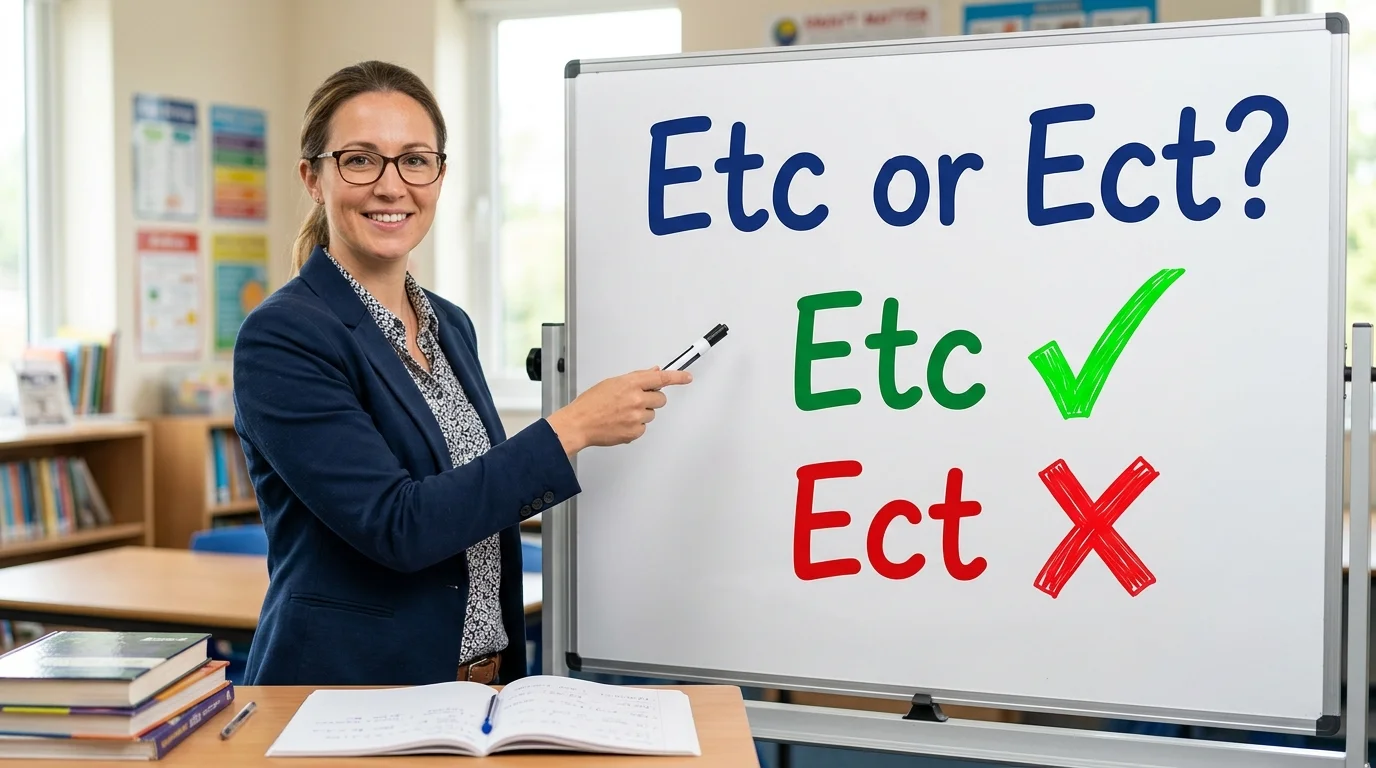
Small spelling mistakes can easily slip into everyday writing, especially when a word or abbreviation is commonly heard but not always spelled correctly. “Etc or Ect” is a common confusion because both forms may look similar, yet only one is correct in standard English. The correct form is “etc.”, which is short for the Latin phrase et cetera, meaning “and other things” or “and so on.”
People use it when listing examples without naming every possible item. For example, “Please bring notebooks, pens, pencils, etc.” means that notebooks, pens, and pencils are examples of the things to bring, but the list may include other supplies as well. On the other hand, “ect” is an incorrect spelling when you intend to use this abbreviation.
Because people often pronounce “etc.” quickly in conversation, it can be easy to mix up the order of the letters when writing it. Knowing the correct spelling can help you communicate more clearly in school assignments, professional emails, articles, and everyday messages. It is also useful to understand that “etc.”
Quick Answer ⚡
“Etc.” is the correct spelling. It’s short for the Latin phrase et cetera, meaning “and so on” or “and other things.” “Ect” is not a real word or abbreviation it’s simply a common typo.
Let’s break down exactly why this happens and how to remember it for good.
What Does “Etc.” Actually Mean? 🧐
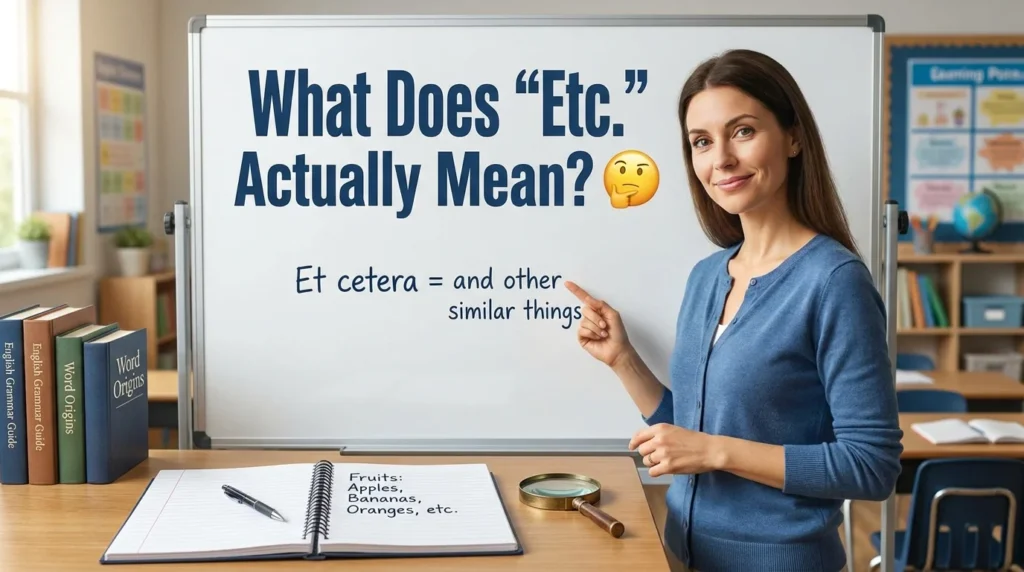
“Etc.” is an abbreviation of the Latin phrase “et cetera” (pronounced et SET-er-uh), which literally translates to “and the rest” or “and other similar things.”
We use “etc.” at the end of a list when we want to suggest that more items could be added, but we don’t need to name them all.
Breaking Down the Latin Roots
| Latin Word | Meaning |
| Et | and |
| Cetera | the rest / other things |
So “et cetera” = “and the rest of the things.” That’s why we abbreviate it as “etc.” keeping the “et” and shortening “cetera” to “c.”
Examples of “Etc.” in a Sentence
- I need to buy apples, bananas, bread, etc. 🍎🍌🍞
- The store sells clothes, shoes, accessories, etc.
- We discussed budgeting, marketing, hiring, etc., during the meeting.
- Please bring your ID, passport, boarding pass, etc., to the airport.
- The museum has paintings, sculptures, artifacts, etc., from ancient civilizations.
Notice how “etc.” always comes at the end of a list, signaling that similar items continue beyond what’s written.
Why Do People Write “Ect” Instead? 🤷♀️
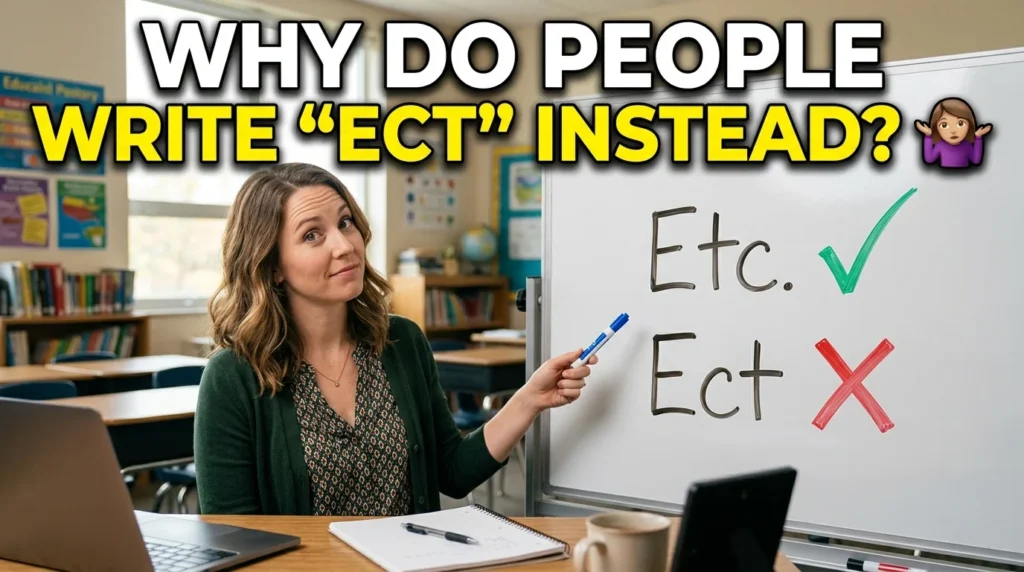
This is purely a pronunciation-based mistake. When people say “etc.” out loud quickly, it can sound like “ek-cetera” or even “ect-etera” and our brains sometimes process the sounds in the wrong order.
Here’s what happens:
- We hear the “t” and “c” sounds blended together
- Our brain reorders them as “c” then “t” giving us “ect”
- We then spell it the way it sounds, instead of the way it’s actually written
This is a classic case of a spelling mistake caused by mispronunciation similar to how people sometimes write “expresso” instead of “espresso”! ☕
“Ect” Is Not a Real Word ❌
Let’s be crystal clear: “ect” has no meaning on its own as a standalone abbreviation in standard English. It doesn’t appear in dictionaries as a substitute for “etc.”
However, you might notice “ect” appearing as part of other unrelated words or medical/technical abbreviations, such as:
- ECT (all caps) a medical term meaning Electroconvulsive Therapy
- Certain scientific abbreviations in specialized fields
But when people misspell “etc.” as “ect,” they are not referring to any of these it’s simply an error. So if you see “ect” used at the end of a list, it’s almost always meant to be “etc.”
Comparison Table: Etc vs Ect
| Aspect | Etc. | Ect |
| Correct? | ✅ Yes | ❌ No (misspelling) |
| Origin | Latin: et cetera | No valid origin as a list abbreviation |
| Meaning | “and so on / and other things” | No meaning (common typo) |
| Used In | Lists, informal & formal writing | Never correct in this context |
| Example | “Pens, notebooks, erasers, etc.” ✅ | “Pens, notebooks, erasers, ect.” ❌ |
| Punctuation | Requires a period (.) after “etc” | N/A |
Memory Trick to Never Confuse Etc and Ect Again 🧠
Here’s a simple mnemonic to lock this into your memory:
“E-T-C: Extra Things Coming!” 🚚
Every letter stands for a reminder:
- E = Et (and)
- T = the
- C = Cetera (rest/others)
Or try this rhyme:
“E before C, that’s the key ‘etc.’ is how it’s meant to be!”
Another simple trick: remember that “etc.” starts the same way as “et cetera” if you can remember the full Latin phrase, you’ll always know the abbreviation starts with E-T, not E-C-T.
Don’t Forget the Period! ⚠️
Since “etc.” is an abbreviation, it should almost always be followed by a period in formal writing:
- ✅ Correct: “We need pens, paper, folders, etc.”
- ❌ Incorrect: “We need pens, paper, folders, etc”
Important punctuation tip: If “etc.” falls in the middle of a sentence (not at the end), you still need a comma after it:
- ✅ “She packed clothes, shoes, etc., before leaving for her trip.”
If “etc.” is the last word in the sentence, the period doing double duty (ending both the abbreviation and the sentence) is enough you don’t need two periods:
- ✅ “He brought snacks, drinks, games, etc.”
- ❌ “He brought snacks, drinks, games, etc..”
Real-Life Examples of “Etc.” in Use 📬
In Emails
“Please prepare the necessary documents: invoices, receipts, contracts, etc., before our call tomorrow.”
In Social Media Posts
“Weekend to-do list: laundry, groceries, gym, etc. Who else feels like adulting is just an endless list? 😅 #adulting”
In News Writing
“The new policy covers healthcare, education, housing, etc., according to officials.”
In Academic Writing
“Various factors economic, political, social, etc. contributed to the historical shift.”
In Everyday Speech
“I have to clean the house, do laundry, cook dinner, etc. Basically, my whole Saturday is booked!”
As you can see, “etc.” shows up everywhere from casual texts to formal reports which is exactly why getting the spelling right matters for your written communication and overall credibility.
British English vs American English 🇬🇧🇺🇸
Good news again: there’s no regional difference here! Both British and American English:
- Spell it the same way: “etc.”
- Pronounce it the same way: et-SET-er-uh (sometimes shortened casually to “et-set-ra”)
- Use it the same way at the end of a list to imply “and more of the same”
So no matter where your audience is from, “etc.” is universally correct, and “ect” is universally wrong.
Other Common Latin Abbreviations People Misspell ✍️
While we’re on the topic, here are a few related abbreviations that often confuse English learners:
| Abbreviation | Meaning | Common Misspelling |
| e.g. | “for example” (exempli gratia) | edg, e.g, eg. |
| i.e. | “that is” (id est) | ie, I.e, i.e, |
| etc. | “and so on” (et cetera) | ect, etc, ect. |
| vs. | “against” (versus) | vs, v.s. |
| et al. | “and others” (et alia) | et. al, et al |
Quick tip: Most Latin abbreviations in English keep their periods and specific letter order so it helps to learn the original Latin phrase behind each one. It makes the spelling much easier to remember!
Common Mistakes People Make With “Etc.” 🚩
- Writing “ect” instead of “etc.” the most frequent mistake, caused by mispronunciation.
- Forgetting the period writing “etc” without the period in formal writing.
- Overusing “etc.” using it too vaguely without giving enough example items first.
- ❌ “We sell things, etc.”
- ✅ “We sell shoes, bags, belts, etc.”
- Using “etc.” for people traditionally, “etc.” refers to things or items, not people. For listing people, “et al.” is more appropriate in formal/academic writing.
- ❌ “The meeting included John, Sarah, etc.”
- ✅ “The meeting included John, Sarah, et al.” (in academic contexts)
Pro tip: In casual writing, using “etc.” for people is common and generally accepted but in academic or professional writing, be mindful of this distinction.
Why This Grammar Tip Matters for SEO & Content Writing ✨
For bloggers, students, and professionals, small spelling errors like “ect” instead of “etc.” can affect:
- Credibility a simple typo can make readers question your attention to detail.
- SEO rankings search engines reward clean, accurate, well-written content.
- Professional communication a resume, email, or report with this error might come across as careless.
Keywords like “correct spelling,” “grammar tips,” and “English usage” are searched by thousands of learners every month who want to avoid exactly this kind of mistake. Mastering small details like “etc.” vs “ect” makes your writing look polished and professional. 🌟
FAQs: People Also Ask 🙋
1. Is “ect” ever a correct abbreviation for “and so on”?
No. “Ect” is not a real abbreviation for “et cetera” in any form of English. It’s always considered a spelling mistake in this context.
2. What does “etc.” stand for?
“Etc.” stands for the Latin phrase “et cetera,” which means “and other things” or “and so on.”
3. Do I need a period after “etc.”?
Yes, in formal writing, “etc.” should always have a period since it’s an abbreviation.
4. Can I use “etc.” at the beginning of a sentence?
It’s not recommended. “Etc.” works best at the end of a list, not as a sentence-starter.
5. Is it okay to use “etc.” in academic writing?
Yes, but sparingly. Many style guides (like APA) recommend using “etc.” only when the list examples are already very clear and specific.
6. What’s the difference between “etc.” and “et al.”?
“Etc.” is used for things or items, while “et al.” (meaning “and others”) is used for people, especially in academic citations.
7. Why does “etc.” sound like it has a “k” sound before the “s”?
Because in Latin, “cetera” is pronounced with a hard “k” sound at the start KET-er-uh which blends into “et” and can sound like “ek-setera” when spoken quickly.
Final Thoughts:
In conclusion, etc. is the correct abbreviation, while ect is a common spelling mistake when referring to “et cetera.” The abbreviation etc. is used to indicate that a list includes other similar items that have not been mentioned. For example, “I bought pens, pencils, notebooks, etc.” shows that there are additional items.
Remember to place a period after etc. because it is an abbreviation. Although ect may appear in casual messages due to typing errors, it is not the correct form for this meaning. Using etc. in your emails, articles, assignments, and everyday writing helps keep your content clear, accurate, and professional.

Olivia Bennett is a passionate English grammar writer at GrammBoost.com who loves making grammar simple and easy to understand. She specializes in spelling, word differences, punctuation, and everyday English usage. Through clear explanations and practical examples, Olivia helps students, writers, and professionals write with greater confidence and accuracy.