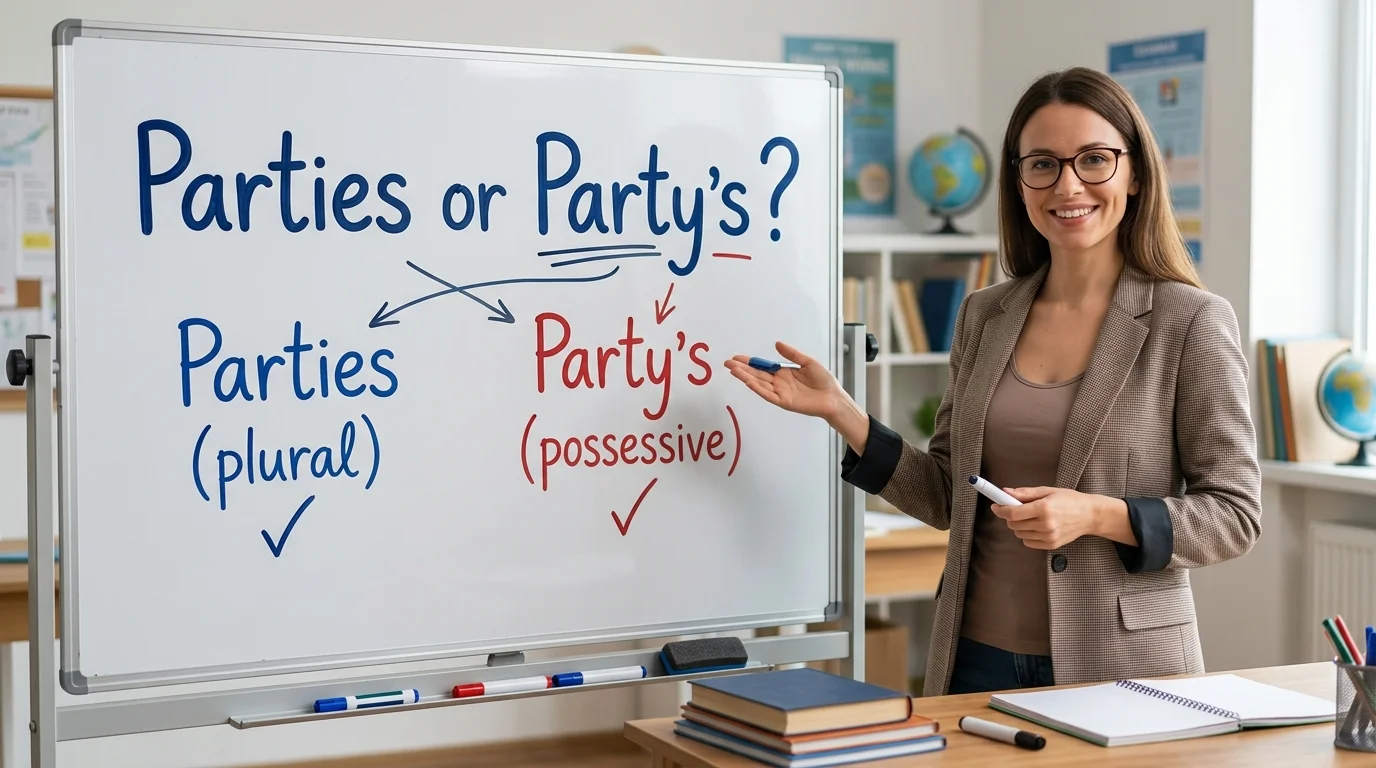
English spelling and punctuation can be tricky, especially when a word changes depending on whether you are talking about more than one person or showing ownership. “Parties or Party’s” is a common grammar question because both forms look similar, but they serve different purposes in a sentence.
The correct choice depends on what you want to express. “Parties” is the plural form of “party” and refers to more than one celebration, group, or person involved in an agreement or situation. For example, “We attended two birthday parties last weekend” refers to multiple celebrations.
On the other hand, “party’s” is usually a possessive form that shows something belongs to one party, or it can be a contraction of “party is” or “party has” in certain sentences. For example, “The party’s decorations were beautiful” means the decorations belonged to or were associated with the party. You might also write, “The party’s starting soon,” where “party’s” means “party is.”
Quick Answer ⚡
“Parties” is the plural form of “party” (more than one party). “Party’s” is the possessive form, showing that something belongs to a party. They are not interchangeable, and mixing them up is one of the most common apostrophe mistakes in English.
Now let’s break it down properly, with plenty of examples. 📚
Understanding “Parties” (Plural) 🎊
What Does “Parties” Mean?
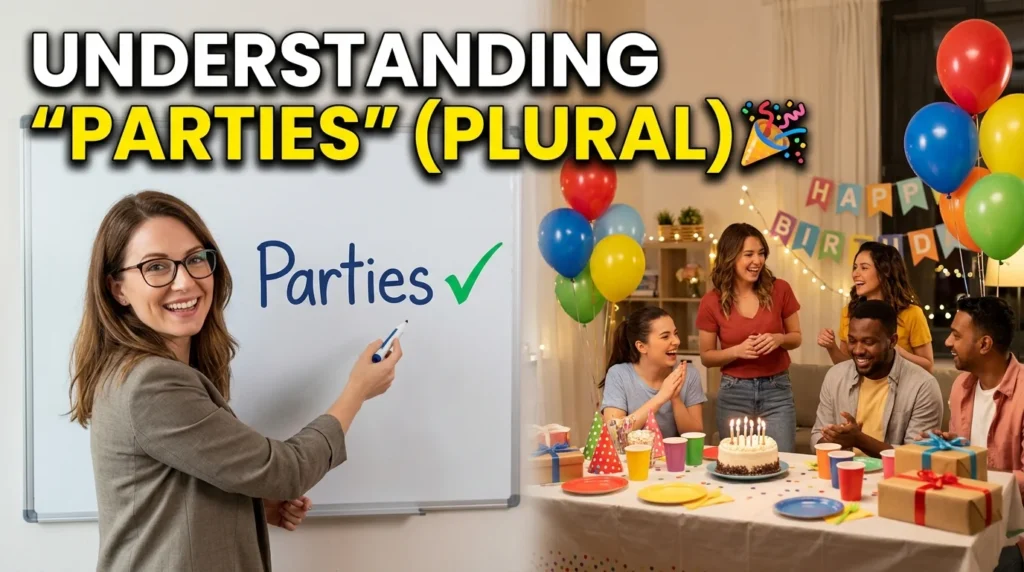
“Parties” is simply the plural of the noun “party.” It refers to more than one party and remember, “party” can mean:
- A social gathering or celebration 🎂
- A group or side in an agreement, contract, or dispute (legal/formal use) ⚖️
- A political party 🗳️
Examples of “Parties” in a Sentence
- We’re hosting two parties this weekend one for the kids and one for the adults. 🥳
- Both parties agreed to the terms of the contract.
- Several political parties participated in the debate.
- She’s been to so many birthday parties this month!
- The lawyer represented both parties in the settlement.
- All parties involved must sign the agreement before it’s finalized.
Notice something? “Parties” never has an apostrophe. It’s a regular plural noun, just like “cats,” “houses,” or “cars.”
Understanding “Party’s” (Possessive) 🔑
What Does “Party’s” Mean?
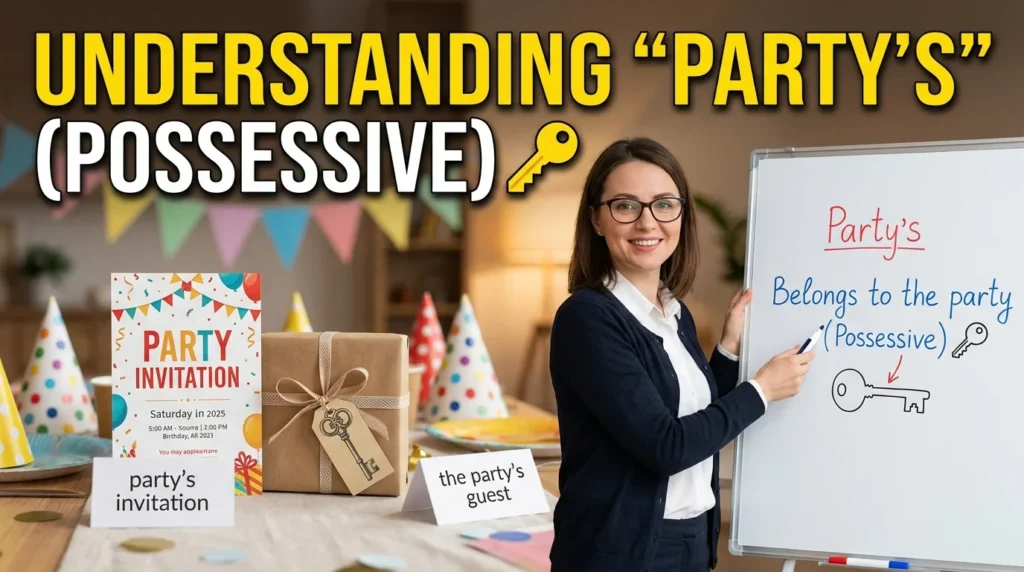
“Party’s” is the possessive singular form of “party.” It shows that something belongs to or is associated with one specific party.
Examples of “Party’s” in a Sentence
- The party’s decorations were absolutely stunning! 🎈
- The party’s location was changed at the last minute.
- Each party’s obligations are outlined in Section 3 of the contract.
- The political party’s platform focuses on healthcare reform.
- The party’s host forgot to send out invitations. 😅
- The winning party’s lawyer released a statement after the verdict.
See the difference? In each of these examples, something (decorations, location, obligations, platform, host, lawyer) belongs to the party. That’s exactly what the apostrophe + “s” signals: possession, not plural.
Comparison Table: Parties vs Party’s
| Aspect | Parties | Party’s |
| Grammar Type | Plural noun | Possessive singular noun |
| Meaning | More than one party | Something belonging to one party |
| Apostrophe? | ❌ No apostrophe | ✅ Has an apostrophe |
| Example Sentence | “The parties signed the deal.” | “The party’s terms were fair.” |
| Common Use | Everyday speech, legal documents, politics, celebrations | Legal contracts, ownership statements, formal writing |
| Easy Test | Can you count more than one? → Use “parties” | Can you say “belonging to the party”? → Use “party’s” |
What About “Parties'” (Plural Possessive)? 🧐
Here’s where it gets a little more advanced but don’t worry, it’s easy once you see it!
“Parties'” (with the apostrophe after the “s”) is the plural possessive form. It means something belongs to multiple parties.
Examples of “Parties'” in a Sentence
- Both parties’ lawyers reviewed the final draft.
- All the parties’ representatives attended the meeting.
- The parties’ signatures appear on the last page.
Quick Comparison:
| Form | Meaning | Example |
| Party’s | Belongs to one party | “The party’s proposal was rejected.” |
| Parties’ | Belongs to multiple parties | “The parties’ proposals were rejected.” |
| Parties | Simply more than one party (no ownership) | “Three parties submitted proposals.” |
This is a classic case of apostrophe placement mattering a lot move it one letter over, and the meaning shifts from “one party owns this” to “multiple parties own this.”
Memory Trick to Never Mix These Up Again 🧠
Here’s a simple mnemonic to help you remember:
“No apostrophe, no ownership just a group!” (Parties = plural, no apostrophe, just means “more than one”)
“Apostrophe before the S = it belongs to just one guest!” (Party’s = singular possessive, one party owns something)
“Apostrophe after the S = shared by the whole guest list!” (Parties’ = plural possessive, multiple parties own something)
Another fun trick:
- Think of the apostrophe as a tiny “belongs to” flag 🚩. If you see an apostrophe, ask yourself: “Does something belong to the party?” If yes, you need “party’s” or “parties’.” If you’re just talking about more than one party with no ownership involved, it’s simply “parties” no apostrophe needed!
Real-Life Examples: Where You’ll See These Words 📬
In Emails
“Please confirm that both parties have reviewed the attached agreement before Friday.”
In Legal Documents
“The party’s failure to comply with Section 4 will result in termination of this contract.”
In Social Media Posts
“So many birthday parties this month, my calendar is exploding! 🎂🎉 #busyweekend”
In News Headlines
“Opposing Parties Reach Agreement After Months of Negotiation”
In Academic Writing
“The study examined how each party’s perception of fairness influenced the negotiation outcome.”
In Everyday Speech
“Did you go to Sarah’s party last night? I heard it was amazing!”
These examples show just how often this word pops up in casual chats, formal contracts, news stories, and academic papers. Getting it right really does matter for clear communication and professional writing.
British English vs American English 🇬🇧🇺🇸
Good news again there’s no difference in how “parties,” “party’s,” and “parties'” are used between British and American English! ✅
Unlike words with regional spelling differences (like organize vs organise), possessive and plural rules for “party” follow the same standard English grammar rules everywhere. So whether you’re writing a UK legal contract or a US wedding invitation, the same rules apply.
Common Mistakes People Make 🚩
- Using “party’s” instead of “parties” when simply referring to more than one party.
- ❌ “Both party’s agreed to the settlement.”
- ✅ “Both parties agreed to the settlement.”
- Using “parties” instead of “party’s” when showing possession.
- ❌ “The parties decorations were beautiful.”
- ✅ “The party’s decorations were beautiful.”
- Confusing “party’s” and “parties'” in legal or contract writing.
- ❌ “Each party’s obligations” (when referring to multiple parties together) should sometimes be “parties’ obligations” depending on context.
- ✅ “The parties’ shared obligations are outlined below” (when talking about a joint responsibility).
- Forgetting the apostrophe entirely in possessive cases.
- ❌ “The partys decorations.”
- ✅ “The party’s decorations.”
Pro tip: Before finalizing any legal or business document, always double-check whether you’re talking about one party’s possession, multiple parties’ possession, or just a plural group with no ownership at all. This single detail can actually affect legal interpretation in contracts! ⚖️
Why This Matters for SEO & Professional Writing ✨
If you’re writing legal content, business proposals, or blog posts, getting apostrophes right isn’t just a “nice to have” it directly impacts:
- Clarity readers instantly understand who owns what.
- Professional credibility legal and business writing especially relies on precision.
- SEO performance search engines and readers both favor clean, well-structured, grammatically correct content.
People frequently search for terms like “grammar tips,” “apostrophe rules,” “common mistakes,” and “correct English usage” because these small details make a big difference in how trustworthy your writing appears. Mastering “parties” vs “party’s” is a simple way to instantly boost the professionalism of your writing. 🌟
FAQs: People Also Ask 🙋
1. Is “party’s” ever used to mean more than one party?
No. “Party’s” is always singular possessive it refers to something belonging to one party. For multiple parties, use “parties” (no possession) or “parties'” (possession).
2. What’s the difference between “party’s” and “parties'”?
“Party’s” shows possession by one party (e.g., “the party’s decision”). “Parties'” shows possession by multiple parties (e.g., “the parties’ decision”).
3. Do I need an apostrophe when just talking about multiple parties?
No! If you’re simply referring to more than one party with no ownership involved, just use “parties” no apostrophe needed.
4. Why do legal documents use “party’s” and “parties'” so often?
Legal writing frequently discusses ownership, obligations, and responsibilities, which is why possessive forms like “party’s” and “parties'” appear so often in contracts and agreements.
5. Is “partys” ever correct?
No. “Partys” is always incorrect. The plural of “party” follows the standard rule for nouns ending in a consonant + “y”: change the “y” to “i” and add “es” → parties.
6. How can I remember when to use an apostrophe with “party”?
Ask yourself: “Does something belong to the party?” If yes, use an apostrophe (“party’s” or “parties'”). If you’re just counting more than one party, skip the apostrophe (“parties”).
7. Are there other words that follow the same pattern as “party”?
Yes! Words like “company” → companies / company’s / companies’ and “country” → countries / country’s / countries’ follow the exact same pattern.
Final Thoughts:
In conclusion, parties and party’s are both correct words, but they have different meanings and uses. Parties is the plural form of “party” and refers to more than one celebration, group, or person involved in an agreement. For example, “We attended two birthday parties.” Party’s, on the other hand, is the singular possessive form, showing that something belongs to one party. For example, “The party’s decorations looked beautiful.”
Remember to use parties when talking about multiple parties and party’s when indicating ownership by one party. Understanding this difference helps you avoid punctuation mistakes and make your writing clearer and more accurate.

James Carter is an English language enthusiast and content writer who loves making grammar simple and easy to understand. He creates clear, beginner-friendly guides on spelling, grammar rules, confusing words, and everyday English usage. His goal is to help readers write with confidence through practical examples, easy explanations, and accurate language tips.