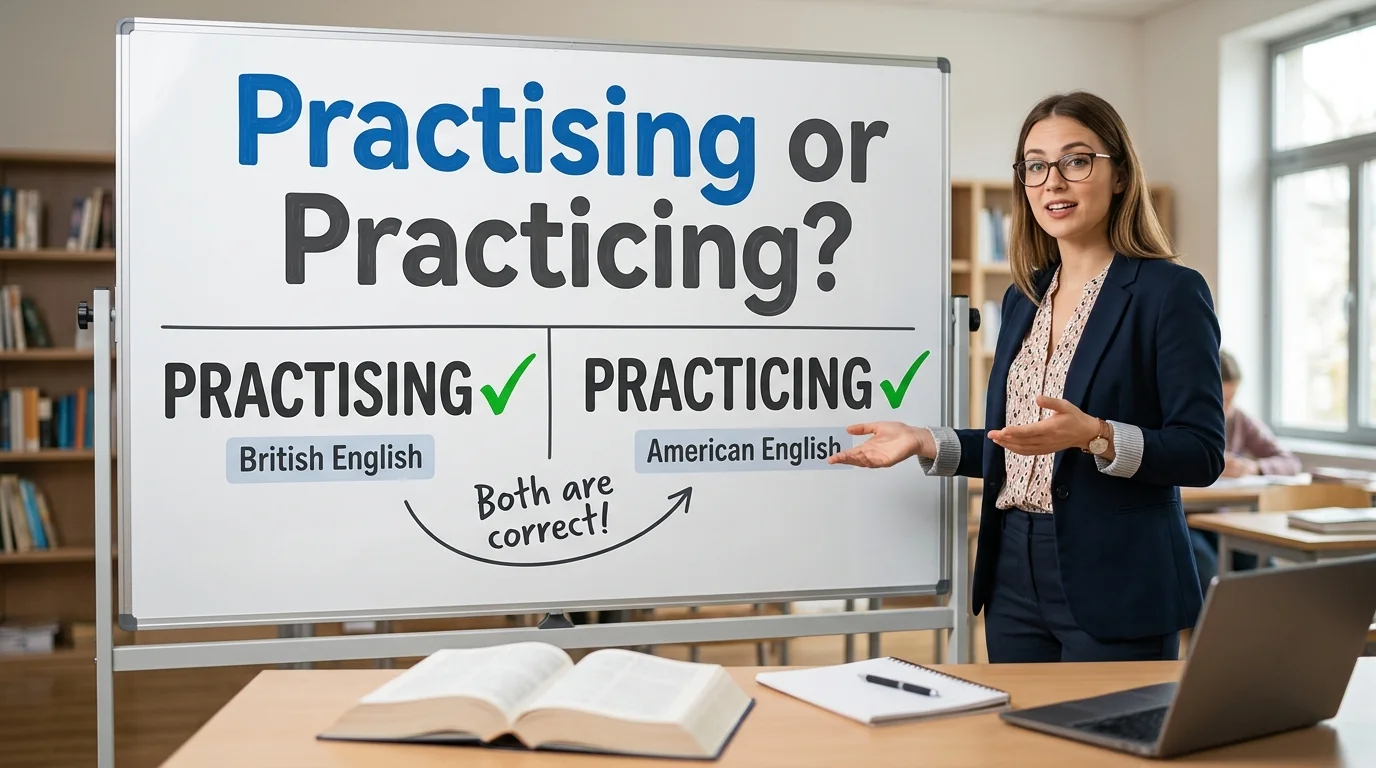
Ever typed out “practicing” in an email, only to have spellcheck throw a squiggly red line under it? Or maybe you wrote “practising” and someone told you it was “wrong”? 🤔
You’re not alone. This is one of the most common spelling mix-ups in the English language, and honestly, it trips up native speakers just as much as English learners. The confusing part? Both spellings are correct it just depends on where you’re writing from and, in some cases, what part of speech you’re using.
Let’s clear up this mess once and for all, with simple explanations, examples, and a few memory tricks that’ll stick with you forever. 🧠
Quick Answer 🎯
“Practicing” is American English, while “practising” is British English. Both mean the same thing doing an activity repeatedly to improve a skill, or carrying out a profession (like practicing/practising law or medicine).
That’s really the heart of it. But there’s a bit more nuance, especially around the noun form (“practice”), so let’s dig in properly.
What Does “Practice/Practise” Actually Mean? 📖

Before we get into spelling differences, let’s make sure we’re clear on the actual meaning.
To practice/practise (verb) means:
- To do something repeatedly to get better at it
- To actively work in a profession (like law, medicine, or teaching)
- To follow a custom, religion, or habit
Practice (noun) refers to:
- The act of practicing something
- A business or professional office (like a doctor’s practice)
- A habit or customary way of doing something
Examples in a Sentence
- She practices yoga every morning before work. 🧘♀️ (American verb)
- She practises yoga every morning before work. 🧘♀️ (British verb)
- He runs a small law practice downtown. (noun same in both dialects!)
- Doctors need years of practice before they’re fully confident. (noun same in both dialects!)
Notice something? The noun “practice” is spelled the same in both British and American English. It’s only the verb form that changes depending on the dialect.
British vs American English: The Real Difference 🇬🇧 🇺🇸
Here’s the breakdown that makes everything click:
| Word Form | American English | British English |
| Verb (to do repeatedly) | practicing / practiced | practising / practised |
| Noun (the activity/business) | practice | practice |
| Example (verb) | “I practice piano daily.” | “I practise piano daily.” |
| Example (noun) | “Practice makes perfect.” | “Practice makes perfect.” |
This is actually similar to how British English distinguishes advice (noun) vs. advise (verb), or license (noun, in American English) vs. licence (noun, in British English). English just loves keeping us on our toes! 😅
Why the Difference Exists
British English tends to preserve the “-ise/-ising” pattern for verbs derived from French or Latin roots, while American English standardized many of these to “-ize/-icing” spellings in the 19th and 20th centuries (thanks in part to Noah Webster, the guy behind Webster’s Dictionary, who pushed for simplified American spellings).
So this isn’t a random typo issue it’s a genuine, intentional regional spelling difference, just like:
- Colour (UK) vs. Color (US)
- Organise (UK) vs. Organize (US)
- Realise (UK) vs. Realize (US)
Common Mistakes People Make 🚫
Even though the rule is fairly simple, here’s where people usually slip up:
- Mixing dialects in the same document. Writing “I am practising my American accent” mixes British spelling with an American English context pick one style and stick with it throughout your writing.
- Confusing the noun and verb forms. Some people write “practicing session” instead of “practice session” remember, the noun is always practice, in both dialects.
- Assuming “practise” is simply wrong. It’s not incorrect it’s just regionally different (correct in the UK, Canada in some contexts, Australia, and other Commonwealth countries).
- Autocorrect confusion. If your device is set to US English, it’ll flag “practising” as wrong but that doesn’t mean it is wrong globally.
Memory Trick to Remember the Difference 💡
Here’s a simple mnemonic that many English teachers use:
“Advice and Practice are nouns with a ‘C.’ Advise and Practise are verbs with an ‘S’ in British English.”
Think of ICE (as in “advICE” and “practICE”) being solid and unchanging like a noun. 🧊 Think of S as the “action” letter for verbs (practiSe, adviSe) but only in British spelling.
For Americans, it’s even simpler:
“American English just uses a ‘C’ for both the noun AND the verb practice and practicing.” One less thing to remember! ✅
Real-Life Examples From Everyday Writing 📝
Let’s look at how this shows up in different contexts:
📧 In an Email (American English)
“Hi Sarah, just a reminder that we’re practicing our presentation at 3 PM today. Please review your slides beforehand.”
📧 In an Email (British English)
“Hi Sarah, just a reminder that we’re practising our presentation at 3 PM today. Please review your slides beforehand.”
📱 On Social Media
“Been practicing my guitar skills every single day this month 🎸 #musicgoals” (American) “Been practising my guitar skills every single day this month 🎸 #musicgoals” (British)
📰 In News Writing
American outlet: “The senator has been practicing law for over two decades.” British outlet: “The MP has been practising law for over two decades.”
🎓 In Academic Writing
“Students who spend more time practicing retrieval-based learning techniques tend to score higher on exams.” (US-based journal) “Students who spend more time practising retrieval-based learning techniques tend to score higher on exams.” (UK-based journal)
🗣️ In Everyday Speech
Since spelling doesn’t matter when speaking out loud, both versions sound identical. The difference only shows up in writing!
Which One Should YOU Use? 🤷
Here’s a simple decision guide:
| If you’re writing for… | Use this spelling |
| A US audience, American company, or US-based publication | practicing / practiced |
| A UK, Australian, Canadian (mostly), Irish, or Commonwealth audience | practising / practised |
| An international or mixed audience | Pick one and stay consistent throughout |
| Academic papers | Follow your institution’s or journal’s style guide |
| SEO content targeting a global audience | Check your primary audience’s location and match it |
💡 SEO Tip: If you’re writing content for search engines, tools like Google Analytics or Search Console can show you where most of your readers are located. If your audience is largely American, prioritize “practicing” in your content but consider mentioning “practising” briefly for readers searching with British spelling this can actually help capture more search traffic from both regions!
Grammar Tips to Keep in Mind ✅
- Always double-check your spellcheck/autocorrect settings (US vs. UK English) before publishing anything.
- The noun form “practice” never changes it’s always spelled with a “c,” regardless of dialect.
- Stay consistent throughout an entire document, website, or brand voice.
- When practicing/practising becomes part of a compound phrase (like “best practices”), the noun form is always used it’s “best practices,” never “best practises.”
- If you’re a student, check whether your school follows American or British English conventions, especially for essays and formal writing.
FAQs: People Also Ask 🙋
1. Is “practicing” or “practising” correct?
Both are correct spellings of the verb form. “Practicing” is American English, while “practising” is British English.
2. Is “practice” or “practise” correct as a noun?
“Practice” (with a “c”) is the correct noun form in both American and British English. Only the verb form changes between dialects.
3. Why does British English use “practise” for the verb but “practice” for the noun?
This follows a broader British spelling pattern where related noun/verb pairs use “c” for nouns and “s” for verbs, similar to “advice/advise” and “device/devise.”
4. Is “practising” used in Canada?
Canadian English often blends American and British spelling. Many Canadian style guides prefer “practising” for the verb, similar to British usage, though American spellings are also common due to US influence.
5. Do Australians use “practising” or “practicing”?
Australian English follows British conventions, so “practising” and “practised” are standard in Australia.
6. Is it “practiced” or “practised” in the past tense?
“Practiced” is American English, and “practised” is British English following the same pattern as the present participle forms.
7. Can I use both spellings in the same piece of writing?
It’s best to avoid mixing them. Pick either American or British English conventions and use them consistently throughout your writing for a professional, polished result.
Final Thoughts:
In conclusion, practising and practicing are both correct spellings, but the choice depends on the type of English you are using. Practising is the standard British English spelling when referring to the verb form of “practice,” while practicing is the standard American English spelling. In British English, “practice” is usually a noun, while “practise” is the verb. In American English, “practice” works as both a noun and a verb.
Understanding this difference can help you choose the correct spelling for your audience. Whether you are writing an email, article, assignment, or social media post, consistency is important for clear and professional writing.

Sophia Collins is a passionate English grammar writer at GrammBoost.com who loves making the English language simple and easy to understand. She creates clear, beginner-friendly guides on grammar, spelling, word differences, and common language mistakes. Her goal is to help students, writers, and English learners build confidence and improve their writing through practical, easy-to-follow explanations.