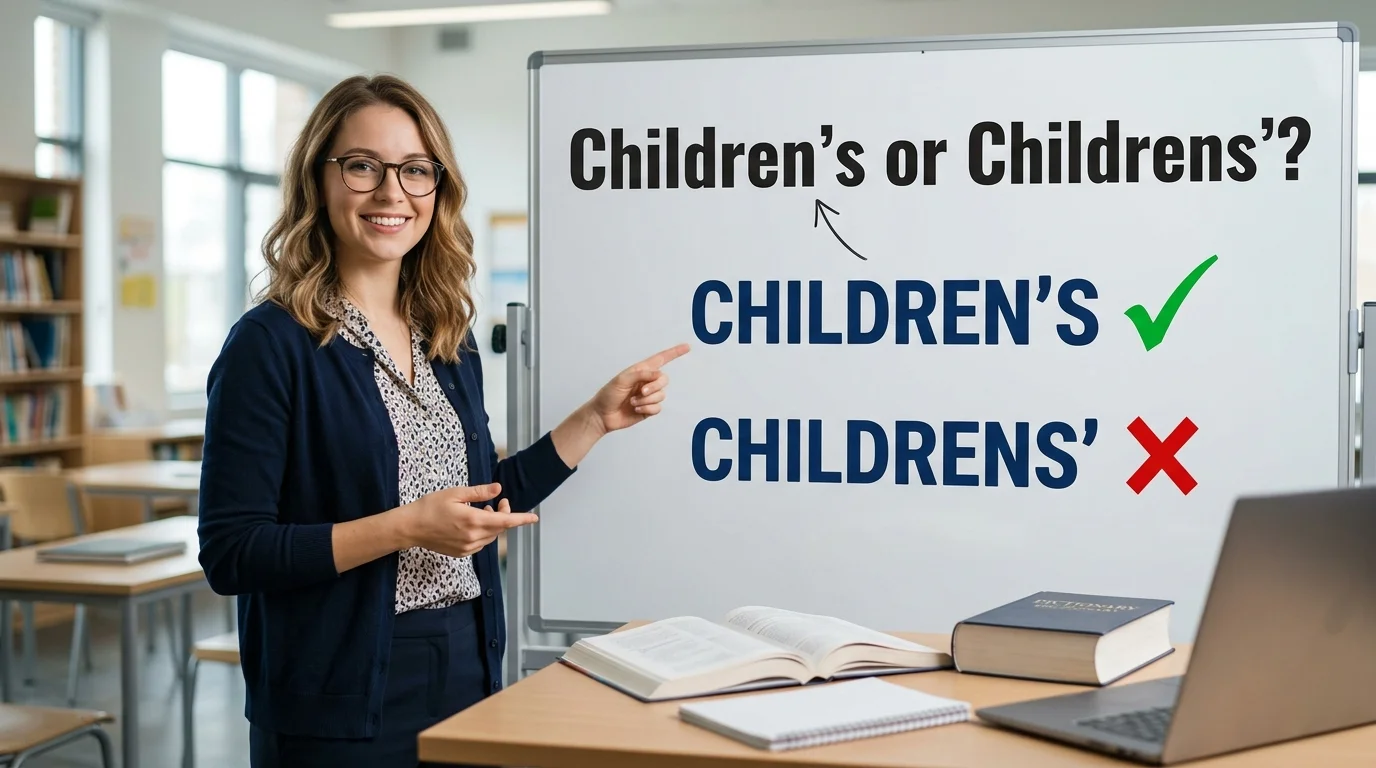
Have you ever typed out a sentence like “the childrens’ toys are on sale” and then paused, staring at that apostrophe, wondering if it’s in the right place? 🤔 You’re not alone. This is one of the most common apostrophe mix-ups in English, and it trips up native speakers, students, and even professional writers.
The confusion usually comes from a simple (but wrong) assumption: “children is plural, so I just add an apostrophe after the ‘s’, like I would with ‘the dogs’ toys.'” Except… children doesn’t play by the usual rules. It’s an irregular plural noun, and irregular plurals need special apostrophe treatment.
Let’s clear this up once and for all, with easy examples, a handy table, and a memory trick you’ll never forget. 🎯
Quick Answer ⚡
“Children’s” is correct. The apostrophe always goes before the “s” as in children’s books, children’s hospital, or children’s day because “children” is already plural. “Childrens'” (with the apostrophe after the s) is never correct in standard English.
Why the Confusion Happens 🌀
In English, we usually make a word possessive by:
- Adding ‘s to a singular noun → the dog’s bone
- Adding just ‘ to a regular plural noun ending in s → the dogs’ bones
This second rule is where people get tripped up with “children.” Since “children” sounds plural (and is plural!), our brains want to apply the “add apostrophe after the s” rule. But here’s the catch:
👉 “Children” is already a plural word, and it does NOT end in “s.”
Because of that, it follows the same rule as singular nouns when forming the possessive you add ‘s, not just an apostrophe.
Understanding “Children’s” The Correct Form ✅
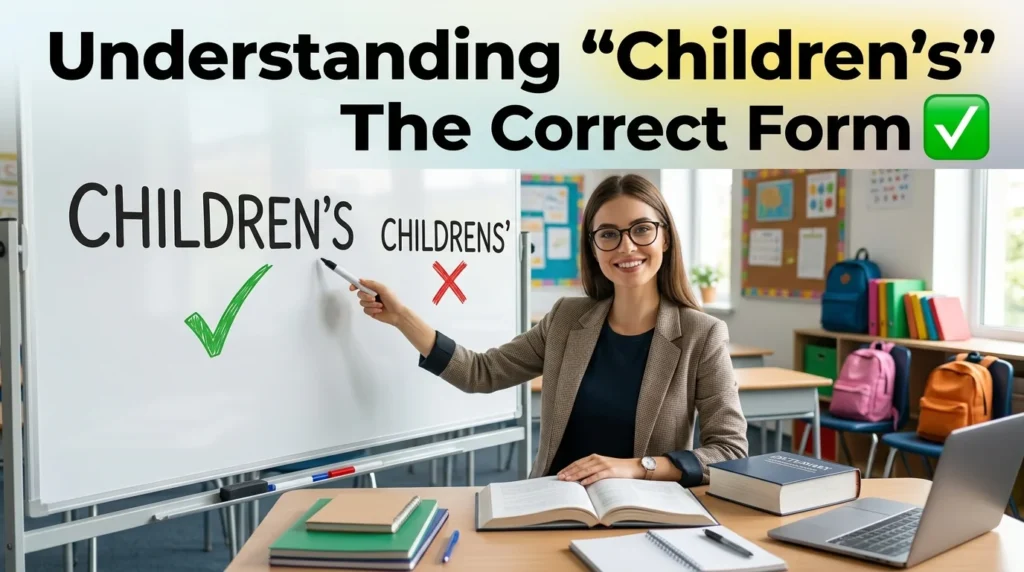
Children’s is the possessive form of “children,” meaning “belonging to children” or “for children.”
Examples:
- The children’s playground was freshly painted. 🎨
- We donated old toys to the children’s charity.
- This is the children’s section of the library. 📚
- Have you seen the children’s menu at that restaurant?
- The children’s laughter filled the backyard.
Notice the pattern? The apostrophe always sits right before the final “s” just like with any singular noun (man’s, woman’s, person’s).
Understanding “Childrens'” Why It’s Incorrect ❌
“Childrens'” simply isn’t a real word or grammatical form in standard English. It looks like someone tried to:
- Take the plural of “child” (children), and
- Apply the “plural possessive” rule (add apostrophe after s)
But since “children” doesn’t end in “s,” there’s no “s” to put the apostrophe after in the first place. There’s no such thing as “childrens” as a base word, so “childrens'” doesn’t exist either.
You will NEVER correctly write:
- ~~The childrens’ toys~~ ❌
- ~~Childrens’ Day~~ ❌
- ~~The childrens’ hospital~~ ❌
If you ever see “childrens'” in a sign, an email, or a website, it’s a spelling/grammar mistake even if it looks common!
Comparison Table: Children’s vs. Childrens’ 📊
| Feature | Children’s ✅ | Childrens’ ❌ |
| Grammatical status | Correct possessive form | Not a real word |
| Meaning | Belonging to / for children | No valid meaning |
| Apostrophe placement | Before the “s” | After the “s” (incorrect here) |
| Example | Children’s books | Childrens’ books (wrong) |
| Used in | Signs, brands, books, formal writing | Should never be used |
| Rule followed | Irregular plural + ‘s | Misapplied regular plural rule |
The Golden Rule of Apostrophes (Quick Refresher) 📏
To really nail this, it helps to understand the broader apostrophe rules:
| Noun Type | Rule | Example |
| Singular noun | Add ‘s | The cat’s tail |
| Regular plural (ends in s) | Add ‘ only | The cats’ tails |
| Irregular plural (doesn’t end in s) | Add ‘s | The children’s tails, the men’s coats, the women’s shoes |
Children, men, women, people, mice these are all irregular plurals, and they all take ‘s, not just an apostrophe. 🧠
Memory Trick to Never Forget! 🧠💡
Here’s a simple mnemonic:
“No S, so add ‘S.”
If the plural word does not already end in “s” (like children, men, women, people), you treat it like a singular word and just tack on ‘s.
Another fun way to remember it:
🧒 Children ➡ no “s” at the end ➡ needs ‘s to show possession ➡ Children’s
Think of it like this: “children” is playing dress-up as a singular noun when it comes to apostrophes even though it’s really plural! 😄
Real-Life Examples 🌍
Let’s look at how “children’s” shows up in everyday writing:
📧 In Emails
“Please remember to pick up your child’s I mean, children’s homework packets from the front office by Friday.”
📱 On Social Media
“Just dropped off donations at the local children’s shelter. Feels good to give back! 💕 #community #giveback”
📰 In News Headlines
“New Children’s Hospital Wing Opens Downtown, Adding 50 Beds for Young Patients”
🎓 In Academic Writing
“The study examined children’s cognitive development across different socioeconomic backgrounds.”
🗣️ In Everyday Speech
“Can you grab the kids’ sorry, the children’s jackets before we leave?”
Notice how “children’s” fits naturally into casual, professional, and academic contexts alike. It’s a versatile, everyday possessive form. 👏
British vs. American English: Any Differences? 🇬🇧🇺🇸
Good news this is one grammar rule where British and American English fully agree! ✅
- 🇬🇧 British English: “Children’s Day,” “children’s literature,” “children’s services”
- 🇺🇸 American English: “Children’s Hospital,” “children’s museum,” “children’s book”
Both varieties of English treat “children” as an irregular plural requiring ‘s for possession. There’s no regional variation here a rare case of complete grammar harmony across the pond! 🌊
Common Mistakes to Avoid 🚫
Here are the top slip-ups people make:
- ❌ Childrens’ book club → ✅ Children’s book club
- ❌ Childrens toys (missing apostrophe entirely) → ✅ Children’s toys
- ❌ Childrens’s shoes (double mistake extra “s”) → ✅ Children’s shoes
- ❌ Confusing it with “child’s” (singular possessive) when talking about more than one child
Quick Self-Check Tip ✔️
Ask yourself: “Am I talking about more than one child?”
- If yes → children’s (always, no exceptions)
- If it’s just one child → child’s (e.g., the child’s toy)
Similar Irregular Plurals to Watch For 👀
“Children” isn’t the only tricky irregular plural. Here are others that follow the same ‘s rule:
| Singular | Plural | Possessive Plural |
| Child | Children | Children’s |
| Man | Men | Men’s |
| Woman | Women | Women’s |
| Person | People | People’s |
| Mouse | Mice | Mice’s |
| Goose | Geese | Geese’s |
Once you learn this pattern for “children’s,” you can apply the same logic to all of these! 🎉
FAQs: People Also Ask ❓
1. Is “childrens'” ever correct?
No. “Childrens'” is never grammatically correct in standard English. Always use children’s.
2. What is the possessive form of “children”?
The possessive form is children’s, formed by adding ‘s to the irregular plural noun “children.”
3. Why doesn’t “children” just get an apostrophe after the s like “dogs'”?
Because “children” doesn’t end in “s” to begin with it’s an irregular plural, so it follows the singular possessive rule (‘s) instead.
4. What’s the difference between “child’s” and “children’s”?
“Child’s” refers to one child (the child’s book), while “children’s” refers to more than one child (the children’s books).
5. Do British and American English spell it differently?
No, both use children’s for the possessive form there’s no regional difference here.
6. Is “childrens” (without any apostrophe) ever correct?
No. Without an apostrophe, “childrens” isn’t a standard English word at all.
7. How can I remember the correct spelling?
Use the mnemonic: “No S, so add ‘S.” Since “children” has no final “s,” you add ‘s to show possession.
Final Takeaway
In conclusion, re-sent and resent may look almost identical, but they have completely different meanings. Re-sent is used when something is sent again, such as an email, message, or document. Resent, without a hyphen, usually means feeling angry, bitter, or unhappy about something that happened. The context of the sentence helps you understand which word is correct. Remember that the hyphen in re-sent clearly shows the idea of sending something again.
By understanding this simple difference, you can avoid confusion and use both words correctly in emails, conversations, and everyday writing. Choosing the right form makes your writing clearer and more accurate.

James Carter is an English language enthusiast and content writer who loves making grammar simple and easy to understand. He creates clear, beginner-friendly guides on spelling, grammar rules, confusing words, and everyday English usage. His goal is to help readers write with confidence through practical examples, easy explanations, and accurate language tips.