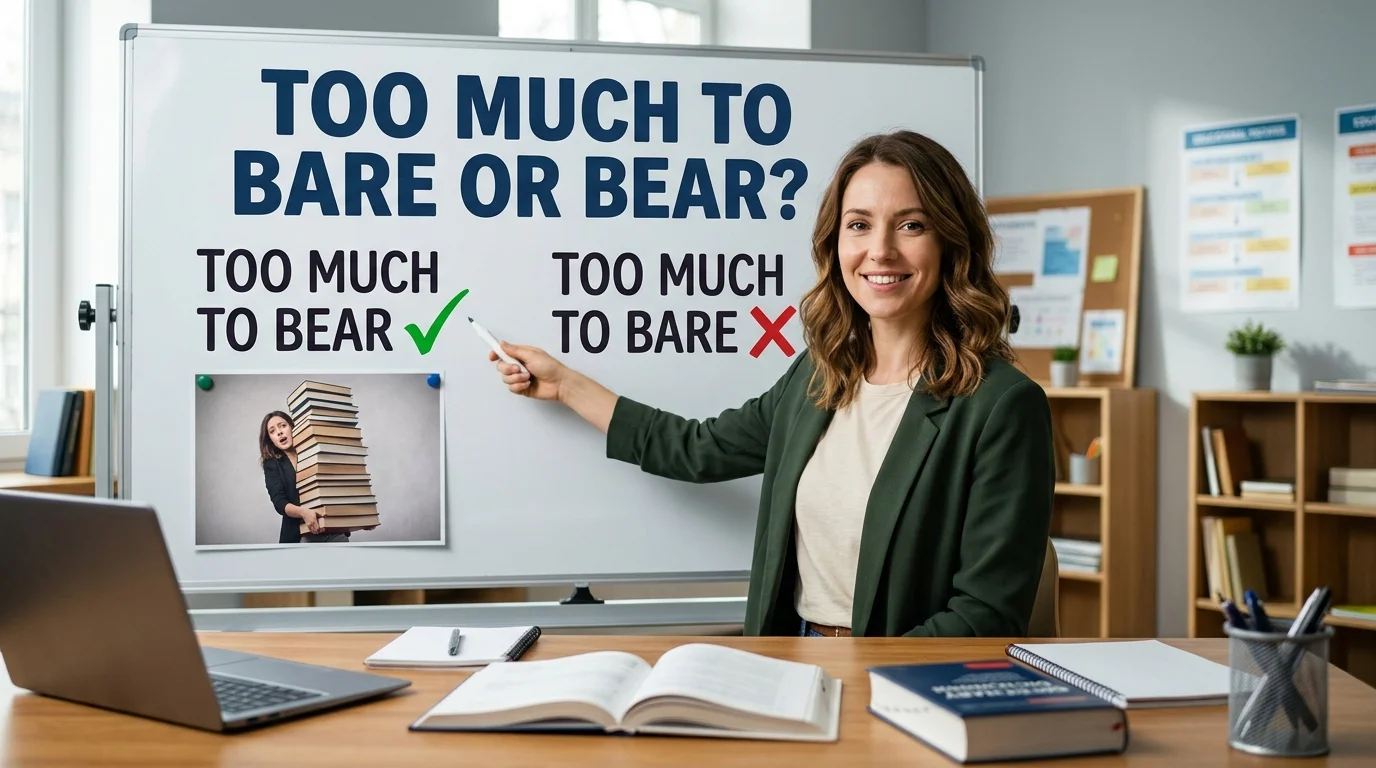
Ever typed out a text like “this week has been too much to bare” and then paused, finger hovering over send, wondering if that’s actually… right? 🤔
You’re not alone. This is one of the most common English usage mix-ups out there, and honestly, it makes total sense why people mix it up. The two words sound exactly the same when spoken out loud, but they mean completely different things on paper. One is about carrying a heavy emotional load. The other is about taking your clothes off. Yeah big difference! 😅
If you’ve ever second-guessed yourself mid-sentence, this article is for you. We’re breaking down the confusion once and for all, with examples, memory tricks, and a handy table you can bookmark for next time.
Quick Answer 🎯
The correct phrase is “too much to bear.” Bear (as a verb) means to endure or tolerate something difficult. Bare means uncovered, naked, or exposed it’s not what you want here.
Now let’s dig into the why behind this, so you never have to guess again.
Why Do People Confuse “Bare” and “Bear”?
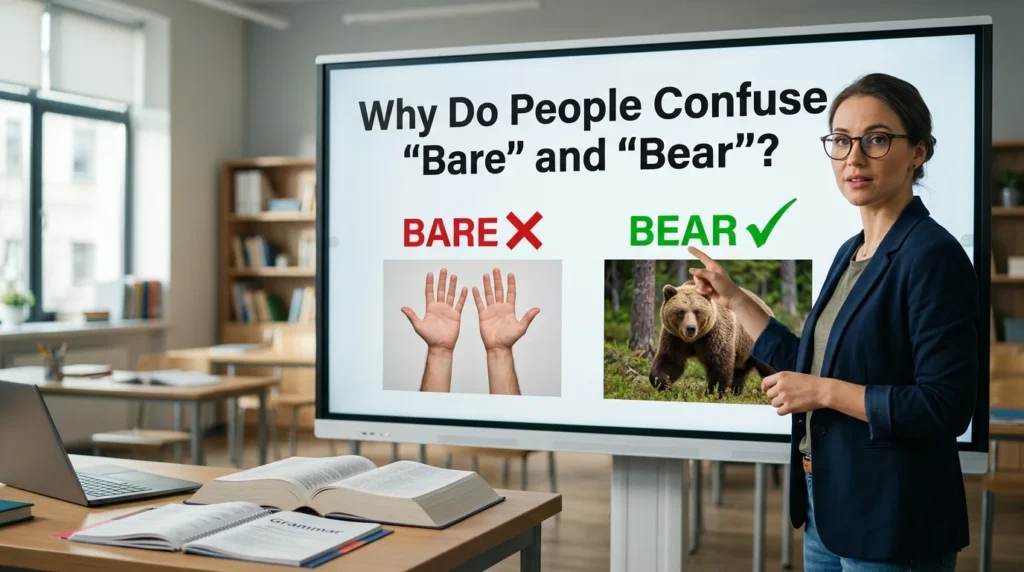
This mix-up happens because bare and bear are homophones words that sound identical but are spelled differently and mean different things. English is full of these little traps (think there/their/they’re or your/you’re), and they trip up even confident writers.
Add to that the fact that “bear” is also an animal 🐻, and it’s easy to see why people second-guess which spelling belongs in a sentence about stress or hardship.
What Does “Bear” Mean? (The One You Want)

Bear is a versatile word. As a verb, it has a few key meanings:
- To endure or tolerate something difficult
- “I can’t bear this heat anymore.” ☀️
- “She had to bear the pain in silence.”
- “This news is too much to bear.”
- To carry or support weight
- “The bridge can bear heavy loads.”
- “He bore the weight of the box on his shoulders.”
- To give birth to (formal/literary usage)
- “She bore three children.”
- To hold a feeling (like a grudge)
- “I bear no ill will toward you.”
As a noun, bear refers to the large furry animal:
- “We saw a bear on our camping trip.” 🐻
Verb Forms of “Bear”
| Tense | Form | Example |
| Present | bear/bears | “I bear the responsibility.” |
| Past | bore | “She bore the criticism gracefully.” |
| Past Participle | borne | “He has borne a lot of stress lately.” |
💡 Note: “Born” (without the e) is used specifically for birth “I was born in 2000” while “borne” is used for everything else, like “The costs were borne by the company.”
What Does “Bare” Mean?
Bare is mostly used as an adjective, meaning uncovered, plain, or without anything extra.
- Uncovered or naked
- “He walked on the beach with bare feet.” 👣
- “The tree branches were bare in winter.”
- Minimal or plain
- “The room had only the bare essentials.”
- “Give me the bare facts, please.”
- As a verb (less common), meaning to reveal or expose
- “She bared her soul in the letter.”
- “The dog bared its teeth.” 🐕
Bare vs Bear: Comparison Table
Here’s a side-by-side cheat sheet so you can see the difference at a glance 👇
| Word | Part of Speech | Meaning | Example |
| Bear | Verb | To endure/tolerate | “I can’t bear the noise.” |
| Bear | Verb | To carry/support | “The shelf can bear the weight.” |
| Bear | Noun | The animal | “A bear wandered into camp.” |
| Bare | Adjective | Uncovered/plain | “Her arms were bare.” |
| Bare | Verb | To expose/reveal | “He bared his emotions.” |
“Too Much to Bare” or “Too Much to Bear”? The Final Verdict ✅
When you’re talking about something being emotionally overwhelming, hard to handle, or too painful to deal with, the correct phrase is always:
✅ “Too much to bear.”
Because you’re enduring or tolerating a difficult situation not exposing skin! Here are some correct examples:
- “The grief was too much to bear.”
- “Watching the news lately feels like too much to bear.”
- “He said the pressure at work was too much to bear.”
❌ Incorrect: “The grief was too much to bare.” ✅ Correct: “The grief was too much to bear.”
Common Mistakes People Make
Let’s look at some real slip-ups people make in writing:
- ❌ “I can’t bare to watch this movie.” ✅ “I can’t bear to watch this movie.”
- ❌ “She has to bare the consequences of her actions.” ✅ “She has to bear the consequences of her actions.”
- ❌ “This heat is unbareable!” ✅ “This heat is unbearable!”
- ❌ “Please bare with me while I finish this.” ✅ “Please bear with me while I finish this.”
That last one “bear with me” is probably the single most common version of this mistake seen online. People write “bare with me” constantly on social media, emails, and even in professional messages. It’s wrong, but it’s everywhere, so watch out for it! 👀
Memory Tricks to Never Mix Them Up Again 🧠
Here are a few mnemonics to lock this in for good:
- 🐻 “Bear” has an animal in it (kind of) think of a bear carrying a heavy load on its back. Bears are strong; they bear weight and hardship.
- 👗 “Bare” sounds like “bare skin” both start with “ba” and relate to being uncovered or exposed.
- 📝 Rhyme it: “To bear is to wear the weight; to bare is to lose the clothes you ate.” (Okay, a little silly, but it sticks!)
- ✅ Substitution trick: If you can replace the word with “endure” or “tolerate” and the sentence still makes sense, use bear. If you can replace it with “naked” or “uncovered,” use bare.
Real-Life Examples From Everyday Communication
📧 In Emails
“Thank you for your patience please bear with us as we resolve this issue.”
📱 On Social Media
“This year has honestly been too much to bear. Ready for a fresh start. 🙏”
📰 In News Headlines
“Families forced to bear the burden of rising costs amid inflation crisis.”
🎓 In Academic Writing
“The study examines how communities bear the long-term effects of climate change.”
💬 In Everyday Speech
“I just can’t bear to see her upset like this.”
Notice a pattern? In every single case, the word relates to enduring something not exposing skin. That’s your clue every time.
British English vs American English: Any Difference?
Good news this one’s the same on both sides of the pond! 🇬🇧🇺🇸
Both British English and American English use “bear” for enduring/tolerating and “bare” for uncovered/plain. There’s no regional spelling variation here (unlike, say, “colour” vs “color”). So no matter where your audience is, “too much to bear” is always the correct choice.
One small usage note: in more formal or literary British writing, you may see “bear” used slightly more often in phrases like “bear witness” or “bear responsibility,” but the core spelling rules don’t change.
Related Phrases That Use “Bear” Correctly
Since we’re here, let’s clear up a few other common bear phrases people often misspell:
| Phrase | Meaning |
| Bear with me | Be patient with me |
| Bear in mind | Remember/consider |
| Bear the brunt | Suffer the main impact |
| Bear fruit | Produce results |
| Bear a resemblance | Look similar to someone/something |
| Grin and bear it | Endure something unpleasant without complaint |
All of these use bear, never bare so if you’re ever unsure, just remember: enduring something = bear. 🐻
Quick Recap Table 📝
| Situation | Correct Word | Example |
| Emotionally overwhelming | Bear | “It’s too much to bear.” |
| Physically carrying weight | Bear | “The rope can bear 200 lbs.” |
| The animal | Bear | “A grizzly bear crossed the trail.” |
| Uncovered skin/surface | Bare | “She walked barefoot.” |
| Minimal/plain | Bare | “Bare necessities only.” |
| Exposing something | Bare | “He bared his heart.” |
FAQs: People Also Ask 🙋
1. Is it “bear with me” or “bare with me”? It’s “bear with me.”
It means to be patient with someone, not to undress.
2. What does “too much to bear” mean?
It means something is emotionally or mentally overwhelming hard to endure or handle.
3. Is “unbearable” spelled with “bear” or “bare”?
It’s spelled “unbearable” from the root word “bear,” meaning something that can’t be endured.
4. Can “bare” ever be a verb?
Yes! “Bare” can mean to expose or reveal something, like “She bared her feelings.”
5. What’s the past tense of “bear”?
The past tense is “bore,” and the past participle is “borne” (or “born” specifically for birth).
6. Why do “bare” and “bear” sound the same?
They’re homophones words that sound alike but have different spellings and meanings, which is common in English.
7. Is “bare minimum” correct or should it be “bear minimum”?
It’s “bare minimum,” meaning the smallest or most basic amount needed.
8. How can I remember the difference between bare and bear?
Try this: if you mean “endure,” use bear (think of a bear carrying weight). If you mean “uncovered,” use bare (think of bare skin).
Final Thoughts:
In conclusion, the correct phrase is “too much to bear,” not “too much to bare.” The verb bear means to tolerate, handle, or endure something difficult, painful, or overwhelming. On the other hand, bare means uncovered, exposed, or without clothing or covering. This simple difference explains why bear is the right choice when describing something that feels emotionally or physically difficult to handle.
Remembering their meanings can help you avoid this common mistake in everyday writing and conversation. Whenever you mean that something is extremely difficult to tolerate, use “too much to bear” for correct and clear communication.

Olivia Bennett is a passionate English grammar writer at GrammBoost.com who loves making grammar simple and easy to understand. She specializes in spelling, word differences, punctuation, and everyday English usage. Through clear explanations and practical examples, Olivia helps students, writers, and professionals write with greater confidence and accuracy.