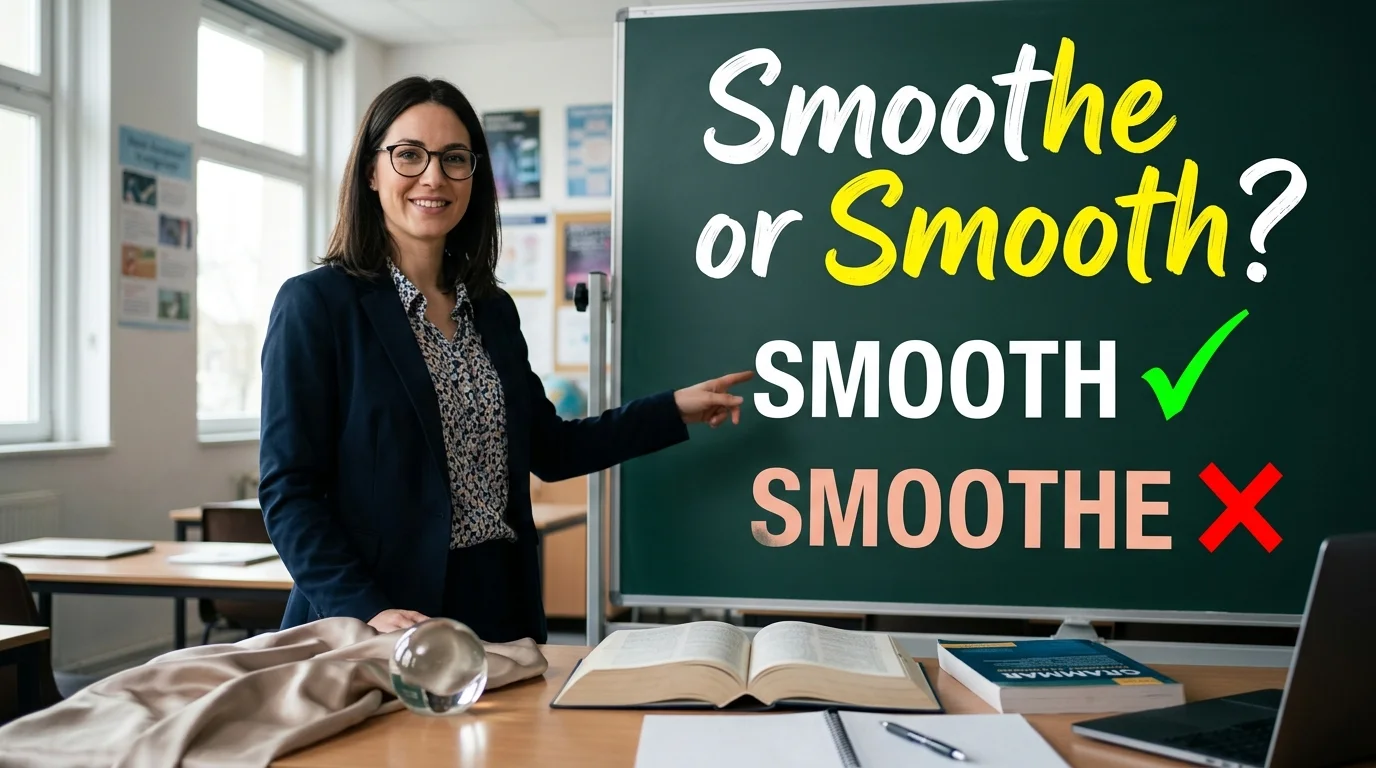
Sometimes an extra letter can make a familiar English word look correct even when it is not. “Smoothe” and “smooth” are a good example of this spelling confusion. When describing something with an even surface, a comfortable experience, or a person’s calm and easy manner, the correct standard English word is “smooth.”
The spelling “smoothe” is generally considered incorrect in modern standard English, although it may occasionally appear as an informal or outdated form. This confusion can happen because English has many words where adding -e changes the spelling, making it tempting to assume the same pattern applies here.
Knowing the correct form is especially useful when writing emails, school assignments, professional content, social media posts, or everyday messages.
Quick Answer ⚡
“Smooth” is the only correct spelling. “Smoothe” is a common misspelling and is not a recognized word in standard English (British or American). The confusion usually comes from the verb form “smoothed,” which does contain that “e” just not in the base word.
What Does “Smooth” Actually Mean? 📖
“Smooth” is a versatile English word that can function as an adjective, a verb, and even a noun in casual speech. Let’s break it down.
1. Smooth as an Adjective
This is the most common use. It describes something that has an even, flat surface no bumps, no roughness.
Examples:
- The baby’s skin was incredibly smooth. 🧴
- We drove down a long, smooth highway.
- Her voice had a smooth, calming tone.
- This peanut butter is smooth, not chunky.
It can also describe something that happens without problems or difficulty:
- The negotiation went smoothly (used as an adverb here see below).
- We had a smooth flight with zero turbulence. ✈️
2. Smooth as a Verb
When “smooth” is used as a verb, it means to make something flat, even, or free of wrinkles literally or figuratively.
Examples:
- Please smooth the tablecloth before guests arrive.
- She tried to smooth things over after the argument.
- He smoothed his hair before the interview. (past tense note the “e” appears here!)
- The therapist helped smooth out the couple’s disagreement.
This is likely where the “smoothe” confusion comes from because the past tense and continuous forms (smoothed, smoothing) add letters, some people assume the base word should too.
3. Smooth as a Noun (Informal)
Rarely, “smooth” is used informally as a noun, especially in slang or drink names (like a “smoothie” but that’s a different word entirely!).
Why Do People Write “Smoothe”? 🧐
Great question! Here’s why this mix-up happens so often:
- Silent “e” pattern confusion: English has tons of words where a silent “e” changes pronunciation or meaning (like “hop” vs. “hope”). People assume “smooth” needs one too.
- Similar-sounding words: Words like “soothe,” “breathe,” and “loathe” all end in “the” + silent “e.” Since “smooth” rhymes with “soothe,” our brains want to apply the same spelling pattern.
- Autocorrect and typos: Fast typing on phones often leads to accidental extra letters that don’t get caught.
- Brand names and stylistic spelling: Some brands (skincare, fitness, etc.) intentionally use “Smoothe” as a stylized name which reinforces the misspelling in people’s minds. 💄
This is a classic case of English spelling confusion caused by pattern-matching with similar words.
Comparison Table: Smooth vs. Smoothe 📊
| Feature | Smooth ✅ | Smoothe ❌ |
| Correct spelling? | Yes | No |
| Part of speech | Adjective, Verb, Noun (informal) | Not a real word |
| Dictionary recognized? | Yes (Merriam-Webster, Oxford, Cambridge) | No |
| Example sentence | “The road is smooth.” | Incorrect usage |
| Common context | Everyday English, writing, speech | Typos, brand names, misspellings |
| British English | Smooth | Not used |
| American English | Smooth | Not used |
“Smooth” vs. Similar Words That DO End in “the” 🔍
To really understand why “smoothe” feels tempting, let’s compare it with real words that follow that “the” + silent-e pattern:
| Word | Correct? | Meaning | Example |
| Soothe | ✅ Yes | To calm or comfort | “Music can soothe a crying baby.” |
| Breathe | ✅ Yes | To take air in and out | “Breathe deeply and relax.” |
| Loathe | ✅ Yes | To hate intensely | “I loathe waiting in long lines.” |
| Smoothe | ❌ No | N/A not a word | N/A |
| Smooth | ✅ Yes | Even, flat, or without difficulty | “The cake batter was smooth.” |
See the pattern? “Soothe,” “breathe,” and “loathe” all legitimately end in “-the.” But “smooth” simply doesn’t follow that rule it’s an exception, and English is famous for exceptions! 😅
Memory Trick to Never Mix It Up Again 🧠
Here’s a simple mnemonic to lock this in:
“Smooth” has no room for an extra ‘e’ it’s already smooth enough!”
Or try this one:
S-M-O-O-T-H = Six letters, Zero extra ‘e’.
Every time you’re tempted to add that “e,” just remember: smooth is already complete. It doesn’t need help from an extra letter to sound or look right.
Another fun trick: think of the phrase “smooth operator” a well-known song and phrase. You’ll never see it spelled “smoothe operator” in any official context, so let that visual stick in your memory. 🎵
Common Mistakes People Make ❌
Let’s look at real mistakes people make with this word:
- Wrong: “This lotion feels so smoothe on my skin.” Right: “This lotion feels so smooth on my skin.”
- Wrong: “He smoothe the wrinkles out of his shirt.” Right: “He smoothed the wrinkles out of his shirt.” (past tense verb)
- Wrong: “We need a smoothe transition plan.” Right: “We need a smooth transition plan.”
- Wrong: “Her smoothe jazz playlist is amazing.” Right: “Her smooth jazz playlist is amazing.”
Quick Spelling Tip 💡
If you’re ever unsure, ask yourself: “Am I using the base word, or a form of the verb?”
- Base word (adjective) → smooth (no extra e)
- Past tense verb → smoothed (the “e” appears because of “-ed,” not because “smooth” needs it)
- Continuous verb → smoothing (again, no standalone “e”)
Real-Life Examples From Everyday Communication 📱
Let’s see how “smooth” shows up in different real-world contexts:
In Emails 📧
“I wanted to follow up and confirm everything went smoothly on your end.”
In Social Media Captions 📸
“Skin so smooth I forgot I even had pores. ✨ #skincare #glowup”
In News Writing 📰
“Officials say the election process ran smoothly, with no major disruptions reported.”
In Academic Writing 🎓
“The transition between the two economic policies was remarkably smooth, according to the study’s findings.”
In Everyday Speech 🗣️
“Dude, that was such a smooth move asking her to dance!”
Notice something? Not a single legitimate source spells it “smoothe.” That’s your proof it’s not standard English.
British English vs. American English 🇬🇧🇺🇸
Good news here there’s no regional difference when it comes to this word. Unlike words such as “colour/color” or “realise/realize,” “smooth” is spelled exactly the same in both British and American English.
| Region | Spelling |
| British English 🇬🇧 | Smooth |
| American English 🇺🇸 | Smooth |
| Australian English 🇦🇺 | Smooth |
| Canadian English 🇨🇦 | Smooth |
So no matter where your audience is, you’re safe using “smooth” it’s universally accepted.
Keyword & Usage Trends 📈
If you’re a content writer, marketer, or just curious about language trends, here’s something interesting: search data consistently shows people typing “smoothe or smooth” and “is smoothe a word” into search engines proving this is a widespread and genuine point of confusion, not just a random question.
Related searches and terms people often look up include:
- correct spelling of smooth
- smooth vs smoothed grammar
- smooth meaning in English
- common English spelling mistakes
- grammar tips for beginners
- English usage rules
- silent e rule in English
Understanding these patterns is a great way to sharpen your own grammar tips and correct spelling habits especially if you write content, essays, or professional emails regularly.
FAQs: People Also Ask 🙋
1. Is “smoothe” ever correct in any context?
No. “Smoothe” is not recognized in any major dictionary (Merriam-Webster, Oxford, Cambridge) as a standard English word. It’s always a misspelling of “smooth.”
2. Why do some brands use “Smoothe” in their names?
Brands sometimes use stylized or altered spellings to create a unique, trademark-friendly name. This is a marketing choice, not a grammar rule don’t use it in regular writing.
3. What’s the past tense of “smooth”?
The past tense is “smoothed” (e.g., “She smoothed the fabric with her hands”).
4. Is “smooth” an adjective or a verb?
It can be both! As an adjective, it describes texture or ease (“a smooth road”). As a verb, it means to flatten or ease something (“smooth out the wrinkles”).
5. What is the adverb form of “smooth”?
The adverb form is “smoothly” (e.g., “The meeting went smoothly”).
6. Does “smooth” rhyme with “soothe”?
Yes, they rhyme and sound similar, which is exactly why people mistakenly add an “e” to “smooth” but only “soothe” actually has one.
7. How can I remember the correct spelling permanently?
Use the mnemonic: “Smooth is already smooth no extra ‘e’ needed!” Repetition and reading real examples (like this article) also help reinforce it.
Final Thoughts:
In conclusion, smooth is the correct and standard spelling, while smoothe is generally considered incorrect in modern English. The word smooth can describe something that feels even, soft, or free from roughness, and it can also describe actions, sounds, or experiences that happen easily. Although people sometimes add an extra “e” because of similar English spelling patterns, smoothe is not normally used in standard writing.
Remembering the correct form will help you avoid spelling mistakes in emails, schoolwork, professional writing, and everyday communication. Whenever you mean something even, polished, or effortless, smooth is the spelling you should choose.

Sophia Collins is a passionate English grammar writer at GrammBoost.com who loves making the English language simple and easy to understand. She creates clear, beginner-friendly guides on grammar, spelling, word differences, and common language mistakes. Her goal is to help students, writers, and English learners build confidence and improve their writing through practical, easy-to-follow explanations.