
Ever typed out an email to a supplier and paused halfway through, wondering: “Wait… is it venders or vendors?” 🤔 You’re definitely not alone. This is one of those sneaky spelling mix-ups that trips up native speakers and English learners alike especially because both words look like they could be correct.
If you’ve ever second-guessed yourself while writing a business proposal, a market report, or even a simple grocery list, this article is for you.
We’re going to clear up the confusion once and for all, with simple explanations, real-life examples, and a handy memory trick you’ll never forget.
Quick Answer ⚡
“Vendors” is the correct and standard spelling. It refers to people or companies that sell goods or services. “Venders” is a rare, outdated variant that you’ll almost never see in modern English so when in doubt, always go with vendors.
Now, let’s dig into why this confusion happens and how to make sure you never misspell it again.
Why Do People Confuse “Venders” and “Vendors”? 🧐
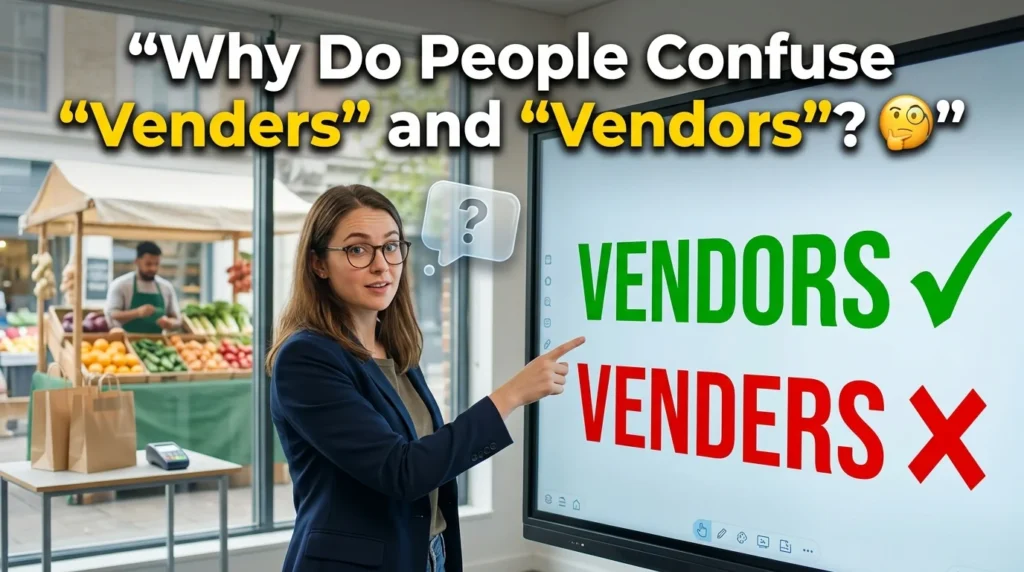
The mix-up usually comes down to how English handles suffixes. Both “-er” and “-or” are used to describe “a person who does something,” which makes it genuinely hard to guess which one applies to a specific word.
Think about it:
- Teacher, writer, worker all end in “-er”
- Actor, director, investor all end in “-or”
There’s no universal rule that tells you which suffix a word “should” use it usually comes down to the word’s origin (Latin-based words often take “-or”) and, frankly, tradition. Vendor comes from the Latin word vendere, meaning “to sell,” and it kept its Latin-style “-or” ending when it entered English.
What Does “Vendor” Mean? 📦
A vendor is a person, business, or organization that sells goods or services to others. This word shows up constantly in business, retail, tech, and everyday conversation.
Examples of “Vendor” in a Sentence:
- The vendor at the farmers market sold the juiciest peaches I’ve ever tasted. 🍑
- Our company just signed a contract with a new software vendor.
- Street food vendors line the busy sidewalks of Bangkok every evening.
- The wedding planner recommended three trusted vendors for catering.
- Amazon works with thousands of third-party vendors across the globe.
Common Word Forms:
- Vendor (singular) – The vendor raised his prices.
- Vendors (plural) – Several vendors competed for the contract.
- Vendor’s (possessive) – The vendor’s booth was the most popular one.
- Vendors’ (plural possessive) – All the vendors’ stalls were set up by 8 AM.
What About “Venders”? ❌
Here’s the truth: “venders” is not considered standard modern English. It technically appears in a few very old or specialized dictionaries as an obsolete spelling variant, but it’s practically extinct in everyday, business, and academic writing today.
You might occasionally see “venders” used to describe vending machines in some older or regional contexts (like “cigarette venders” referring to vending machines), but even this usage has largely been replaced by “vending machines” or simply “vendors.”
Bottom line: Unless you’re reading a text from over a century ago, you should always use vendors.
Vendors vs Venders: Comparison Table 📊
| Feature | Vendors ✅ | Venders ❌ |
| Correct spelling? | Yes, standard modern spelling | No, considered outdated/obsolete |
| Meaning | Sellers of goods/services | Same intended meaning, but archaic form |
| Common usage | Business, retail, tech, everyday speech | Rarely used; occasionally in old texts |
| Word origin | Latin vendere (“to sell”) + “-or” suffix | Non-standard “-er” variant |
| Example sentence | “The vendors set up their stalls early.” | “The venders set up their stalls early.” (incorrect) |
| Dictionary status | Found in all major dictionaries | Marked as rare/archaic or not listed at all |
| Recommended use | ✅ Always use this | 🚫 Avoid in formal or casual writing |
Memory Trick to Never Misspell It Again 🧠
Here’s a simple mnemonic to lock in the correct spelling:
“A vendOR sells prOducts.”
Both “vendor” and “products” contain the letter combination “or” and vendors literally sell products! This little trick connects the meaning to the spelling, so your brain has an easy anchor to remember.
Another fun way to remember it:
- V-O-R = Vendors Offer Retail (goods)
Pick whichever trick sticks best in your mind the goal is just to associate “vendor” with that “-or” ending permanently. 💡
Common Mistakes People Make ⚠️
Let’s look at a few typical errors and how to fix them:
- Incorrect: “We hired several venders for the trade show.” Correct: “We hired several vendors for the trade show.”
- Incorrect: “The vender’s booth was closed.” Correct: “The vendor’s booth was closed.”
- Incorrect: “Please contact our software vender for support.” Correct: “Please contact our software vendor for support.”
- Incorrect: “Street venders sell snacks all day.” Correct: “Street vendors sell snacks all day.”
💡 Pro tip: If autocorrect or spell-check underlines “venders” in red, trust it! Most modern word processors (Microsoft Word, Google Docs) will flag it as a misspelling.
Real-Life Examples: Where You’ll See “Vendors” Used 🌍
📧 In Emails
“Hi team, please find attached the list of approved vendors for Q3 procurement.”
📱 On Social Media
“Shoutout to all the amazing vendors at today’s craft fair! So much local talent 🙌 #smallbusiness #supportlocal”
📰 In News Articles
“City officials announced new regulations for food truck vendors operating downtown.”
🎓 In Academic Writing
“The study analyzed procurement strategies used by small business vendors in emerging markets.”
🗣️ In Everyday Speech
“I love this farmers market the vendors here are so friendly and their produce is always fresh.”
Notice a pattern? In every single context professional, casual, academic, or online it’s always vendors, never venders.
British English vs American English 🇬🇧🇺🇸
Good news: this isn’t one of those tricky words where British and American English disagree (like “colour” vs “color” or “organise” vs “organize”).
“Vendor” is spelled the same way in both British and American English. There’s no regional variation here, which makes it a little easier to remember. Both sides of the Atlantic agree: it’s vendors, all the way. ✅
Related Words You Might Also Mix Up 🔤
Since we’re on the topic of “-er” vs “-or” confusion, here are a few similar word pairs worth knowing:
| Correct Word | Common Misspelling | Meaning |
| Advisor / Adviser | (Both are actually correct!) | Someone who gives advice |
| Editor | Editer ❌ | Someone who edits |
| Author | Auther ❌ | A writer of a book/article |
| Sponsor | Sponser ❌ | Someone who funds an event/person |
| Vendor | Vender ❌ | Someone who sells goods |
Building awareness of these patterns can seriously boost your overall English usage and correct spelling skills over time.
Why Getting This Right Matters for SEO & Business Writing 📈
If you run a blog, e-commerce store, or business website, spelling matters more than you think:
- Search engines favor correctly spelled, professional content using “vendors” instead of “venders” helps your content rank properly for relevant searches.
- Credibility: Misspellings in vendor contracts, proposals, or marketing materials can make a business look unprofessional.
- Consistency: Keeping consistent, correct terminology across your website, invoices, and communications builds trust with vendors and customers alike.
If you’re writing content around topics like “vendor management,” “vendor contracts,” or “vendor relationships,” always double-check your spelling it’s a small detail with a big impact on professionalism and grammar tips best practices.
Frequently Asked Questions (FAQs) ❓
1. Is “venders” ever correct?
Technically, it appears in some very old texts as an obsolete variant, but in modern English, it’s considered incorrect. Always use vendors.
2. What is the plural of vendor?
The plural is simply vendors just add an “s.” Example: “The market had over fifty vendors.”
3. What’s the difference between a vendor and a supplier?
A vendor typically sells directly to the end customer (like a market stall or retailer), while a supplier usually provides goods or raw materials to businesses further up the supply chain. The terms are sometimes used interchangeably in casual speech.
4. Is “vendor” a formal or informal word?
It’s used in both! You’ll see “vendor” in casual conversation (like describing a street food stall) as well as in highly formal business and legal documents (like vendor contracts).
5. How do you pronounce “vendor”?
It’s pronounced VEN-dor (rhymes with “condor”). The stress is on the first syllable.
6. Can “vendor” be used as a verb?
No, “vendor” is strictly a noun. If you need a verb form, you’d say someone sells, vends, or trades goods.
7. Is “vending” related to “vendor”?
Yes! Both words come from the same root, vendere (Latin for “to sell”). “Vending” refers to the act of selling, especially through vending machines, while “vendor” refers to the seller themselves.
Final Thoughts:
Let’s wrap this up simply: “vendors” is the correct spelling, used consistently across British and American English, in business, casual conversation, and academic writing. “Venders” is an outdated form you’ll rarely (if ever) need to use.
Next time you’re writing an email, drafting a contract, or posting about your favorite local market, remember our mnemonic: “A vendOR sells prOducts.” That simple trick will help the correct spelling stick for good. ✅

James Carter is an English language enthusiast and content writer who loves making grammar simple and easy to understand. He creates clear, beginner-friendly guides on spelling, grammar rules, confusing words, and everyday English usage. His goal is to help readers write with confidence through practical examples, easy explanations, and accurate language tips.