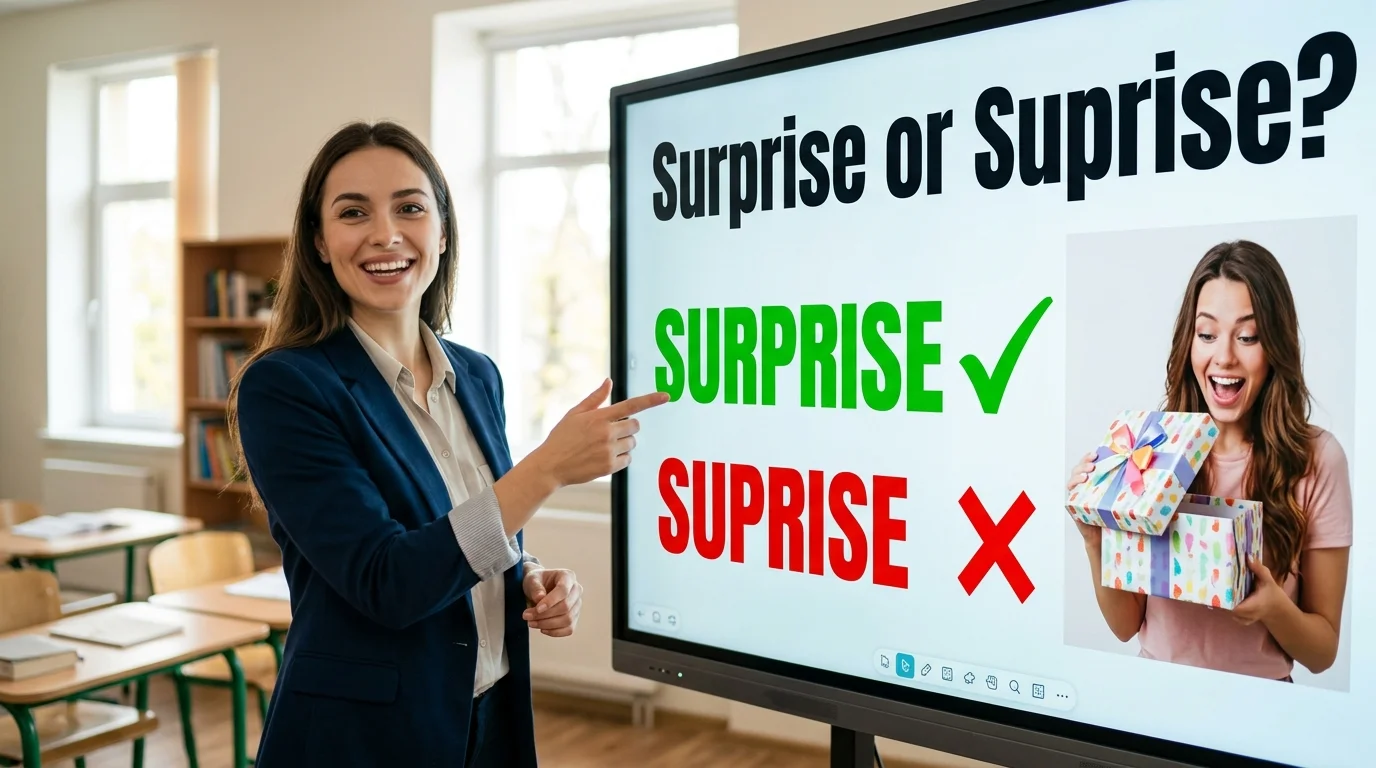
Have you ever wanted to write about an unexpected gift, a special celebration, or an exciting moment but paused to check the spelling of “surprise”? You are not alone! Many English learners and even native speakers accidentally write “suprise” instead of “surprise.” The two spellings look very similar, so it is easy to overlook the missing letter.
However, “surprise” is the correct spelling in standard English, while “suprise” is a common misspelling. The word surprise can be used as a noun to describe an unexpected event or as a verb meaning to cause someone to feel amazed or astonished.
You might use it when planning a birthday party, sharing exciting news, or describing an unexpected visit from a friend. Learning the correct spelling will help you communicate clearly in everyday conversations, emails, school assignments, and social media posts.
Quick Answer ⚡
“Surprise” is the only correct spelling. “Suprise” is simply a common misspelling and is never correct in standard English, whether British or American.
Now let’s dig into why this mistake happens so often, and how you can make sure you never make it again.
Why Do People Misspell “Surprise” as “Suprise”? 🧐
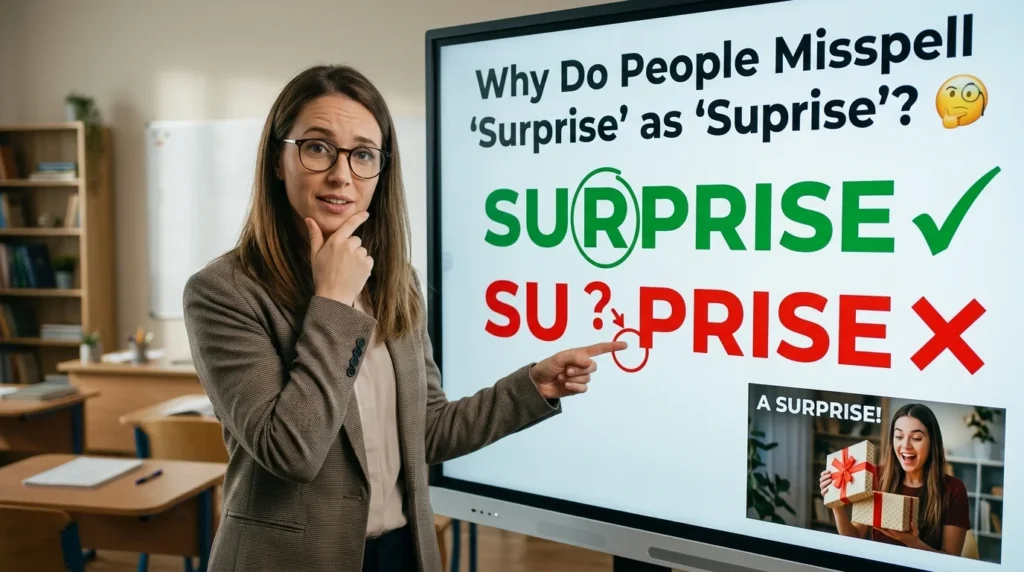
The confusion boils down to pronunciation vs. spelling. When we say “surprise” quickly in casual speech, the first “r” often gets swallowed or softened. It sounds a bit like “suh-prize” instead of “sur-prize.” Because our brains tend to spell words the way they sound, many people accidentally drop that first “r.”
Here’s a breakdown of the word’s structure:
- Sur- (from Latin super, meaning “over” or “above”)
- -prise (from French prendre, meaning “to take” or “to seize”)
So etymologically, “surprise” literally means to be “taken over” or “caught off guard” which makes total sense when you think about how surprises actually feel! 😲
Meaning and Correct Usage of “Surprise”
“Surprise” can function as both a noun and a verb, and understanding both uses will help you use it confidently in your writing.
As a Noun 📝
A “surprise” refers to an unexpected event, feeling, or piece of news.
Examples:
- What a lovely surprise to see you here!
- The party was a complete surprise for my mom.
- I have a big surprise for you this weekend.
- Her resignation came as a total surprise to everyone in the office.
As a Verb 🎬
“Surprise” also means to cause someone to feel astonished or amazed because something is unexpected.
Examples:
- The results might surprise you.
- We wanted to surprise her with a cake.
- Don’t let this surprise you it happens more often than you think.
- His talent continues to surprise his teachers.
Common Word Forms
Since “surprise” is a root word, it has several related forms you’ll come across often:
- Surprised (adjective/past tense) I was surprised by the ending.
- Surprising (adjective) That was a surprising twist!
- Surprisingly (adverb) The test was surprisingly easy.
- Surprises (plural noun/third-person verb) Life is full of surprises.
Comparison Table: Surprise vs. Suprise
| Word | Correct? | Part of Speech | Meaning | Example |
| Surprise | ✅ Yes | Noun / Verb | An unexpected event or to astonish someone | “It was a surprise party!” |
| Suprise | ❌ No | N/A | Misspelling has no meaning | Should always be corrected to “surprise” |
There’s really no gray area here “suprise” isn’t an alternate spelling, a British variant, or an informal version. It’s simply incorrect in every context. 🚫
British vs. American English: Does It Matter Here? 🇬🇧🇺🇸
Good news this is one area where British and American English agree completely! Unlike words such as “colour/color” or “organise/organize,” there’s no regional variation for “surprise.” Both dialects spell it the exact same way:
| Region | Spelling |
| British English 🇬🇧 | Surprise |
| American English 🇺🇸 | Surprise |
| Canadian English 🇨🇦 | Surprise |
| Australian English 🇦🇺 | Surprise |
So no matter where your audience is located, you’re safe using “surprise” one spelling works everywhere.
Common Mistakes People Make ❌
Beyond the classic “suprise” typo, here are a few other errors worth watching for:
- Suprize Sometimes people swap the “s” for a “z,” possibly influenced by words like “prize.” Still incorrect.
- Surprize A blend of the two mistakes above. Also wrong.
- Missing the double letters Some learners forget there’s only one “r” in the middle (it’s sur-pr-ise, not sur-rr-ise).
- Confusing it with “suspense” These words are related in feeling but not interchangeable. “Suspense” means anticipation of something happening, while “surprise” is the reaction to an unexpected event.
Memory Trick to Never Misspell It Again 🧠✨
Here’s a simple mnemonic to lock in the correct spelling:
“SUR” like “SURE” + “PRISE” like a “PRIZE” (just change the Z to an S)
Think of it this way: “I’m SURE this PRIZE will surprise you!”
Another fun trick: Break the word into three chunks: SUR + PR + ISE
Say it slowly a few times: sur-pr-ise, sur-pr-ise. This helps your brain register that all three parts including that first “r” belong there.
Real-Life Examples 🌍
Seeing the word in real contexts helps cement the correct spelling in your memory.
In Emails 📧
“Hi Sarah, just a quick note to say surprise! We’re throwing you a farewell lunch on Friday.”
On Social Media 📱
“Guess what?! Biggest surprise of my life happened today and I’m still shaking 😭🎉 #blessed”
In News Headlines 📰
“Election Results Deliver Surprise Upset in Local Race”
In Academic Writing 🎓
“The study’s findings were a surprise, as they contradicted previous research on consumer behavior.”
In Everyday Speech 🗣️
“Oh my gosh, what a surprise running into you at the grocery store!”
Notice how in every single example, the spelling stays consistent because there’s only one correct way to write it!
Tips to Master Tricky Spellings Like “Surprise” 💡
- Read more the more you see correctly spelled words, the more natural they’ll feel.
- Use spell-check tools, but don’t rely on them 100% double-check manually too.
- Practice writing the word in different sentences until it feels automatic.
- Say it slowly when unsure, sounding out each syllable: sur-prise.
- Create flashcards for commonly misspelled words you personally struggle with.
FAQs About “Surprise” vs. “Suprise” ❓
1. Is “suprise” ever correct in any dialect of English?
No. “Suprise” is not a recognized spelling in British, American, Canadian, or Australian English. It’s simply a common typo.
2. Why do so many people misspell “surprise”?
Because the first “r” is often not clearly pronounced in casual speech, leading people to spell the word the way it sounds rather than the way it’s actually written.
3. How many syllables does “surprise” have?
“Surprise” has two syllables: sur-prise.
4. What is the past tense of “surprise”?
The past tense is “surprised” for example, “I was surprised by the news.”
5. Is “surprising” the same as “surprised”?
Not quite. “Surprising” describes something that causes surprise (e.g., “a surprising fact”), while “surprised” describes how a person feels (e.g., “I was surprised”).
6. What’s a synonym for “surprise”?
Common synonyms include: astonish, amaze, startle, shock, and stun.
7. Can “surprise” be used as an adjective?
Not directly, but its related forms like “surprised” and “surprising” function as adjectives.
8. Does spell-check always catch “suprise”?
Most modern spell-checkers and browsers will flag “suprise” as incorrect, but it’s still good practice to proofread manually, especially in fast typing or messaging apps.
Final Thoughts:
Let’s wrap this up simply: “Surprise” is always correct, and “suprise” is always wrong. There’s no regional exception, no informal variant, and no gray area. The mix-up happens because of how the word sounds when spoken quickly but now that you know the correct spelling, the structure (sur + prise), and a handy mnemonic, you’re all set to use it confidently in emails, essays, social media posts, and everyday conversations.

Olivia Bennett is a passionate English grammar writer at GrammBoost.com who loves making grammar simple and easy to understand. She specializes in spelling, word differences, punctuation, and everyday English usage. Through clear explanations and practical examples, Olivia helps students, writers, and professionals write with greater confidence and accuracy.