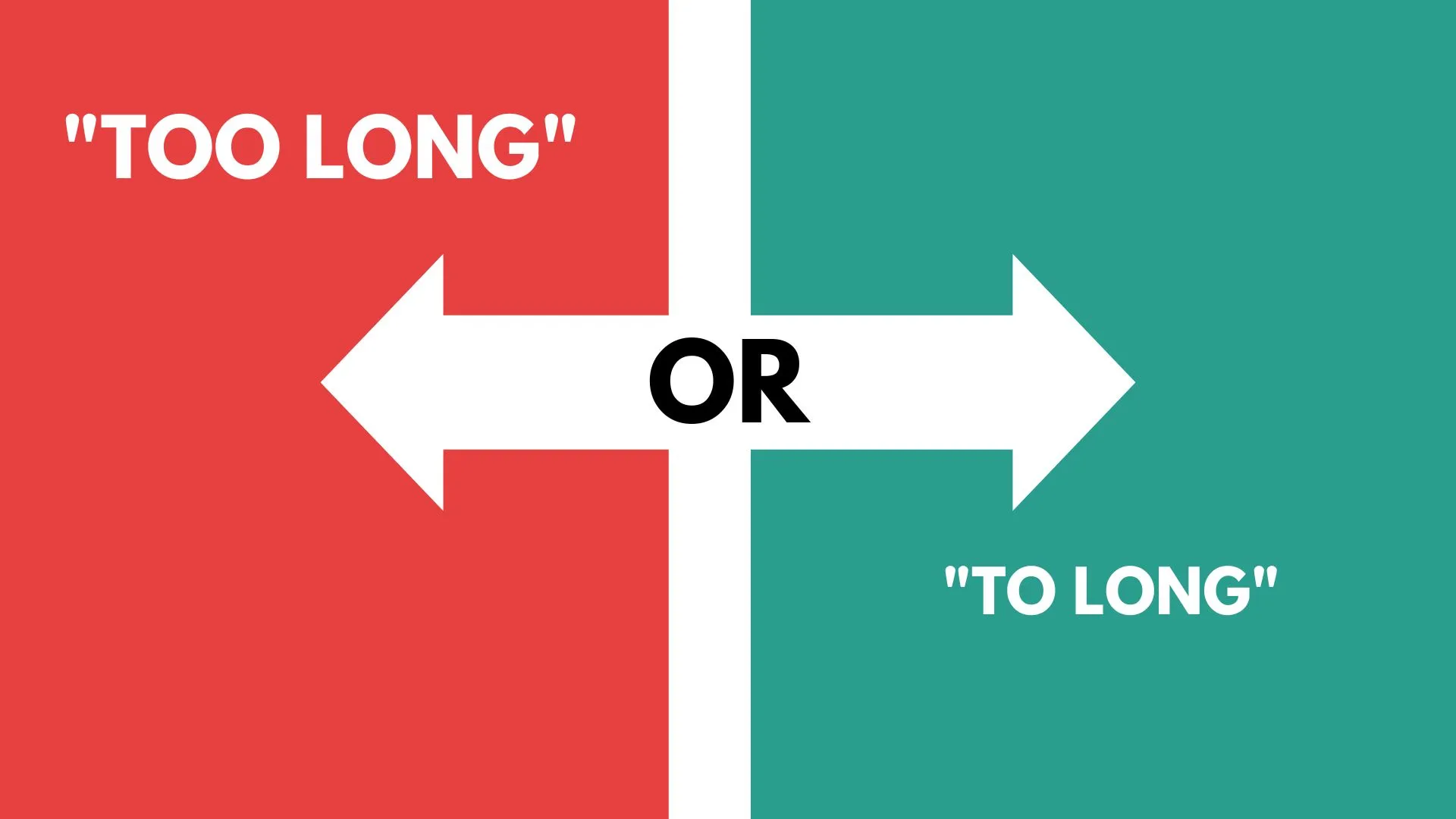
Have you ever stopped while writing and wondered you should use “Too Long” or “To Long”? You’re not alone. This is one of the most common English mistakes because the words “to” and “too” look almost identical but have very different meanings.
Using the wrong one can make your writing appear less polished, whether you’re sending an email, posting on social media, writing an essay, or chatting with friends.
The good news is that the difference is much easier to understand than you might think. In most cases, “too long” is the correct phrase when you want to say that something is longer than necessary, expected, or acceptable.
Quick Answer ⚡
“Too long” is correct. “Too” means “excessively” or “also,” while “to” is a preposition used before a place, action, or object. So if you’re describing something that exceeds an expected length, you always write “too long.” “To long” is grammatically incorrect on its own (unless followed by a verb, like “to long for something”).
Too Long Meaning
Too long means something has lasted for more time than expected, wanted, or considered appropriate. Here, too means “more than necessary” or “excessively.”
Example: The movie was too long.
To Long Meaning
To long is usually grammatically incorrect when talking about duration. To is a preposition or part of an infinitive, while long describes length or duration.
In most cases, you should use too long instead.
To Long for Something Meaning
The phrase “to long for something” means to strongly desire or deeply wish for something. Here, long for is a verb phrase meaning “to yearn for.”
Example: She longs for peace and happiness.
Understanding “Too” vs “To”: The Basics
Let’s break each word down so the difference sticks in your brain for good.
What Does “Too” Mean?
“Too” is an adverb with two main jobs:
- Meaning “excessively” or “more than needed”
- This report is too long to read in one sitting.
- The coffee was too hot to drink.
- She arrived too late for the meeting.
- Meaning “also” or “as well”
- I want pizza too! 🍕
- He’s coming to the party too.
- My sister loves hiking, and I do too.
💡 Memory Trick: “Too” has two O’s think of it as having “too much” of something, just like it has an extra letter!
What Does “To” Mean?
“To” is a preposition or part of an infinitive verb. It shows direction, purpose, or connection.
- Showing direction or destination
- I’m going to the store.
- She drove to work early today.
- Before a verb (infinitive form)
- I want to sleep.
- They plan to travel next month.
- Showing purpose or relationship
- This letter is addressed to you.
- He’s married to my cousin.
💡 Memory Trick: “To” has just one O, just like it points to one simple direction or destination.
It’s Been Too Long or To Long
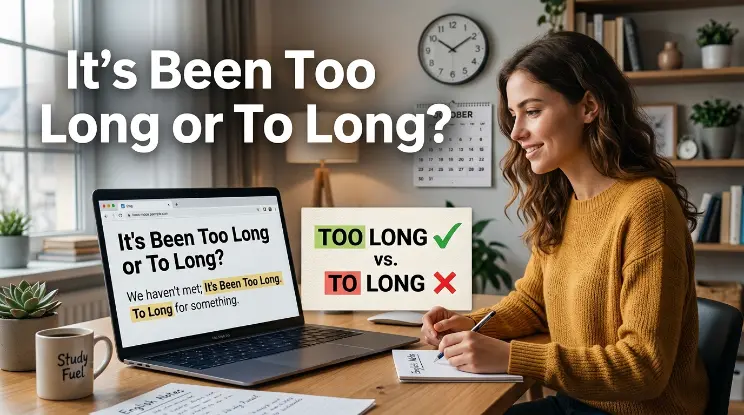
The correct phrase is “It’s been too long.” It means that a lot of time has passed, often since you last saw, spoke to, or did something.
Example: It’s been too long since we last met.
To Long or Too Long
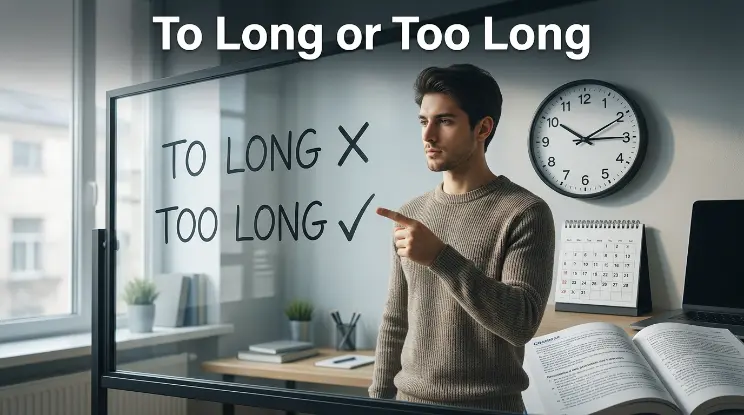
| Phrase | Correct? | Meaning | Example |
|---|---|---|---|
| to long | ❌ No | Incorrect spelling in this context | The movie is to long. |
| too long | ✅ Yes | Longer than necessary or expected | The movie is too long. |
| to short | ❌ No | Incorrect in this context | The dress is to short. |
| too short | ✅ Yes | Shorter than necessary | The dress is too short. |
| to much | ❌ No | Incorrect spelling in this context | There is to much noise. |
| too much | ✅ Yes | More than necessary | There is too much noise. |
“Too Long” vs “To Long”: Side-by-Side Comparison
| Phrase | Meaning | Correct Usage | Example |
| Too long | Excessively lengthy in time or size | Use when describing something that exceeds a limit | “This meeting is too long.” |
| To long | Grammatically incomplete unless paired with a verb like “for” | Only correct in phrases like “to long for” (meaning to yearn for something) | “I long for a vacation.” / “I to long” ❌ (incorrect alone) |
| To (general) | Preposition showing direction/purpose | Use before places, people, or verbs | “I’m going to Paris.” |
| Too (general) | Adverb meaning “excessively” or “also” | Use before adjectives/adverbs or at the end of a sentence | “That’s too expensive.” |
📌 Key takeaway: “To long” is almost never correct as a standalone phrase describing length. The only time “long” pairs naturally with “to” is in the verb phrase “long for” a completely different meaning (to desire something deeply).
Way Too Long or Way To Long
| Phrase | Correct? | Meaning | Example |
|---|---|---|---|
| way to long | ❌ No | Incorrect spelling | The meeting was way to long. |
| way too long | ✅ Yes | Much longer than necessary | The meeting was way too long. |
| way to short | ❌ No | Incorrect spelling | This article is way to short. |
| way too short | ✅ Yes | Much shorter than necessary | This article is way too short. |
| way too much | ✅ Yes | Much more than necessary | You spent way too much money. |
| way too little | ✅ Yes | Much less than necessary | We have way too little time. |
Common Mistakes People Make 🚫
Here are the classic slip-ups you’ll want to avoid:
- ❌ “This video is to long.” ✅ “This video is too long.”
- ❌ “The line was to long to wait in.” ✅ “The line was too long to wait in.”
- ❌ “I want to go to.” ✅ “I want to go too.” (meaning “as well”)
- ❌ “She’s smart to.” ✅ “She’s smart too.”
Why Does This Mistake Happen So Often?
- Homophones confuse spelling. Since “to” and “too” sound identical, spell-check sometimes misses the error because both are real words.
- Autocorrect isn’t perfect. Your phone won’t always catch the wrong “to/too” because grammatically both can appear in a sentence.
- Speed typing on social media leads to more slip-ups especially in casual captions and comments.
Memory Tricks to Never Mix Them Up Again 🧠
Here are some fun mnemonics that make this grammar tip stick:
- 🟢 “Too” = Too much, too many, too far → all mean “excess,” and all use too.
- 🟢 If you can replace the word with “also” and the sentence still makes sense, use too.
- Example: “I’m hungry too” → “I’m hungry also” ✅ makes sense!
- 🟢 If the word comes before a place, person, or verb, use to.
- Example: “I’m going to the gym” → direction, so it’s to.
- 🟢 Count the O’s: “Too” has too many O’s (two), just like it means “too much”!
Real-Life Examples: Where You’ll See This Mistake
📧 In Emails
“Sorry for the delayed reply, this project just took too long to finish.”
📱 On Social Media
“This line at Starbucks is way too long today 😩☕”
📰 In News Headlines
“Experts say wait times at hospitals have become too long for patients.”
🎓 In Academic Writing
“The study concluded that the survey was too long, leading to participant fatigue.”
🗣️ In Everyday Speech
“Can you believe that movie was three hours long? Way too long if you ask me!”
Notice a pattern? In every single example, “too long” is describing excess never direction or purpose. That’s your biggest clue for picking the right word.
Usage Notes: British vs American English 🇬🇧🇺🇸
Good news here this one’s universal! “Too long” is used the same way in both British and American English. There’s no regional spelling difference or alternate usage like you’d see with words such as “colour/color” or “organise/organize.”
However, here are a few usage notes worth knowing:
- Both British and American speakers use “too” for emphasis in casual speech (“That’s too much!”).
- In formal British writing, “too” is sometimes avoided at the start of a sentence, while American English is more relaxed about placement.
- Example (formal/British-leaning): “The report, too, highlighted budget concerns.”
- Example (casual/American-leaning): “Too, the report highlighted budget concerns.” (less common but still understood)
Either way, the core grammar rule stays exactly the same worldwide. 🌍
Quick Reference Table: When to Use “Too” vs “To”
| Situation | Correct Word | Example |
| Showing excess | too | “It’s too cold outside.” |
| Meaning “also” | too | “Can I come too?” |
| Before a place | to | “I’m heading to school.” |
| Before a verb | to | “I need to study.” |
| Showing purpose | to | “This gift is to you.” |
| Describing length/size negatively | too | “The essay was too long.” |
FAQs: People Also Ask ❓
1. Is it “too long” or “to long” when describing an essay?
It’s always “too long” when you’re describing excessive length for example, “My essay was too long for the word limit.”
2. Can “to long” ever be correct?
Yes, but only in the phrase “to long for” something, meaning to deeply desire it. Example: “I used to long for adventure.” This has nothing to do with length.
3. Why do “to” and “too” get confused so often?
Because they’re homophones they sound identical when spoken, so the mistake usually shows up in writing, not speech.
4. Is there a simple trick to remember the difference?
Yes! If you can substitute the word with “also” and it still makes sense, use “too.” Otherwise, use “to.”
5. Does autocorrect fix “to” vs “too” automatically?
Not always. Since both are real, correctly spelled words, autocorrect often won’t flag the mistake unless it drastically breaks the sentence.
6. Is “too long” different in British and American English?
No, the usage is identical in both. This is a universal English grammar rule with no regional variation.
7. What’s the difference between “too,” “to,” and “two”?
- Too = excessively / also
- To = direction, purpose, or before a verb
- Two = the number 2️⃣
Conclusion: The Key Takeaway 🎯
Here’s the simple truth to remember: “too long” is the correct phrase whenever you’re talking about something being excessively lengthy whether it’s a meeting, a movie, a line, or an essay. “To long” only makes sense in the rare phrase “to long for,” which is about desire, not length.
Next time you’re unsure, just ask yourself: Can I replace it with “also”? If yes, it’s too. If you’re pointing toward a place, person, or verb, it’s to.
Read More Articles
Panel or Pannel: When to Use Each Word Correctly for 2026
Jesus’ or Jesus’s: The Correct Possessive Form Explained for 2026
Eery or Eerie: Which Spelling Is Correct? Complete Grammar 2026
Wierd or Weird: Meaning, Difference, and Proper Usage for 2026

James Carter is an English language enthusiast and content writer who loves making grammar simple and easy to understand. He creates clear, beginner-friendly guides on spelling, grammar rules, confusing words, and everyday English usage. His goal is to help readers write with confidence through practical examples, easy explanations, and accurate language tips.