Amid or Amidst are two closely related English prepositions that often confuse learners because they have almost the same meaning.
Both words are used to describe something that is surrounded by, happening in the middle of, or taking place during a particular situation or group of things. Although they can usually be used interchangeably, there are small differences in style, tone, and frequency that make one a better choice in certain contexts.
In modern English, amid is more common in everyday writing and conversation, while amidst has a slightly more formal or literary feel.
Quick Answer
Which Is Correct: Amid or Amidst?
Both amid and amidst are correct.
- Amid = More common in modern English and everyday writing.
- Amidst = Slightly more formal, literary, or poetic.
They have the same meaning and are interchangeable in most contexts.
What Does “Amid” Mean?
Definition of Amid
Amid is a preposition that means:
- In the middle of
- Surrounded by
- During
- Among
It is used when something happens while surrounded by people, objects, events, or circumstances.
Examples of “Amid”
The children played amid the flowers.
She remained calm amid the chaos.
The company expanded amid growing competition.
He smiled amid the applause.
The village was hidden amid the mountains.
What Does “Amidst” Mean?
Definition of Amidst
Amidst is also a preposition with the same meaning as amid.
It is often chosen to create a slightly more formal, poetic, or traditional style.
Examples of “Amidst”
The castle stood amidst ancient trees.
She found hope amidst difficult times.
They celebrated amidst loud cheers.
The hikers rested amidst the forest.
Peace returned amidst the uncertainty.
What Is the Difference Between Amid and Amidst?
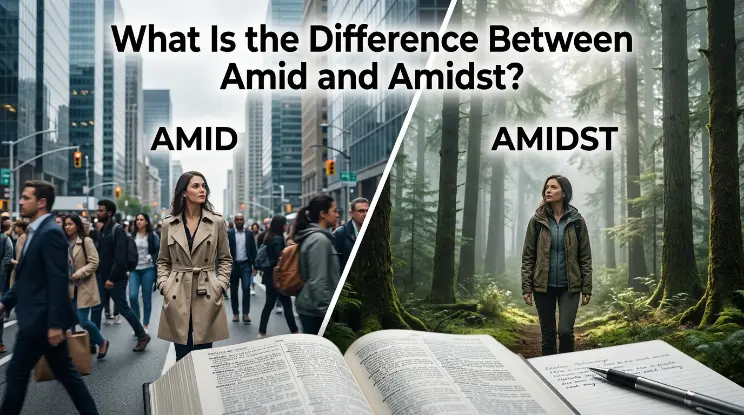
Amid and amidst have almost the same meaning. Both are prepositions used to mean “in the middle of,” “surrounded by,” or “during.” The main difference is style rather than meaning. Amid is shorter and more common in modern English, especially in formal writing, news, and everyday usage. Amidst has the same basic meaning but can sound slightly more literary, traditional, or expressive. For example, “She remained calm amid the chaos” and “She remained calm amidst the chaos” are both correct. In most situations, you can use either word without changing the meaning.
Amid vs Amidst in British English
In British English, both amid and amidst are accepted and grammatically correct. Amid is generally more concise and is widely used in newspapers, formal writing, and everyday English. Amidst is also used in British English, but it can have a slightly more traditional or literary feel. British English does not require you to use “amidst” instead of “amid.” For example, both “amid the noise” and “amidst the noise” are correct. The choice usually depends on style and personal preference rather than grammar.
Amid vs Amidst
Comparison Table
| Feature | Amid | Amidst |
| Meaning | In the middle of; surrounded by | In the middle of; surrounded by |
| Part of Speech | Preposition | Preposition |
| Correct? | Yes | Yes |
| Common in Everyday English | More common | Less common |
| Formal or Literary Style | Sometimes | More common |
| British English | Common | Slightly more common than in US English |
| American English | Very common | Used, but less frequently |
Key Differences
The meanings are identical.
The difference is mainly one of style:
- Amid sounds more modern and conversational.
- Amidst sounds slightly more elegant or literary.
Amid vs Amidst vs Among vs Amongst
| Word | Main Meaning | Common Use | Example |
|---|---|---|---|
| Amid | In the middle of; surrounded by | Events, conditions, situations | He stayed calm amid the confusion. |
| Amidst | In the middle of; surrounded by | Similar to amid, often more literary | She walked amidst the trees. |
| Among | In or surrounded by a group | People, things, or groups | She was among her friends. |
| Amongst | Same basic meaning as among | More traditional or formal style | He felt comfortable amongst colleagues. |
The key point is that amid/amidst are commonly used for a surrounding situation, condition, or setting, while among/amongst usually refer to being within or surrounded by a group or collection. For example, “The decision was made amid growing concerns” focuses on the surrounding circumstances. “The decision was discussed among the team members” focuses on the people involved.
Why Do People Confuse Amid and Amidst?
Nearly Identical Meanings
Both words mean “in the middle of” or “surrounded by.”
Similar Spelling
The only difference is the extra -st at the end of amidst.
Style Rather Than Grammar
Since both are grammatically correct, writers often wonder which sounds more natural.
When Should You Use “Amid”?
Correct Situations
Use amid when writing:
- News articles
- Blogs
- Business documents
- Academic papers
- Everyday conversations
Correct Examples
The city recovered amid heavy rainfall.
Investors remained optimistic amid market uncertainty.
The teacher stayed calm amid the noise.
The athlete won amid loud applause.
When Should You Use “Amidst”?
Correct Situations
Use amidst when writing:
- Literature
- Poetry
- Historical writing
- Formal speeches
- Creative storytelling
Correct Examples
The old cottage stood amidst rolling hills.
She found strength amidst adversity.
The knight rode amidst the crowd.
Birds sang amidst the morning mist.
Common Mistakes
Mistake 1: Thinking One Is Incorrect
❌ “Amid is wrong.”
❌ “Amidst is wrong.”
Both are correct.
Mistake 2: Mixing Styles
Using amid and amidst interchangeably in the same article may create an inconsistent writing style.
Choose one and use it consistently.
Mistake 3: Confusing Them with “Among”
Although similar, amid/amidst often emphasize being surrounded by a situation or environment, while among usually refers to being part of a group.
Example:
She stood among her friends.
She stayed calm amid the confusion.
Easy Memory Trick
Amid = Modern
Think:
Amid = Modern writing
Use it in everyday English.
Amidst = Storytelling
Think:
Amidst = More poetic
Imagine reading a novel or hearing a speech.
Another Trick
If you’re unsure, choose amid. It’s the more common option in modern English.
Real-Life Examples
News Report
“The president addressed the nation amid economic concerns.”
Business Email
“The company continued operations amid changing market conditions.”
Novel
“The cabin stood amidst snow-covered trees.”
Social Media
“Finding peace amid a busy week. 🌿”
Travel Blog
“We discovered a beautiful village amidst the mountains.”
Academic Writing
“The research continued amid growing public interest.”
Everyday Conversation
“He stayed positive amid all the challenges.”
British vs American English
British English 🇬🇧
Both amid and amidst are used, but amidst appears slightly more often than in American English, especially in literary and formal writing.
American English 🇺🇸
Amid is much more common in newspapers, business writing, and everyday English.
Amidst is still correct but is used less frequently.
Usage Trends
Amid Is Common In
- Newspapers
- Blogs
- Business reports
- Academic writing
- News headlines
- Everyday English
Amidst Is Common In
- Poetry
- Novels
- Historical books
- Speeches
- Literary writing
Grammar Tips
Both Are Prepositions
Both amid and amidst are always followed by a noun or noun phrase.
Examples:
Amid the rain
Amidst the trees
Similar Expressions
Other words with similar meanings include:
- Among
- During
- Surrounded by
- In the middle of
- In the midst of
More Example Sentences
Examples Using Amid
The concert continued amid heavy rain.
She remained hopeful amid uncertainty.
The flowers bloomed amid the rocks.
The child laughed amid the excitement.
The workers stayed focused amid constant distractions.
The announcement came amid public debate.
He found comfort amid difficult circumstances.
The ship sailed amid rough seas.
Examples Using Amidst
The castle stood amidst beautiful gardens.
She smiled amidst the celebration.
They walked amidst the falling leaves.
Hope remained amidst despair.
The temple rested amidst ancient ruins.
Birds nested amidst the tall trees.
The village survived amidst harsh winters.
The musicians performed amidst thunderous applause.
Frequently Asked Questions (FAQs)
Is it amid or amidst?
Both are correct. Amid is more common in modern English, while amidst has a slightly more formal or literary tone.
Do amid and amidst mean the same thing?
Yes. Both mean “in the middle of” or “surrounded by.”
Which is more common?
Amid is generally more common, especially in American English and everyday writing.
Is amidst old-fashioned?
Not exactly. Amidst is still widely used but often sounds more formal or poetic than amid.
Can I use them interchangeably?
Yes. In most contexts, amid and amidst can be used interchangeably without changing the meaning.
Is there a difference between British and American English?
Yes. British English uses both forms regularly, while American English strongly favors amid.
How can I remember the difference?
Remember:
Amid = Modern
Amidst = More Literary
Conclusion
The difference between amid and amidst is mainly a matter of style, not meaning. Both prepositions mean “in the middle of” or “surrounded by” and are grammatically correct. Amid is the preferred choice in modern, everyday English and is especially common in American English, while amidst adds a slightly more formal, traditional, or poetic tone and is seen more often in British English and literary writing.
If you’re ever unsure, choose amid for general writing. If you’re aiming for a more elegant or literary style, amidst is an excellent alternative.
Read More Articles
Separate or Seperate: Which Spelling Is Correct? Complete Grammar & Usage Guide 2026
Cleanup or Clean Up: Grammar Rules and Examples for 2026
Or vs Nor: What’s the Difference? Complete Grammar 2026
Latter or Ladder: Meaning, Usage, and Common Mistakes 2026

Sophia Collins is a passionate English grammar writer at GrammBoost.com who loves making the English language simple and easy to understand. She creates clear, beginner-friendly guides on grammar, spelling, word differences, and common language mistakes. Her goal is to help students, writers, and English learners build confidence and improve their writing through practical, easy-to-follow explanations.