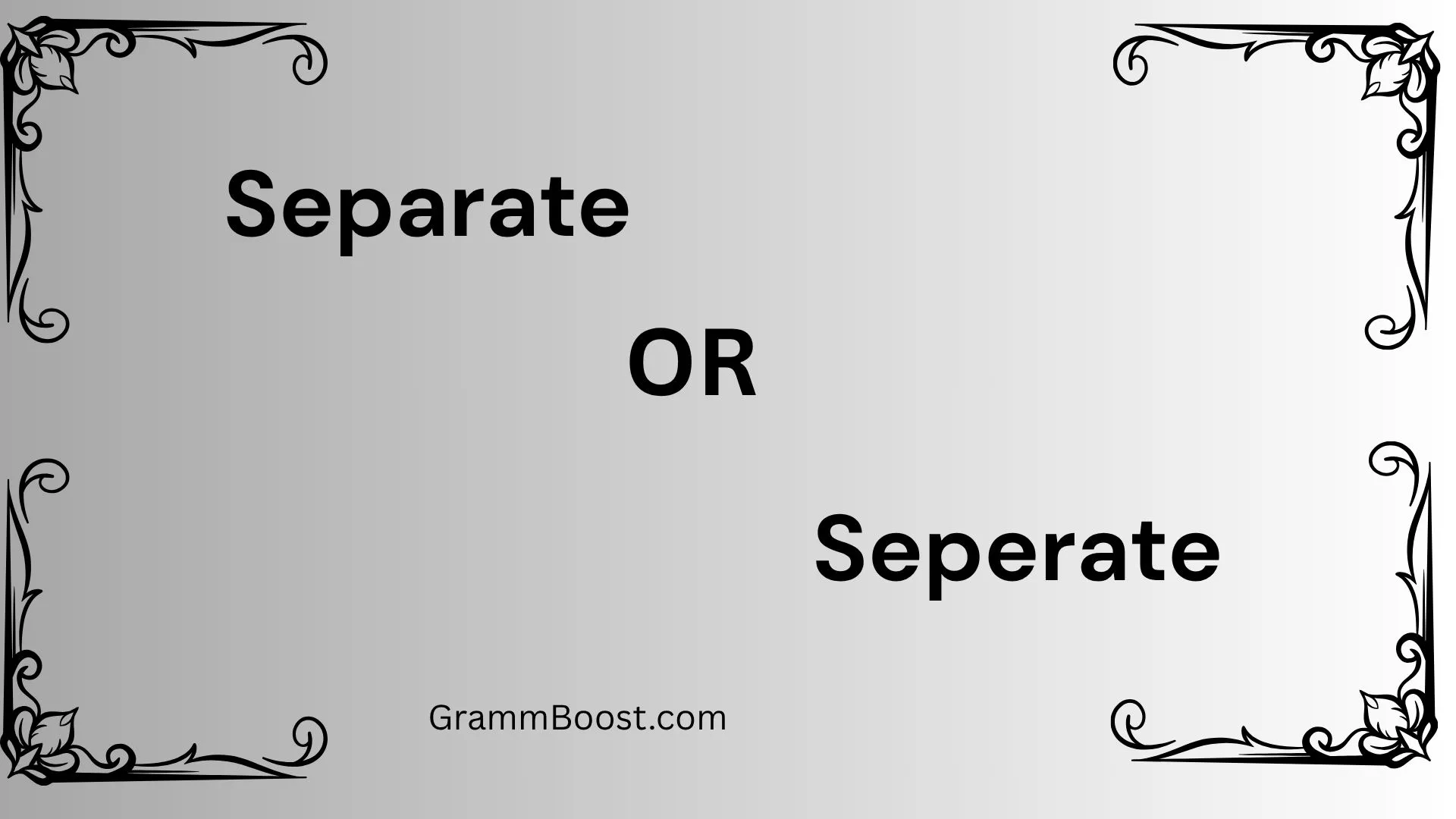
Have you ever stopped while writing and wondered it should be separate or seperate? 🤔 If so, you’re in good company. This is one of the most commonly misspelled words in English.
Students, professionals, bloggers, and even native speakers often type seperate by mistake because the pronunciation can make it sound like there’s an “e” in the middle.
Fortunately, the rule is simple: only one spelling is correct. Learning the correct form will improve your writing, help you avoid embarrassing spelling mistakes, and make your emails, essays, and social media posts look more professional.
Quick Answer
Which Is Correct: Separate or Seperate?
Separate is the correct spelling. It can be used as both an adjective and a verb. Seperate is not a standard English wordit is simply one of the most common spelling mistakes in English.
What Does “Separate” Mean?
Definition of Separate
The word separate means to divide, keep apart, disconnect, or exist independently. Depending on the sentence, it can function as either a verb or an adjective.
As a verb, it means to divide or split things.
As an adjective, it means not joined together or existing independently.
Examples of “Separate” as a Verb
Please separate the white clothes from the colored ones.
The teacher asked the students to separate into groups.
Oil and water naturally separate.
We need to separate fact from opinion.
The manager decided to separate the two departments.
Examples of “Separate” as an Adjective
They live in separate houses.
We booked separate hotel rooms.
The twins attended separate schools.
Please use a separate folder for each project.
The company has separate offices in London and New York.
What Does “Seperate” Mean?
Is “Seperate” a Real Word?
No.
Seperate is not a correct English word. It is simply a common misspelling of separate.
Most spell-checkers, dictionaries, and grammar tools automatically correct seperate to separate.
Incorrect Examples
❌ Please seperate the papers.
Please separate the papers.
❌ They have seperate bedrooms.
They have separate bedrooms.
❌ We need seperate accounts.
We need separate accounts.
Separate vs Seperate
Comparison Table
| Feature | Separate | Seperate |
| Spelling | Correct | ❌ Incorrect |
| Part of Speech | Verb / Adjective | Not a standard English word |
| Meaning | Divide or keep apart | Misspelling of separate |
| Dictionary Entry | Yes | ❌ No |
| Formal Writing | Yes | ❌ Never |
| Everyday English | Yes | ❌ Avoid |
Key Differences
The difference is very simple:
- Separate is the correct spelling.
- Seperate is a spelling mistake.
Whenever you’re talking about dividing, keeping things apart, or describing things that are not together, always write separate.
Why Do People Confuse Separate and Seperate?
Pronunciation
Many people pronounce the word in a way that makes the middle vowel sound like “e”, leading to the incorrect spelling seperate.
Difficult Spelling Pattern
The sequence “…par…” is less intuitive than “…per…”, making it one of the easiest words to misspell.
Typing Quickly
Fast typing often leads people to replace the “a” with an “e”.
Common English Mistake
Separate consistently appears on lists of the most frequently misspelled English words.
When Should You Use “Separate”?
Correct Situations
Use separate when talking about:
- Dividing objects
- Different people
- Independent ideas
- Different locations
- Distinct categories
- Individual accounts
- Individual files
Correct Examples
Keep your work and personal life separate.
Let’s separate the recyclable materials.
They traveled in separate cars.
Please create separate folders for each client.
Should You Ever Use “Seperate”?
The Simple Answer
No.
There is no standard English situation where seperate is the correct spelling.
If you accidentally type seperate, simply change it to separate.
Common Mistakes
Mistake 1: Using “E” Instead of “A”
❌ We need seperate reports.
We need separate reports.
Mistake 2: Trusting Pronunciation
Although many speakers pronounce it in a way that sounds like “seperate,” the correct spelling remains separate.
Mistake 3: Ignoring Spell Check
Modern spelling tools usually underline seperate because it isn’t a correct English word.
Always proofread your work before submitting or publishing it.
Easy Memory Trick
Remember: “There’s A Rat in SepARate”
A popular memory trick is:
SepARate has “A RAT” in the middle.
Look closely:
sepARATe
If you can remember the hidden word “A RAT,” you’ll never spell separate as seperate again.
Another Trick
Think:
“Separate always has an A after P.”
This simple reminder can help you avoid one of the most common spelling mistakes in English.
Real-Life Examples
Business Email
“Please save the invoices in separate folders.”
School Assignment
“Write your answers on separate sheets of paper.”
Social Media
“Sometimes it’s healthy to keep work and personal life separate. 😊”
Office Conversation
“We’ll separate today’s tasks among the team.”
Everyday Conversation
“The twins sleep in separate bedrooms.”
News Report
“The investigation has been divided into separate phases.”
Travel Planning
“We booked separate hotel rooms for each family.”
British vs American English
Is There a Difference?
No.
Both British English and American English use:
Separate
Neither variety accepts seperate as the correct spelling.
Usage Trends
Separate Is Used Everywhere
You’ll commonly find separate in:
- Schools
- Universities
- Newspapers
- Business documents
- Government reports
- Books
- Emails
- Legal writing
Seperate Is Usually a Typo
Almost every appearance of seperate online is simply a spelling mistake.
Grammar Tips
Separate Can Be Both a Verb and an Adjective
Examples as a verb:
- Please separate the files.
- We should separate the facts from the rumors.
Examples as an adjective:
- We stayed in separate apartments.
- The company has separate departments.
Related Words
Here are some words related to separate:
- Divide
- Split
- Isolate
- Distinct
- Independent
- Apart
- Individual
- Disconnect
More Example Sentences
Examples Using Separate
The teacher asked us to sit at separate desks.
We should separate the laundry by color.
They maintain separate bank accounts.
Please separate the documents into folders.
The company operates in separate markets.
The children were placed in separate classrooms.
Let’s separate the reusable materials.
We took separate flights to the conference.
Incorrect Examples Using Seperate
❌ We have seperate offices.
We have separate offices.
❌ Please seperate the books.
Please separate the books.
❌ The files are in seperate folders.
The files are in separate folders.
Frequently Asked Questions (FAQs)
Is it separate or seperate?
Separate is the correct spelling. Seperate is a common misspelling.
Is seperate a real English word?
No. Seperate is not a standard English word and should be avoided.
Why do people spell separate as seperate?
Because the pronunciation can make the middle vowel sound like “e,” many people accidentally replace the “a” with “e.”
Can separate be both a verb and an adjective?
Yes. Separate can mean to divide (verb) or not joined together (adjective).
Is separate spelled the same in British and American English?
Yes. Both British and American English use separate.
How can I remember the correct spelling?
Remember the phrase:
“There’s A RAT in sepARate.”
This popular memory trick makes the spelling much easier to remember.
What are some synonyms for separate?
Common synonyms include divide, split, distinct, apart, independent, disconnect, isolate, and individual.
Conclusion
The confusion between separate and seperate is one of the most common spelling mistakes in English, but the rule is easy to remember once you know it. Separate is the only correct spelling and can be used as both a verb and an adjective to describe dividing things or keeping them apart. Seperate, on the other hand, is simply a misspelling and should never be used in standard English writing.
You’re writing emails, essays, reports, or social media posts, always choose separate. A helpful memory trick is to remember that there’s “A RAT” hidden inside sepARate. This simple reminder can help you spell the word correctly every time.
Read More Articles
Amid or Amidst: What’s the Difference? Complete Grammar & Usage Guide 2026
Cleanup or Clean Up: Grammar Rules and Examples for 2026
Or vs Nor: What’s the Difference? Complete Grammar 2026
Latter or Ladder: Meaning, Usage, and Common Mistakes 2026

James Carter is an English language enthusiast and content writer who loves making grammar simple and easy to understand. He creates clear, beginner-friendly guides on spelling, grammar rules, confusing words, and everyday English usage. His goal is to help readers write with confidence through practical examples, easy explanations, and accurate language tips.