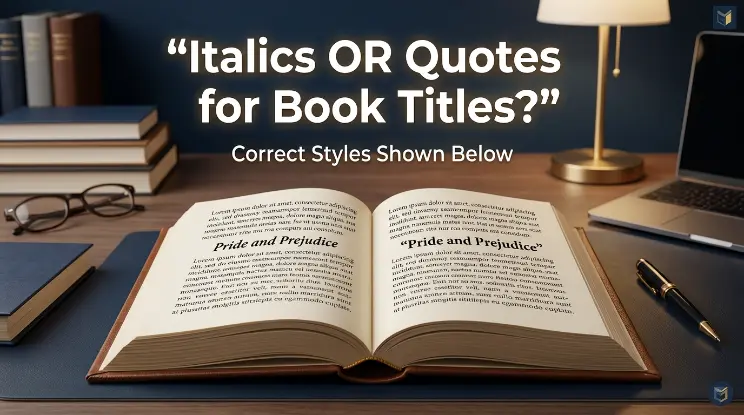
You’re writing an essay, an email, or maybe a Instagram caption about the book you just finished. You type the title… and then freeze. Should it be italicized? Or “in quotation marks”? Or maybe just capitalized and left alone?
If you’ve ever paused mid-sentence wondering whether to reach for italics or quotation marks, you’re in very good company. This is one of the most common grammar mistakes in English writing even seasoned writers, students, and bloggers mix it up all the time. The confusion usually comes from the fact that titles come in many forms: books, chapters, songs, poems, articles, movies, TV episodes… and each one follows a slightly different rule.
The good news? Once you learn the underlying logic, you’ll never second-guess yourself again. 🎉
Quick Answer 🎯
Italicize titles of complete, standalone works (like books, novels, and full TV series). Use quotation marks for titles of shorter works that are part of a larger collection (like chapters, poems, articles, or single TV episodes). That’s the whole rule in a nutshell.
Why This Rule Exists (It’s Simpler Than You Think)
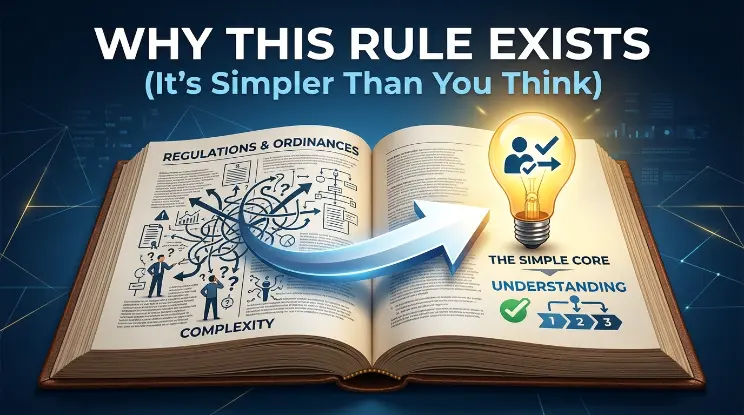
Here’s the secret: this isn’t a random rule someone invented to make English harder. It’s based on one simple question:
Is this a “big” independent work, or a “small” piece that belongs to something bigger?
- Big, standalone work → Italicize it
- Small piece inside a bigger work → “Put it in quotation marks”
Think of it like a book on a shelf versus a page inside that book. The book itself gets the special formatting (italics), while the individual chapter or poem inside it gets quotation marks.
Italics: For Complete, Standalone Works
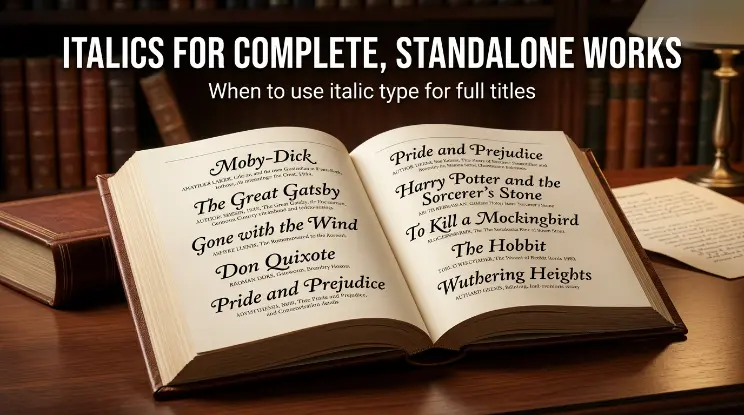
You should italicize the titles of things that stand on their own as a full, complete work. These include:
- Books/novels → The Great Gatsby, Harry Potter and the Sorcerer’s Stone
- Newspapers and magazines → The New York Times, National Geographic
- Movies → Inception, Barbie
- TV shows (entire series) → Stranger Things, Friends
- Plays → Romeo and Juliet
- Albums → Thriller, 1989
- Long poems (epic length) → The Odyssey, Paradise Lost
- Websites → Wikipedia, Amazon
Examples in Sentences:
- I just finished reading Educated by Tara Westover.
- Have you seen The Godfather? It’s a classic!
- She writes for The Washington Post.
- We watched every episode of Breaking Bad this month.
Quotation Marks: For Shorter Works Within a Larger Collection
Use quotation marks for shorter pieces that are typically part of something bigger. These include:
- Book chapters → “The Boy Who Lived” (Chapter 1 of Harry Potter)
- Short stories → “The Tell-Tale Heart” by Edgar Allan Poe
- Poems (short ones) → “The Road Not Taken” by Robert Frost
- Magazine or newspaper articles → “10 Tips for Better Sleep”
- Songs (individual tracks) → “Bohemian Rhapsody”
- TV episodes → “The One Where Ross Got High” (an episode of Friends)
- Essays → “Self-Reliance” by Ralph Waldo Emerson
Examples in Sentences:
- My favorite chapter is “The Battle of Hogwarts.”
- We studied “The Road Not Taken” in English class.
- Have you heard “Shape of You” by Ed Sheeran?
- That article, “5 Habits of Successful People,” went viral last week.
Comparison Table: Italics vs. Quotation Marks 📊
| Type of Work | Formatting | Example |
| Book / Novel | Italics | To Kill a Mockingbird |
| Chapter in a book | “Quotation Marks” | “Boo Radley” |
| Newspaper / Magazine | Italics | Time Magazine |
| Article in a magazine | “Quotation Marks” | “How to Save Money Fast” |
| Movie | Italics | Titanic |
| TV Series (whole show) | Italics | The Office |
| TV Episode | “Quotation Marks” | “Dinner Party” |
| Album | Italics | Lover |
| Song | “Quotation Marks” | “Blank Space” |
| Long/Epic Poem | Italics | Paradise Lost |
| Short Poem | “Quotation Marks” | “Fire and Ice” |
| Play | Italics | Hamlet |
| Short Story | “Quotation Marks” | “The Lottery” |
Common Mistakes People Make ❌
Here are the slip-ups that show up again and again in student essays, emails, and even published blog posts:
- Using both italics AND quotation marks together Wrong: “The Great Gatsby” ❌. Pick one, not both!
- Forgetting to format titles at all Writing “I read the great gatsby” with no capitalization or styling.
- Italicizing short story or poem titles These should get quotation marks, not italics.
- Using underlining instead of italics Underlining was the old-school workaround for typewriters that couldn’t italicize. In modern digital writing, always use italics instead.
- Inconsistent formatting across a document Switching between styles mid-essay confuses readers and looks unprofessional.
🧠 Memory Trick (Mnemonic)
Here’s an easy way to remember it:
“Big work, italic smirk. Small piece, quotation crease.”
Or think of it this way:
- Italics = Independent (a full, standalone work)
- Quotation marks = a Quick, smaller piece within something bigger
Another fun trick: imagine the title is either “a whole pizza” (the book gets italics, it’s the whole thing) or “a single slice” (a chapter/poem/song gets quotation marks, because it’s just a piece of the pizza). 🍕
Real-Life Examples: Where You’ll See This Rule in Action
📧 In Emails
“Hi Team, I wanted to recommend Atomic Habits for our next book club pick. The chapter ‘The 1st Law: Make It Obvious’ is especially useful for building routines.”
📱 On Social Media
“Just finished The Silent Patient 😱 and I can’t stop thinking about the twist! Highly recommend.”
📰 In News Writing
The New York Times published an article titled “Why Remote Work Is Here to Stay” last week.
🎓 In Academic Writing
In her essay “Self-Reliance,” Ralph Waldo Emerson explores themes later expanded in Walden by Henry David Thoreau.
🗣️ In Everyday Speech
While spoken English doesn’t show formatting, people often say “the book” or use vocal emphasis but when you write it down later (in a text, caption, or email), the formatting rule kicks in.
British vs. American English: Any Differences? 🇬🇧 🇺🇸
Good news this rule is largely the same in both British and American English. Both style guides (like the Chicago Manual of Style in the US and the Oxford Style Guide in the UK) agree:
- Italics for full-length, standalone works
- Quotation marks (called “inverted commas” in British English) for shorter pieces
The only regional difference is in the type of quotation marks used:
| Region | Quotation Mark Style | Example |
| American English | Double quotes (” “) | “The Road Not Taken” |
| British English | Single quotes (‘ ‘) often preferred | ‘The Road Not Taken’ |
So if you’re writing for a UK audience, single quotation marks are common but italics for books stays exactly the same either way.
Handwritten Work: What If You Can’t Italicize?
If you’re handwriting an essay or filling out a form where italics aren’t possible, the traditional workaround is to underline the title instead. This came from the days of typewriters, which couldn’t produce italics. So:
- Typed/digital: The Hobbit
- Handwritten: <u>The Hobbit</u>
Both are considered correct in their respective contexts.
Quick Cheat Sheet 📝
| Ask Yourself… | Answer | Formatting |
| Is it a full book, movie, or TV series? | Yes | Italics |
| Is it a chapter, poem, or song? | Yes | “Quotation Marks” |
| Am I handwriting it? | Yes | <u>Underline</u> |
| Am I typing it digitally? | Yes | Italics (for standalone works) |
FAQs: People Also Ask 🙋
1. Do you italicize book titles in MLA format?
Yes. MLA style requires italics for book titles, and quotation marks for shorter works like poems, articles, and chapters.
2. Should I italicize the title of my own book in an essay?
Yes even if you’re the author, the formatting rule is based on the type of work, not who wrote it.
3. Are movie titles italicized or in quotes?
Movie titles are always italicized since they’re standalone, complete works.
4. How do you format a book series title?
Both the series name and the individual book titles are typically italicized, like Harry Potter and Harry Potter and the Chamber of Secrets.
5. Do you italicize the Bible or religious texts?
No. Sacred texts like the Bible, Quran, and Torah are traditionally not italicized or put in quotes they’re treated as proper nouns.
6. What about italicizing titles on social media platforms?
Most platforms like Instagram or Twitter/X don’t support italics easily, so many people use asterisks (like this) or just capitalize the title as a workaround.
7. Is it okay to bold a title instead of italicizing it?
It’s not standard grammar practice, but in informal writing (like blog headers or social captions), bold is sometimes used for visual emphasis. For formal writing, stick to italics.
Conclusion: The Key Takeaway 🔑
In conclusion, book titles are generally italicized, while shorter works, such as poems, articles, and short stories, are placed in quotation marks. Following this simple rule makes your writing clear, professional, and grammatically correct. You are writing an essay, blog post, research paper, or social media content, proper title formatting improves readability and presentation. Remember that style guides may have small differences, but italicizing the titles of full-length books is the most common standard. Understanding when to italicize or use quotation marks will help you write with greater confidence and accuracy.

Olivia Bennett is a passionate English grammar writer at GrammBoost.com who loves making grammar simple and easy to understand. She specializes in spelling, word differences, punctuation, and everyday English usage. Through clear explanations and practical examples, Olivia helps students, writers, and professionals write with greater confidence and accuracy.