
Picture this: you’re texting a friend, and you type “I’m just gonna lay in bed all day” then you pause. Wait… is that even right? Should it be “lie in bed” instead? 🤔
You’re not alone. “Laying” vs “lying” is one of the most commonly confused word pairs in the English language, and honestly, even native speakers mess it up all the time. It’s not just you this mix-up shows up in text messages, Instagram captions, news articles, and even published books.
The good news? Once you understand the simple rule behind these two words, you’ll never second-guess yourself again. Let’s break it down in a fun, easy way. 😊
Quick Answer ⚡
If you’re just resting your body somewhere, the correct phrase is “lying in bed” (not “laying in bed”). You use “lay” only when you’re placing something else down, like “I laid the book on the table.” Grammatically speaking, “laying in bed” is incorrect unless you’re laying something down while in bed.
Now let’s dig into why because understanding the reasoning is what actually makes it stick. 🧠
The Real Difference Between “Lay” and “Lie”
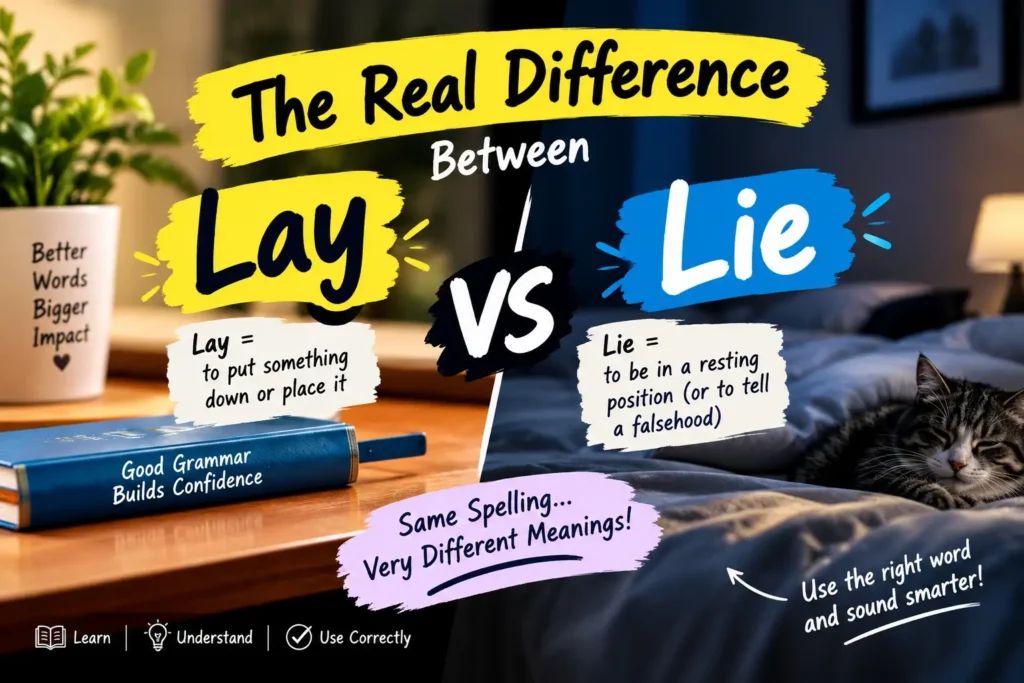
Here’s the root of the confusion: “lay” and “lie” are two completely different verbs that just happen to look and sound similar. They also have overlapping forms in different tenses, which makes things extra messy.
1. “Lie” To Rest or Recline (No Object Needed)
Lie means to recline, rest, or be in a horizontal position. It’s an intransitive verb, which is a fancy way of saying it doesn’t need an object you don’t “lie” something, you just lie down yourself.
✅ Examples:
- “I want to lie down for a nap.”
- “She lies on the couch every Sunday afternoon.”
- “He was lying in bed when the phone rang.”
- “Yesterday, I lay in bed until noon.” (past tense yes, it’s confusing that “lay” is also the past tense of “lie”!)
- “They have lain in the sun for hours.”
2. “Lay” To Place Something Down (Needs an Object)
Lay means to put or place something down. It’s a transitive verb, meaning it always needs an object something is being laid.
✅ Examples:
- “Please lay the blanket on the bed.”
- “She lays her keys on the counter every night.”
- “He was laying the tiles when I arrived.”
- “Yesterday, I laid the baby down for a nap.”
- “They have laid the foundation for the new house.”
3. Why “Laying in Bed” Feels So Natural (Even Though It’s Wrong)
Here’s the twist that trips everyone up: the past tense of “lie” is “lay”! So when someone says:
“I lay in bed all morning” ✅ (correct past tense of “lie”)
…it sounds just like the incorrect present-tense version:
“I lay in bed” (present tense incorrect, should be “I lie in bed”)
No wonder people are confused the words literally overlap. 😅
Comparison Table: “Lay” vs “Lie” at a Glance 📊
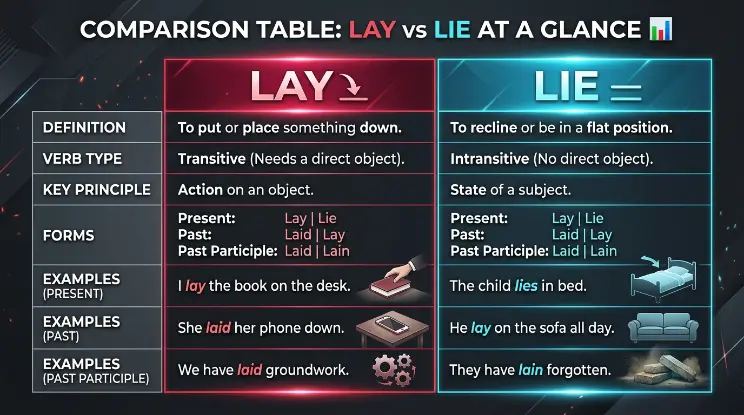
| Verb | Meaning | Needs an Object? | Present Tense | Past Tense | Past Participle | Present Participle | Example |
| Lie | To recline/rest | ❌ No | lie/lies | lay | lain | lying | “I lie down every night at 10.” |
| Lay | To place something down | ✅ Yes | lay/lays | laid | laid | laying | “She lays the plates on the table.” |
Full Verb Conjugation Chart
| Tense | Lie (to recline) | Lay (to place something) |
| Present | lie / lies | lay / lays |
| Past | lay | laid |
| Past Participle | (have) lain | (have) laid |
| Present Participle | lying | laying |
💡 Tip: The trickiest part is that “lay” is BOTH the present tense of “lay” AND the past tense of “lie.” That’s the entire source of the confusion!
Common Mistakes People Make 🚫
Let’s look at real mistakes people make every day, and how to fix them:
| ❌ Incorrect | ✅ Correct | Why |
| “I’m laying in bed” | “I’m lying in bed” | No object you’re just resting |
| “She’s laying down” | “She’s lying down” | No object reclining herself |
| “He laid in bed all day” | “He lay in bed all day” | Past tense of “lie,” not “lay” |
| “Lay down!” (to a person) | “Lie down!” | Command to recline, no object |
| “I laid down for a nap” | “I lay down for a nap” | Same as above |
| “The dog is laying on the rug” | “The dog is lying on the rug” | The dog is reclining, not placing anything |
A Simple Memory Trick 🧩
Here’s a mnemonic that many grammar teachers swear by:
“Lay” needs prey. 🦁
Just like a lion needs prey to hunt, the verb “lay” needs an object (something to place down). If there’s no object in the sentence, you need “lie” instead.
Another fun trick:
- L-I-E = “I” is in the middle, just like you are in the middle of the action (you’re the one lying down).
- L-A-Y = think of “lay” as needing something else “lay it down.”
Real-Life Examples From Everyday Communication 📱
In Text Messages
“omg I’ve been lying in bed scrolling tiktok for 3 hours 😭”
In Social Media Captions
“Sunday mood: lying by the pool with a good book 📚☀️”
In Emails (Formal Writing)
“I apologize for the delay in my response I’ve been lying in bed with the flu since Monday.”
In News Headlines
“Rescue workers found the hiker lying near the trail, dehydrated but alive.”
In Academic Writing
“The patient was lying in a supine position during the examination.”
In Everyday Speech
“Stop lying around and get ready we’re leaving in 10 minutes!”
Notice something? In all of these examples, no object follows the subject is simply reclining. That’s your clue it should always be “lying,” never “laying,” in these contexts.
When “Laying in Bed” IS Correct ✅
Here’s a fun exception: if you’re placing something down while in bed, “laying” becomes correct because now there’s an object involved.
✅ Examples:
- “I’m laying the laundry on the bed to fold it later.”
- “She’s laying her phone on the nightstand.”
- “He’s laying the blanket over the baby.”
See the difference? There’s always something being placed laundry, a phone, a blanket. That object is your signal that “lay/laying” is the right choice.
British English vs American English 🇬🇧🇺🇸
Good news this rule is the same in both British and American English. There’s no regional exception here; “lay” and “lie” follow identical grammar rules on both sides of the pond.
However, there are a couple of usage notes worth mentioning:
- Informal/spoken English: In casual conversation (especially in the U.S.), many native speakers say “laying in bed” instead of “lying in bed.” It’s technically incorrect, but it’s become so common that it’s widely accepted in informal speech.
- Formal/written English: In essays, professional emails, news articles, and academic writing, sticking to the correct form (“lying”) is important for correct spelling and English usage credibility.
- Chickens lay eggs this is one context where “lay” always stays as “lay,” regardless of region. Fun fact: this is actually the most common correct usage of “lay” people encounter daily!
Quick Recap Table: Choosing the Right Word 🎯
| Ask Yourself | If YES | If NO |
| Is something being placed down? | Use lay/laid/laying | Use lie/lay/lying |
| Is the subject just resting/reclining? | Use lie/lay/lying | |
| Talking about a chicken and eggs? | Always lay |
FAQs: People Also Ask 🙋
1. Is it “lying in bed” or “laying in bed”?
It’s “lying in bed” when you mean resting or reclining. “Laying in bed” is only correct if you’re placing an object while in bed (e.g., “laying clothes on the bed”).
2. What is the past tense of “lie”?
The past tense of “lie” (to recline) is “lay.” For example: “I lay in bed yesterday” (correct).
3. What is the past tense of “lay”?
The past tense of “lay” (to place something) is “laid.” For example: “I laid the book on the table.”
4. Why do “lay” and “lie” get confused so often?
Because “lay” is the present tense of one verb and the past tense of the other. This overlap is the main source of confusion in English grammar.
5. Is “laying down” ever correct?
Yes if you’re placing something down, like “She’s laying down the rules” (a figurative use where “rules” is the object) or “He’s laying down the carpet.”
6. Is “lay” a synonym for “lie” in casual speech?
In very informal, spoken English, many people use “lay” and “lie” interchangeably, but it’s grammatically incorrect. For formal writing, it’s best to follow proper grammar rules.
7. What’s an easy way to remember the difference?
Use the mnemonic: “Lay” needs prey meaning “lay” always needs an object. If there’s no object, use “lie” instead.
8. Does British English use “lay” and “lie” differently than American English?
No, the grammar rules are the same in both. The only difference is that “laying in bed” is heard more often in casual American speech, though it remains grammatically incorrect in both dialects.
Final Takeaway 🎉
In conclusion, “lying in bed” is the correct phrase when you mean resting or being in a horizontal position on a bed. The verb lie means to recline or rest, so its present participle is lying. On the other hand, laying usually means putting or placing something somewhere, so it needs an object, such as “laying the book on the bed.” Remembering this simple difference can help you avoid a common grammar mistake. Whether you are writing an email, chatting online, or creating formal content, use “lying in bed” when talking about yourself or someone resting on a bed.

Sophia Collins is a passionate English grammar writer at GrammBoost.com who loves making the English language simple and easy to understand. She creates clear, beginner-friendly guides on grammar, spelling, word differences, and common language mistakes. Her goal is to help students, writers, and English learners build confidence and improve their writing through practical, easy-to-follow explanations.