
If you’ve ever stood in front of your computer with a box taped up, staring at two shipping calculators open in different tabs, you already know the struggle.
You type in the same weight, the same zip codes… and somehow FedEx and UPS spit out prices that are almost identical but not quite. So which one actually saves you money?
Here’s the twist: there’s no single winner. The “cheaper” carrier changes depending on your package’s weight, size, destination, and how fast you need it there. Most people assume one company is always the budget option that’s actually the biggest misconception in this whole topic. 😅
Quick Answer ⚡
Neither FedEx nor UPS is consistently cheaper. For light packages under 5 lbs, UPS often wins by a small margin; for heavier packages traveling long distances, FedEx sometimes edges ahead but the gap is usually just a few dollars, and it flips depending on zone and account discounts.
Let’s break down exactly why, with real numbers, common mistakes people make when comparing rates, and a simple way to remember which carrier tends to favor which situation.
What Do “FedEx” and “UPS” Actually Mean? 🧐

Before comparing prices, let’s get the basics straight because mixing these two up (or their service names) is one of the most common shipping mistakes beginners make.
FedEx
FedEx (short for Federal Express) is a shipping and logistics company best known for express and time-definite delivery. Think overnight envelopes, next-day boxes, and international priority shipments.
Example usage:
- “I sent the contract via FedEx overnight so it would arrive by 8 a.m.”
- “Our office uses FedEx Ground for bulk shipments.”
UPS
UPS (United Parcel Service) is a shipping company known for its extensive ground network and reliable tracking, especially for domestic parcels and business-to-business deliveries.
Example usage:
- “The package is coming through UPS, so check the tracking on their site.”
- “We ship most of our online orders using UPS Ground.”
A Quick Grammar Note ✍️
Both are proper nouns (brand names), so they’re always capitalized:
- ✅ FedEx (note the capital “E” in the middle this trips up a LOT of writers)
- ❌ Fedex, fed ex, FEDEX
- ✅ UPS (all caps, since it’s an acronym for United Parcel Service)
- ❌ Ups, U.P.S. (the periods aren’t used in modern branding)
Memory trick: Think of “FedEx” as two squished words Fed + Express so the capital E marks where the second word starts. For UPS, remember it’s an acronym, so it stays in all caps, just like FBI or NASA. 🧠
FedEx vs UPS: Side-by-Side Comparison Table 📊
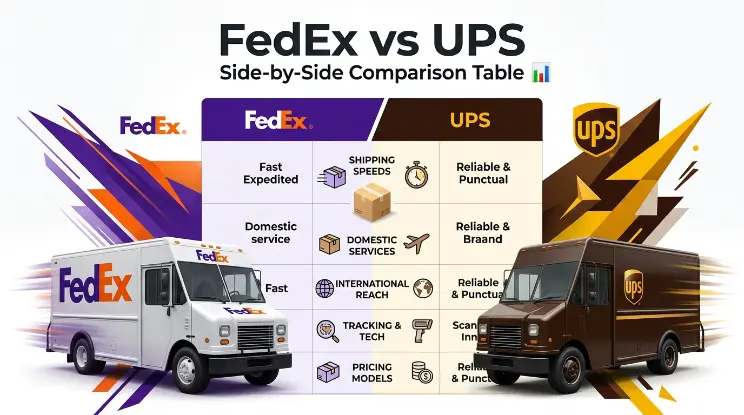
| Feature | FedEx | UPS |
| Best for | Time-definite & international shipping | Domestic ground & heavier packages |
| Cheaper for | Lighter packages over longer zones, some international lanes | Packages 5–15 lbs, shorter distances |
| Ground delivery speed | 1–5 business days | 1–5 business days |
| Overnight starting price (2 lb, Zone 5) | ~$55–$90 | ~$55–$90 |
| Residential surcharge (2026) | ~$6.45/package | ~$6.50/package |
| PO Box delivery | ❌ No | ❌ No |
| International strength | Strong in Europe, fast customs clearance | Strong across 220+ countries, competitive on heavier parcels |
| 2026 general rate increase | 5.9% | 5.9% |
Key takeaway: Since both carriers matched each other’s 2026 rate increases almost dollar-for-dollar, published rate cards look nearly identical. <cite index=”8-1″>Both carriers announced general rate increases of 5.9% for 2025, and the pattern of matching each other’s increases has continued into 2026, resulting in striking rate parity across most weight breaks and zones for shippers paying list prices</cite>.
Real Rate Examples: What You’d Actually Pay 💵
Numbers speak louder than opinions, so here’s what recent rate comparisons show for common shipping scenarios:
Ground Shipping (Heavier Packages)
For a 65-pound package traveling from Atlanta to Salt Lake City, <cite index=”1-1″>UPS Ground and FedEx Ground Economy came in nearly tied, with UPS at $90.52 with a 3-day transit and FedEx at $91.03 with a 5-day transit a shift from prior years when FedEx held a clearer pricing edge on heavy shipments</cite>.
Lighter Packages, Longer Zones
<cite index=”8-1″>FedEx Ground tends to be a few cents cheaper on 2 to 3 pound packages shipped cross country, while UPS occasionally edges ahead on 4 to 5 pound packages in mid-range zones</cite>. So if you’re shipping something small across the whole country, FedEx might sneak ahead by pocket change.
Overnight/Express Shipping
<cite index=”9-1″>For a 2-pound package shipping overnight across a mid-range zone, both FedEx First Overnight and UPS First Overnight run $80–$120+ at retail rates, with FedEx Priority Overnight and UPS Next Day Air typically landing in the $55–$90 range</cite>. <cite index=”9-1″>The pricing gap between the two for equivalent overnight services is typically less than $2–$3, meaning the choice often comes down to pickup convenience and regional reliability rather than price alone</cite>.
International Shipping
<cite index=”5-1″>For global shipping, FedEx tends to save more money relative to its faster customs clearance and delivery times, and it offers volume discounts, though pricing can increase sharply with weight or non-standard sizes</cite>. Meanwhile, <cite index=”9-1″>UPS tends to offer slightly more competitive rates on heavier packages to Canada and Mexico, while FedEx International Economy is often a strong value pick for Europe-bound shipments in the 5–20 pound range</cite>.
Common Mistakes People Make When Comparing FedEx and UPS ❌
- Comparing only the base rate. Surcharges (fuel, residential delivery, dimensional weight) can add 8–12% on top of the sticker price.
- Ignoring dimensional weight (DIM) pricing. A big, light box can be billed as if it weighs much more than it actually does this rule is identical for both carriers now, using a divisor of 139.
- Assuming one carrier is “always” cheaper. As we’ve seen, the winner flips depending on weight, zone, and speed.
- Forgetting negotiated rates exist. Businesses that ship often can unlock discounts that make published “list prices” almost meaningless for comparison purposes.
- Misspelling the brand names remember, it’s FedEx (capital E) and UPS (all caps), not “Fed ex” or “U.p.s.”
Memory Trick for Remembering Who’s Usually Cheaper 🧠
Think: “UPS Under FedEx Far.”
- UPS tends to win on Under-15-lb packages going shorter distances.
- FedEx tends to win on Far zones and international lanes.
It’s not a hard rule, but it’s a handy starting point before you check real rates.
Real-Life Examples From Everyday Situations 🌍
From a small business owner’s email:
“Hey team, switching our under-5-lb orders to UPS this month noticed FedEx was charging us about $2 more per package for that weight bracket.”
From a Reddit thread on e-commerce shipping: <cite index=”8-1″>One reviewer who runs an ecommerce fulfillment center noted that their negotiated UPS rates beat FedEx on every weight break under 20 pounds, but FedEx won everything above 30 pounds showing how individual contracts matter more than published rates</cite>.
From a customer service chat:
“Is FedEx or UPS cheaper for a 10 lb box to California?” “It depends on your zone, but they’re usually within a couple dollars of each other.”
From a shipping blog: <cite index=”9-1″>After the 2026 rate increases, a standard 5-pound package shipping within a mid-range zone costs approximately $14–$18 at retail rates with either carrier</cite> proof that at this size, the difference is often pennies, not dollars.
Trends and Insights Worth Knowing 📈
- Rate parity is the big 2026 story. <cite index=”8-1″>Practitioners frequently point out that the published rate cards for UPS Ground and FedEx Ground are nearly identical once you compare apples to apples</cite>.
- Surcharges are rising faster than base rates. <cite index=”4-1″>Both carriers now charge residential delivery surcharges of $6.45–$6.95 per package, up from the $4.50–$5.30 range prior to the 2026 rate increases</cite>.
- USPS is changing the comparison too. <cite index=”2-1″>USPS raised prices more sharply than UPS and FedEx in 2026, so it’s not an automatic win once you move past small, light parcels</cite> worth factoring in if you’re comparing all three carriers, not just two.
- Don’t forget UK/international readers: if you’re shipping from outside the US, always confirm local pricing directly, since international rate structures (and even service names) can differ by region.
FAQs: People Also Ask 🙋
1. Is FedEx or UPS cheaper for small businesses?
It depends on your typical package weight and zone. Businesses shipping mostly under 15 lbs to nearby zones often lean UPS; those shipping heavier or farther sometimes find FedEx competitive but negotiated discounts usually matter more than the published rate.
2. Which is cheaper, FedEx Ground or UPS Ground?
<cite index=”3-1″>FedEx Home Delivery is generally 3-5% cheaper than UPS Ground for residential deliveries, while UPS Ground is often competitive or cheaper for business addresses</cite>.
3. Is FedEx or UPS cheaper for overnight shipping?
They’re extremely close <cite index=”9-1″>the pricing gap for equivalent overnight services is typically less than $2–$3</cite>, so speed and reliability usually matter more than price at this tier.
4. Does FedEx or UPS charge more in surcharges?
They’re nearly identical: <cite index=”9-1″>UPS’s residential surcharge sits around $6.50 per package while FedEx’s is about $6.45</cite>.
5. Is UPS or FedEx better for international shipping?
<cite index=”5-1″>FedEx tends to save more money for global shipping thanks to faster customs clearance</cite>, though UPS remains competitive on heavier international parcels and has a larger country footprint.
6. Can I get a cheaper rate than what’s listed online?
Yes both carriers offer negotiated business rates that can beat published prices significantly, especially for regular shippers.
7. How do I know which carrier is cheaper for MY specific package?
Always compare live rates for your exact weight, dimensions, and zip codes using each carrier’s calculator or a third-party rate-shopping tool, since small changes in size or distance can flip the winner.
Final Takeaway 🎯
So, is FedEx or UPS cheaper? The honest answer: it’s a coin flip that depends on your package’s weight, size, distance, and delivery speed not a fixed rule. In 2026, both carriers have matched each other’s rate increases so closely that published prices are nearly twins. Your best move is to rate-shop your specific shipment every time rather than assuming brand loyalty will save you money.
And remember the small grammar detail while you’re at it: it’s FedEx (capital E) and UPS (all caps) getting the name right is the easiest part of this whole comparison! 😊

Olivia Bennett is a passionate English grammar writer at GrammBoost.com who loves making grammar simple and easy to understand. She specializes in spelling, word differences, punctuation, and everyday English usage. Through clear explanations and practical examples, Olivia helps students, writers, and professionals write with greater confidence and accuracy.