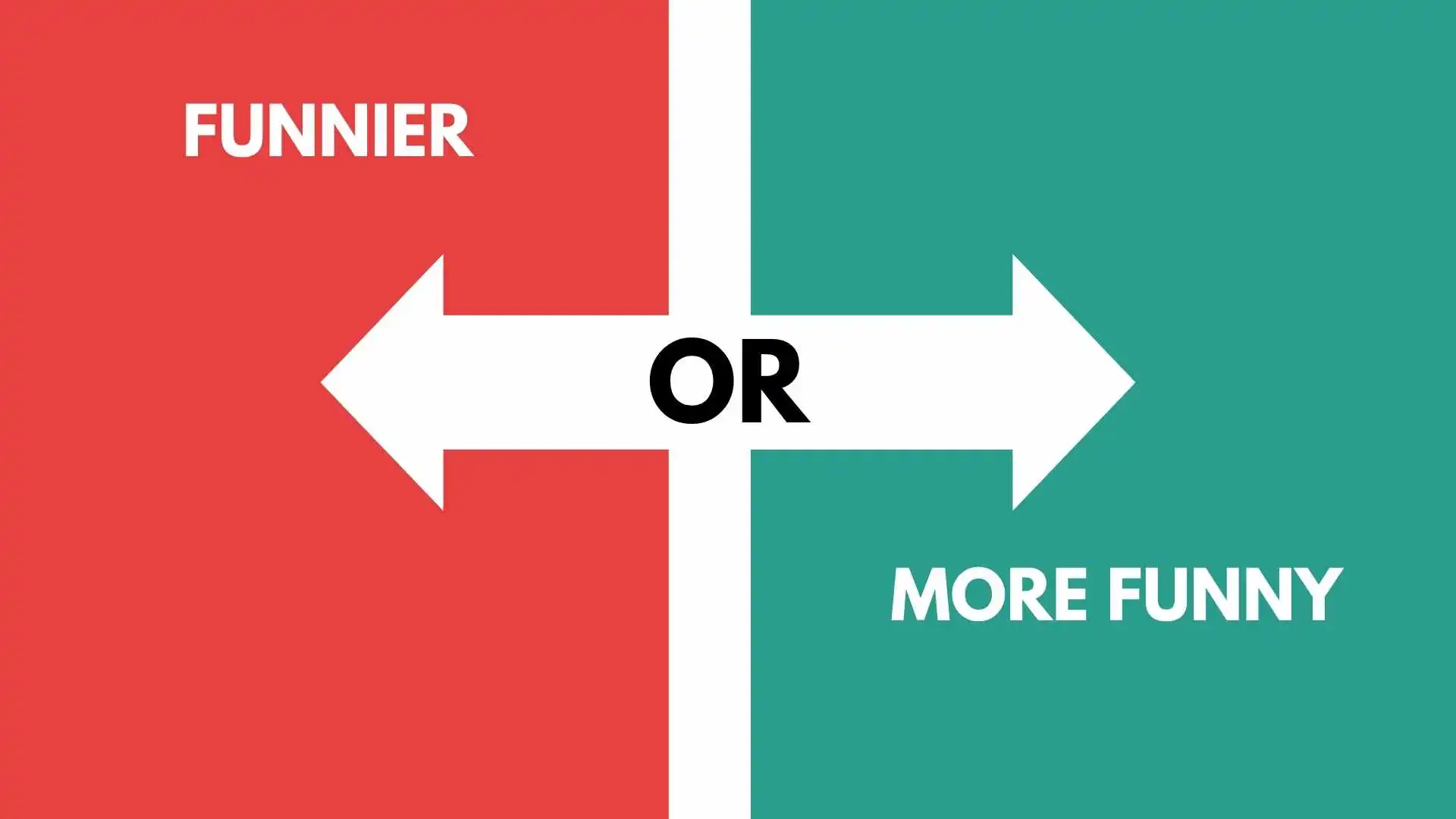
Choosing between “funnier” and “more funny” can be confusing, especially when you want your English to sound natural and grammatically correct.
Both forms are used to compare how funny two people, situations, jokes, or things are, but “funnier” is generally the more common and natural choice in everyday English. For example, you might say, “This movie is funnier than the last one.
” However, “more funny” can also appear in certain contexts, particularly when a speaker wants to emphasize the word “funny” or when making a comparison that feels clearer with “more.” Understanding when to use each form can help you write and speak English with greater confidence.
Quick Answer ⚡
“Funnier” is the correct and preferred form in almost all situations. “More funny” isn’t technically wrong, but it’s rarely used and can sound clunky or overly formal. Stick with funnier as your go-to comparative form of “funny.”
Now let’s break down exactly why that’s the case with examples, a comparison table, common mistakes, and a memory trick you’ll actually remember.
Why Do We Even Have Two Options?
In English, we form the comparative degree of adjectives (used to compare two things) in two main ways:
- Adding “-er” to the end of short adjectives → tall → taller, fast → faster
- Adding “more” before longer adjectives → beautiful → more beautiful, interesting → more interesting
The word “funny” falls into a special category: it’s a two-syllable adjective ending in “y.” And English grammar has a neat little rule just for these words.
The Rule for Two-Syllable Adjectives Ending in “Y”
When a two-syllable adjective ends in -y, you usually:
- Drop the y
- Add -ier
This gives us:
- happy → happier
- easy → easier
- funny → funnier
That’s it. That’s the whole secret. 🎉
“Funnier” Meaning and Usage
Funnier is the comparative form of “funny.” It means more amusing or humorous than something (or someone) else.
Examples of “Funnier” in Sentences:
- This movie is funnier than the last one. 🎬
- My brother is way funnier than me at parties.
- Her second joke was funnier than her first.
- TikTok memes are honestly funnier than most sitcoms these days.
- Nothing is funnier than watching a cat get startled by a cucumber. 🐱
Funnier works perfectly in casual chats, formal writing, essays, and everyday conversation. It’s the safe, standard, widely accepted choice.
“More Funny” Is It Ever Correct?
Grammatically, “more funny” isn’t incorrect but it’s unnatural and rarely used by fluent English speakers. Native speakers almost always default to “funnier.”
However, there’s one exception worth knowing:
When You’re Comparing Two Adjectives (Not Two Things)
If you’re comparing two qualities of the same thing rather than comparing two different things “more” can sneak in, but usually paired with another adjective, like this:
- The show was more funny than scary. 😅
- His comment was more funny than rude.
In these cases, you’re not comparing “funny” against “funnier funny” you’re comparing funny vs. another adjective (scary, rude, etc.). This is called a parallel comparison, and it’s the only time “more funny” sounds natural.
⚠️ But even here, many native speakers would still lean toward simplifying the sentence structure. It’s a stylistic choice, not a strict rule.
Comparison Table: Funnier vs. More Funny
| Feature | Funnier ✅ | More Funny ⚠️ |
| Grammar Rule | Standard comparative for 2-syllable “-y” adjectives | Rare exception, used only in parallel comparisons |
| Common Usage | Very common, natural, widely accepted | Uncommon, sounds awkward in most contexts |
| Example | “This joke is funnier than yours.” | “His humor was more funny than offensive.” |
| Formality | Works in both casual and formal writing | Rarely used even in formal writing |
| Recommended? | ✅ Yes, always safe to use | ❌ Avoid unless comparing two adjectives |
Common Mistakes People Make 🚫
Let’s look at the usual slip-ups so you can avoid them:
1. Saying “More Funnier” (Double Comparative)
❌ This show is more funnier than the last one. ✅ This show is funnier than the last one.
This is called a double comparative, and it’s one of the most common English mistakes. You should never combine “more” and “-er” together.
2. Using “Funnyer” Instead of “Funnier”
❌ That was the funnyer joke. ✅ That was the funnier joke.
Remember: drop the y, add -ier. Not just “-er.”
3. Overusing “More Funny” in Everyday Speech
❌ She’s more funny than her sister. ✅ She’s funnier than her sister.
Unless you’re doing a parallel comparison, always default to “funnier.”
Memory Trick to Never Forget 🧠
Here’s a fun mnemonic to lock this in:
“Y flies away, IER comes to play!” 🛫
Whenever a short adjective ends in y, picture the “y” flying away and “-ier” landing in its place.
- happy → happier
- funny → funnier
- silly → sillier
Say it out loud a few times it sticks fast!
Real-Life Examples: Funnier in Action
📧 In Emails
“Hey team, I tried making the presentation funnier by adding some memes let me know if it works!”
📱 On Social Media
“This meme is officially funnier than anything I’ve seen all week 😂 #comedy”
📰 In News Headlines
“Critics say the sequel is funnier, faster, and far more clever than the original.”
🎓 In Academic Writing
“The satirical tone of the second essay was noticeably funnier, using irony more effectively than the first draft.”
🗣️ In Everyday Speech
“Okay but ngl, your dog’s reaction was way funnier than mine.”
See how naturally “funnier” fits everywhere? That’s your sign it’s the correct default choice.
British English vs. American English 🇬🇧🇺🇸
Good news here there’s no difference between British and American English when it comes to “funnier” vs. “more funny.” Both dialects follow the same comparative rule for two-syllable “-y” adjectives.
| Region | Preferred Form | Example |
| 🇺🇸 American English | Funnier | “That’s funnier than I expected.” |
| 🇬🇧 British English | Funnier | “That’s funnier than I expected.” |
So no matter where you’re writing from, funnier is universally correct. One less thing to worry about! 🙌
Trend Insight: What Does Google Search Data Show?
If you look at online search and usage trends, “funnier” is used dramatically more often than “more funny” across blogs, news sites, and social media. This aligns perfectly with standard English grammar rules and it’s a great real-world confirmation that native speakers overwhelmingly favor “funnier” in daily use.
Related keyword insights people often search alongside this topic:
- grammar tips for comparatives
- correct spelling of funnier
- common English mistakes
- comparative and superlative adjectives
- English usage rules
- funnier vs funniest
- how to use comparative adjectives correctly
Funnier vs. Funniest Don’t Mix These Up!
While we’re here, let’s clear up a related point of confusion:
- Funnier = comparative (comparing two things) → “This is funnier than that.”
- Funniest = superlative (comparing three or more things, or naming the top one) → “This is the funniest video I’ve ever seen.”
Quick Example Table
| Form | Type | Example |
| Funny | Base adjective | “That’s a funny story.” |
| Funnier | Comparative | “That’s a funnier story than his.” |
| Funniest | Superlative | “That’s the funniest story I’ve heard all year.” |
FAQs: People Also Ask 🙋
1. Is “funnier” or “more funny” grammatically correct?
“Funnier” is the grammatically correct and commonly used comparative form. “More funny” is rarely used and only appears in specific parallel comparisons.
2. Can I ever use “more funny” correctly?
Yes, but only when comparing “funny” to another adjective, like: “His tone was more funny than serious.”
3. What is the superlative form of “funny”?
The superlative form is “funniest” used when comparing three or more things.
4. Is “more funnier” ever correct?
No. “More funnier” is a double comparative and is always considered incorrect in standard English.
5. Why does “funny” become “funnier” instead of “funnyer”?
Because of the spelling rule: when a two-syllable adjective ends in consonant + y, you drop the “y” and add “-ier.”
6. Do British and American English differ on this rule?
No, both British and American English use “funnier” as the standard comparative form.
7. What other adjectives follow the same “-ier” rule as funny?
Words like happy → happier, easy → easier, busy → busier, and silly → sillier all follow the same pattern.
Final Takeaway 🎯
Here’s the simple truth: when comparing two things, always go with “funnier.” It’s shorter, cleaner, and matches standard English grammar rules for two-syllable adjectives ending in “y.” Save “more funny” for those rare moments when you’re comparing funny to a completely different adjective and even then, it’s optional.
Next time you’re unsure, just remember our mnemonic: “Y flies away, IER comes to play!” ✈️😄

Olivia Bennett is a passionate English grammar writer at GrammBoost.com who loves making grammar simple and easy to understand. She specializes in spelling, word differences, punctuation, and everyday English usage. Through clear explanations and practical examples, Olivia helps students, writers, and professionals write with greater confidence and accuracy.