
Ever typed “an university” and then paused, staring at your screen, wondering if that little “an” looks… wrong? You’re not alone! This is one of the most common grammar mix-ups in English, and honestly, it trips up even advanced learners and native speakers alike.
The confusion makes total sense once you see why it happens. We’re taught a simple rule in school: use “a” before consonants and “an” before vowels. Since “university” starts with the letter U a vowel your brain screams “an university!” But your ears (and every English teacher) will tell you that’s wrong.
Let’s clear up this confusion once and for all. 🙌
Quick Answer ⚡
The correct phrase is “a university,” not “an university.” Even though “university” starts with the vowel letter U, it starts with a consonant sound (“yoo-nih-VER-sih-tee”), and that sound not the spelling determines whether you use “a” or “an.”
The Real Rule: Sound Beats Spelling 🔊

Here’s the grammar tip that fixes this confusion forever:
“A” and “an” are chosen based on the sound that follows, not the letter.
- Use “an” before words that begin with a vowel sound.
- Use “a” before words that begin with a consonant sound.
This is a classic case where English usage breaks away from the “letters” rule and follows pronunciation instead. Most learners are taught the simplified version (vowel letter = “an”) in early school years, but the real, correct rule is about sound.
Why “University” Gets the “A”
The word university is spelled with a vowel (U), but it’s pronounced with a “y” sound at the start like the word “you.” Say it slowly:
- U-ni-ver-si-ty → “Yoo-ni-ver-si-ty”
That “y” sound (technically called a glide or semi-vowel) is a consonant sound in English, even though “y” itself can sometimes act like a vowel. Since the word starts with a consonant sound, it needs “a,” not “an.”
✅ A university is a great place to learn. ❌ ~~An university is a great place to learn.~~
Meaning and Correct Usage: “A” vs “An” 📖
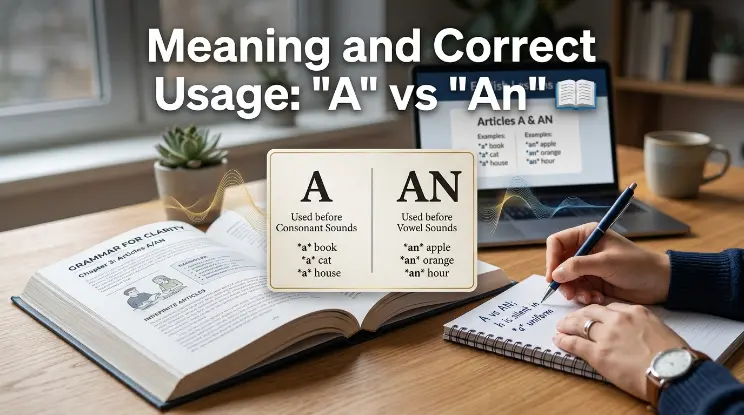
Let’s break both words down individually so the rule really sticks.
Using “A”
“A” is the indefinite article used before words that begin with a consonant sound.
Examples:
- I study at a university in London.
- She wants to become a doctor after graduation.
- He bought a used car (say it: “yoosed” consonant sound!).
- They live in a one-bedroom apartment (“won” consonant sound!).
- This is a unique opportunity (“yoo-neek” consonant sound!).
Using “An”
“An” is the indefinite article used before words that begin with a vowel sound.
Examples:
- She is an honest person (silent H, so it starts with a vowel sound).
- I need an umbrella; it’s raining.
- He waited for an hour (“our” silent H again).
- That’s an amazing idea!
- She’s an MBA graduate (say the letter “M” “em,” which starts with a vowel sound).
Notice the pattern? It’s always about how the word sounds when spoken aloud, not how it’s spelled. This is one of the most useful grammar tips for mastering correct spelling and pronunciation together.
Comparison Table: “A University” vs “An University” 📊
| Feature | ✅ A University | ❌ An University |
| Grammatical correctness | Correct | Incorrect |
| Reason | “University” starts with a consonant sound (“yoo”) | Based on the wrong assumption that spelling determines the article |
| Sound rule | Consonant sound → use “a” | Would only apply if it started with a vowel sound |
| Example sentence | She got into a university in Canada. | She got into ~~an university~~ in Canada. |
| Used by | Native speakers, textbooks, style guides | Common mistake among ESL learners |
| SEO/search trend | Correct usage searched to confirm grammar | Searched due to confusion, not correctness |
More Words That Follow the Same Sneaky Rule 🕵️
“University” isn’t the only troublemaker. Several common words start with a vowel letter but a consonant sound or the opposite. Here’s a handy table:
| Word | Starts With (Letter) | Sounds Like | Correct Article | Example |
| University | U (vowel) | “yoo” (consonant sound) | a | a university degree |
| Uniform | U (vowel) | “yoo” (consonant sound) | a | a school uniform |
| Unicorn | U (vowel) | “yoo” (consonant sound) | a | a magical unicorn |
| European | E (vowel) | “yoo” (consonant sound) | a | a European country |
| One | O (vowel) | “won” (consonant sound) | a | a one-way street |
| Hour | H (consonant) | “our” (vowel sound, silent H) | an | an hour of sleep |
| Honest | H (consonant) | “on-est” (vowel sound, silent H) | an | an honest mistake |
| MBA | M (consonant) | “em-bee-ay” (vowel sound) | an | an MBA program |
| Umbrella | U (vowel) | “um” (vowel sound) | an | an umbrella |
See the pattern? It’s all about the first sound, not the first letter. This little trick will instantly upgrade your English usage and help you avoid common mistakes in both writing and speech.
Common Mistakes and How to Avoid Them 🚫
Here are the most frequent slip-ups people make with this rule:
Mistake 1: Trusting the Letter Instead of the Sound
❌ “I go to an university every day.” ✅ “I go to a university every day.”
Mistake 2: Applying the Same Logic to All “U” Words
Not every “U” word behaves the same way!
- A university (consonant “yoo” sound)
- An umbrella (vowel “uh” sound)
So don’t assume all U-words take “an” check the sound first.
Mistake 3: Overcorrecting With “H” Words
Some learners flip the rule the wrong way with “H” words too. ❌ “I waited for a hour.” ✅ “I waited for an hour.” (silent H → vowel sound)
Mistake 4: Ignoring Acronyms and Abbreviations
❌ “She has a MBA.” ✅ “She has an MBA.” (say the letter “M” out loud it starts with a vowel sound)
Memory Trick to Never Get This Wrong Again 🧠
Here’s a simple mnemonic to lock this rule into your memory forever:
🎯 “Listen, don’t look!”
Before choosing “a” or “an,” say the word out loud (even in your head). If the sound is a vowel (“ah, eh, ih, oh, uh”), use an. If it’s a consonant sound (like “yoo,” “wuh,” or “huh”), use a.
Another fun trick: think of the word “university” as secretly starting with a “Y” because “you-niversity” sounds just like “you.” And nobody says “an you,” right? You’d naturally say “a you.” That’s your instant reminder. 🎓
Real-Life Examples 🌍
Seeing this rule in action across different contexts makes it stick even better.
📧 In Emails
“I’m excited to share that I’ve been accepted into a university in New York for the fall semester!”
📱 On Social Media
“Just toured a university campus today and I’m in love with it! 😍 #CollegeBound”
📰 In News Writing
“The report shows that graduates from a university setting earn 20% more on average than those without a degree.”
🎓 In Academic Writing
“This study was conducted at a university located in the northeastern United States, using a sample of 500 undergraduate students.”
🗣️ In Everyday Speech
“My cousin just started a university program in engineering she’s so excited!”
Notice how “a university” appears naturally and correctly in every single context, from casual texting to formal academic papers.
British vs American English: Any Differences? 🇬🇧🇺🇸
Good news this is one grammar rule where British and American English fully agree! Both dialects use:
- “A university” ✅ (never “an university”)
- “An hour” ✅
- “An honest” ✅
The sound-based article rule is a shared feature of standard English grammar worldwide, whether you’re studying in London, Sydney, Toronto, or New York. There’s no regional variation here so you can use this rule with total confidence no matter which English-speaking country you’re writing for. 🌎
Why This Grammar Rule Matters for SEO and Writing 📈
If you’re a blogger, student, or content writer, small grammar slips like “an university” can:
- Hurt your credibility with readers
- Signal low-quality content to search engines and editors
- Distract from your actual message
- Lower your writing’s professional polish
Getting details like correct spelling and article usage right is part of good English usage and it’s exactly the kind of thing that separates strong writers from careless ones. Small fixes, big impact! ✨
FAQs: People Also Ask 🤔
1. Is it correct to say “an university”?
No. “An university” is grammatically incorrect. Since “university” starts with a consonant sound (“yoo”), the correct form is always “a university.”
2. Why does “university” use “a” instead of “an” if it starts with a vowel?
Because English articles are chosen based on pronunciation, not spelling. “University” is pronounced with an initial “y” (consonant) sound, so it takes “a.”
3. What is the rule for “a” and “an” in English grammar?
Use “an” before words starting with a vowel sound and “a” before words starting with a consonant sound. The spelling of the first letter doesn’t matter only how it’s pronounced.
4. Are there other words like “university” that break the vowel-letter rule?
Yes! Words like uniform, unicorn, European, one, and union all start with a vowel letter but a consonant sound, so they use “a.”
5. Is “an hour” correct even though “hour” starts with a consonant letter?
Yes, “an hour” is correct because the “h” is silent, making the word sound like it starts with a vowel (“our”).
6. Does British English follow a different rule than American English for “a” vs “an”?
No, both British and American English follow the same sound-based rule. “A university” is correct in both dialects.
7. How can I remember when to use “a” and when to use “an”?
Say the word out loud first. If it sounds like it starts with a vowel, use “an.” If it sounds like it starts with a consonant, use “a.” Remember: “listen, don’t look!”
8. Is “a MBA” or “an MBA” correct?
“An MBA” is correct because the letter “M” is pronounced “em,” which starts with a vowel sound.
Final Thoughts: Get It Right Every Time ✅
Use “a university,” never “an university,” because English articles follow the sound of the next word, not its spelling.
This single grammar tip can instantly improve your writing, whether you’re crafting a college application email, writing a blog post, or chatting with friends online. Once you train your ear to listen for the sound instead of the letter, you’ll never second-guess yourself again. 🎉
Keep practicing, keep listening, and soon “a university” will roll off your tongue (and your keyboard) without a second thought

Olivia Bennett is a passionate English grammar writer at GrammBoost.com who loves making grammar simple and easy to understand. She specializes in spelling, word differences, punctuation, and everyday English usage. Through clear explanations and practical examples, Olivia helps students, writers, and professionals write with greater confidence and accuracy.