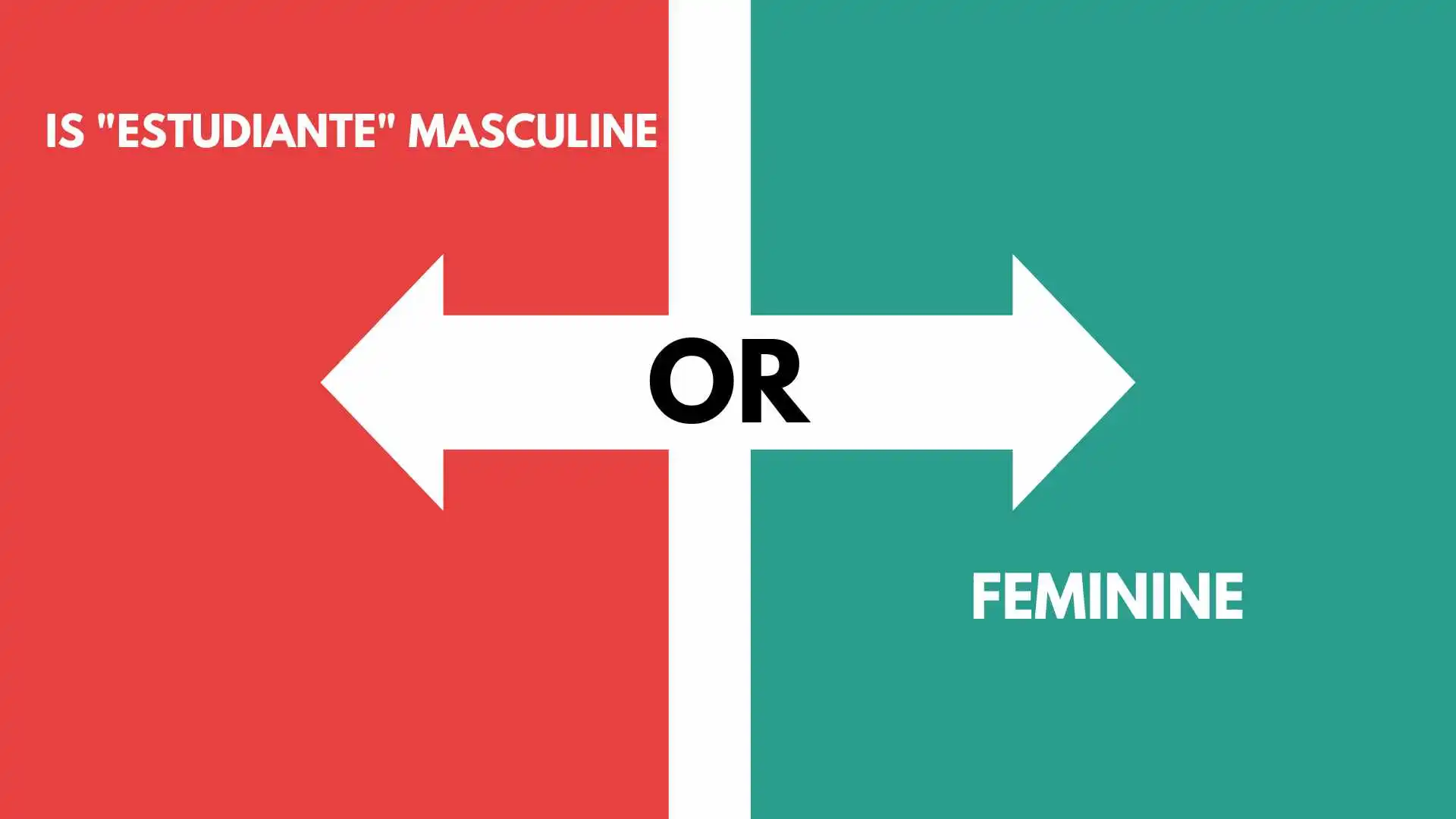
Have you ever been halfway through a Spanish sentence, ready to say “the student,” and suddenly frozen because you weren’t sure whether to say el estudiante or la estudiante?
You’re not alone! This is one of the most common questions Spanish learners ask, and honestly, it trips up even intermediate learners.
The confusion makes total sense. In Spanish, most nouns ending in -o are masculine, and most ending in -a are feminine. But “estudiante” ends in -e, which doesn’t fit neatly into either box. So what’s the real answer?
Quick Answer 🚀
“Estudiante” can be both masculine and feminine — it’s what’s called an “invariable noun” or “common gender noun.” The word itself doesn’t change; only the article changes: el estudiante (male student) or la estudiante (female student).
That’s it! Now let’s dig into why this happens and how to use it correctly every time.
Understanding Spanish Gender Rules (The Basics) 📖
Before we go further, here’s a quick refresher on Spanish grammar rules for gender:
- Nouns ending in -o → usually masculine (el libro, el gato)
- Nouns ending in -a → usually feminine (la mesa, la casa)
- Nouns ending in -e → can be either! This is where “estudiante” lives.
Words like estudiante, cliente, paciente, and cantante all follow this same pattern. They don’t change form based on gender — the article (el/la) does all the work.
“El Estudiante” vs “La Estudiante” What’s the Difference? 🤔
| Term | Gender | Meaning | Example Sentence |
| El estudiante | Masculine | A male student | El estudiante llegó tarde a clase. (The male student arrived late to class.) |
| La estudiante | Feminine | A female student | La estudiante sacó buenas notas. (The female student got good grades.) |
| Los estudiantes | Masculine plural / Mixed group | Male students OR a mixed group | Los estudiantes están en el aula. (The students are in the classroom.) |
| Las estudiantes | Feminine plural | Female students only | Las estudiantes ganaron el premio. (The female students won the prize.) |
💡 Key Insight
Notice that the word “estudiante” never changes — only “el,” “la,” “los,” and “las” change. This is different from words like maestro/maestra (teacher), where the noun itself changes based on gender.
More Examples to Practice With ✍️
Here are several examples showing “estudiante” in different contexts:
- El estudiante de medicina trabaja mucho. (The medical student works a lot.)
- La estudiante nueva es muy inteligente. (The new student is very intelligent.)
- Mi hermano es un estudiante excelente. (My brother is an excellent student.)
- Mi hermana es una estudiante excelente. (My sister is an excellent student.)
- Los estudiantes universitarios protestaron ayer. (The university students protested yesterday.)
- Las estudiantes del equipo de fútbol ganaron. (The female students on the soccer team won.)
Notice how “un” and “una” (a/an) also change depending on gender, just like “el” and “la.”
Common Mistakes Learners Make ❌
Here are the biggest common mistakes with “estudiante”:
Mistake #1: Adding an “-a” to make it feminine
❌ La estudianta This is incorrect and doesn’t exist in standard Spanish. ✅ La estudiante Correct!
Mistake #2: Forgetting to change the article
❌ El estudiante (referring to a woman) — grammatically wrong. ✅ La estudiante — Correct, matches feminine gender.
Mistake #3: Assuming all “-e” words follow the same pattern
Not every noun ending in “-e” is gender-neutral. Words like el coche (car) or la noche (night) have fixed genders. Only certain words like estudiante, cliente, paciente, and cantante are truly flexible.
Memory Trick to Remember This 🧠
Here’s a simple mnemonic to lock this in:
“E for Estudiante, E for Either!”
Since “estudiante” ends in -e, just remember that -e endings often mean “either gender works” — you just swap the article (el/la) to match the person you’re talking about.
Another fun trick: think of “estudiante” like the English word “student” it doesn’t change whether you’re talking about a boy or girl student. Only the pronoun (they) changes. Spanish does the same thing, but with “el” and “la” instead of “he” and “she.”
Real-Life Examples 🌍
In Everyday Speech
- “¿Eres estudiante?” (Are you a student?) This works for anyone, male or female!
In Academic Writing
- “El estudiante debe entregar su tarea antes del viernes.” (The student must submit their homework before Friday.)
On Social Media
- “¡Felicidades a todos los estudiantes que se graduaron hoy!” (Congratulations to all the students who graduated today!)
In Emails
- “Estimada estudiante, le informamos que sus calificaciones están disponibles.” (Dear student, we inform you that your grades are available.) Notice “estimada” (feminine) matches “la estudiante.”
Other Similar Words That Work the Same Way 📝
If you found this helpful, here are other Spanish words that follow the same el/la pattern:
| Word | Meaning | Masculine | Feminine |
| Cliente | Client | El cliente | La cliente |
| Paciente | Patient | El paciente | La paciente |
| Cantante | Singer | El cantante | La cantante |
| Gerente | Manager | El gerente | La gerente |
| Adolescente | Teenager | El adolescente | La adolescente |
Learning this pattern once helps you master dozens of words at the same time! 🎯
British vs American English Note 🇬🇧🇺🇸
Since this is a Spanish grammar topic, there isn’t a British vs American English variation. However, it’s worth noting that English speakers learning Spanish (from both the UK and US) often make the same mistake of trying to force gendered endings onto words like “estudiante” because English doesn’t have grammatical gender at all. This cross-language confusion is completely normal — don’t be hard on yourself!
Why This Matters for Correct Spelling and Grammar ✅
Understanding whether “estudiante” is masculine or feminine isn’t just a grammar technicality it affects:
- Adjective agreement: El estudiante inteligente vs La estudiante inteligente
- Article usage: el/la/los/las
- Formal writing and emails: Getting this right shows professionalism
- Spoken fluency: Native speakers notice these small details immediately
Mastering this small rule will boost your confidence in both spoken and written Spanish.
FAQs About “Estudiante” 🙋
1. Is “estudiante” masculine or feminine in Spanish?
It’s both! “Estudiante” is a common-gender noun. Use “el estudiante” for males and “la estudiante” for females.
2. Is there a feminine form like “estudianta”?
No, “estudianta” is not standard Spanish. Always use “la estudiante” for females.
3. How do you say “female student” in Spanish?
You say “la estudiante” or “una estudiante.”
4. How do you say “students” (plural) in Spanish?
Use “los estudiantes” for male or mixed groups, and “las estudiantes” for all-female groups.
5. What other Spanish words work like “estudiante”?
Words like cliente, paciente, cantante, and gerente follow the same pattern.
6. Why doesn’t “estudiante” change like “maestro/maestra”?
Because “estudiante” ends in -e, not -o or -a, so it doesn’t need a separate feminine form — only the article changes.
7. Is this rule the same in all Spanish-speaking countries?
Yes! This rule is standard across Latin America and Spain.
Final Thoughts: Key Takeaway 🎯
In conclusion, “estudiante” is a gender-neutral Spanish noun that can be used for both males and females. Unlike many Spanish nouns, its ending does not change according to gender. Instead, the article or other descriptive words help identify whether the student is male or female. For example, “el estudiante” refers to a male student, while “la estudiante” refers to a female student.
Understanding this rule makes Spanish grammar easier and helps learners use the word correctly in everyday conversations and writing. Therefore, the gender of “estudiante” depends on the person being described, not on the noun’s ending.

Olivia Bennett is a passionate English grammar writer at GrammBoost.com who loves making grammar simple and easy to understand. She specializes in spelling, word differences, punctuation, and everyday English usage. Through clear explanations and practical examples, Olivia helps students, writers, and professionals write with greater confidence and accuracy.