Ever typed a sentence, stared at it for a second, and thought wait, is it “too many” or “to many”? 🤔 You’re definitely not alone. This is one of the most common English mix-ups, and it trips up native speakers and English learners alike.
The confusion makes total sense once you think about it. “Too” and “to” sound exactly the same when spoken out loud, but they play totally different roles in a sentence. One tiny letter that extra “o” changes the entire meaning.
Good news: by the end of this article, you’ll never second-guess yourself again. 🙌
Quick Answer ⚡
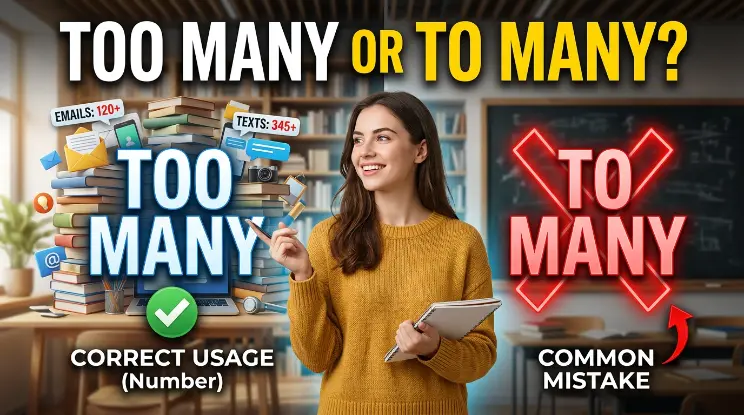
“Too many” is correct when talking about an excessive quantity (too many cookies, too many emails). “To many” is correct only when “to” is a preposition pointing to a destination, recipient, or group (I spoke to many people). If you’re describing “an excessive amount of something,” always use too many.
Let’s break it down properly. 👇
What Does “Too Many” Mean? 📚
Too is an adverb meaning “excessively” or “more than needed.” When you pair it with many, you’re describing a quantity that is more than desired, acceptable, or manageable.
Think of too many as your go-to phrase whenever you’re complaining (kindly or not!) about an amount that’s just… a lot. 😅
Examples of “Too Many” in Sentences
- I have too many tabs open on my browser right now. 💻
- There were too many people at the concert to find a good spot.
- She’s eaten too many snacks before dinner.
- We received too many applications for one job opening.
- Honestly, there are too many streaming services to keep track of these days.
Notice a pattern? “Too many” always answers the question “how much is too much?” It’s used with countable nouns (people, snacks, tabs, applications).
What Does “To Many” Mean? 🎯
Here’s where it gets interesting. “To many” isn’t really a fixed phrase it’s just two separate words that happen to sit next to each other:
- To = a preposition showing direction, purpose, or recipient (going to the store, talking to someone)
- Many = an adjective meaning “a large number of”
So “to many” simply means “to a large number of [people/things].”
Examples of “To Many” in Sentences
- The teacher explained the concept to many students during office hours.
- This news will come as a surprise to many readers.
- I’ve given this advice to many clients over the years.
- The award was presented to many deserving nominees.
- Her book resonated to many across different generations. (Note: this is often more naturally phrased as “resonated with many” more on natural phrasing below!)
Here, “to” is doing its normal job of connecting an action to a target a person, group, or audience.
Too Many vs To Many: Comparison Table 📊
| Feature | Too Many ✅ | To Many ✅ |
| Part of speech | Adverb (“too”) + adjective (“many”) | Preposition (“to”) + adjective (“many”) |
| Meaning | Excessive amount/quantity | Directed toward a large group |
| Used with | Countable nouns (people, things, items) | A noun phrase representing a group/audience |
| Answers the question | “How much is too much?” | “To whom/what?” |
| Example | I ate too many cupcakes. 🧁 | I gave cupcakes to many guests. 🎂 |
| Common context | Complaints, warnings, excess | Actions directed at an audience/recipient |
Common Mistakes People Make ❌
Let’s look at real mix-ups so you can spot them instantly.
Mistake #1: Using “to many” when you mean excess
- ❌ There are to many cars on this road.
- ✅ There are too many cars on this road.
Mistake #2: Using “too many” when “to” should point to a recipient
- ❌ I explained the plan too many employees.
- ✅ I explained the plan to many employees.
Mistake #3: Confusing “too” with plain “to”
This happens beyond just “many” people often drop the extra “o” in phrases like “too much,” “too late,” or “too tired,” writing “to much,” “to late,” “to tired” instead. Always remember: extra letter, extra meaning.
Memory Trick / Mnemonic to Remember the Difference 🧠
Here’s a simple trick that sticks:
🔑 “Too” has one EXTRA ‘o’ just like it means an EXTRA (too much) amount.
Another fun way to remember it:
- Too = Too much (both have double letters “too” has double O, and it describes something happening in excess)
- To = a short word for a short job (just pointing somewhere)
If you can replace the word with “also” or “excessively,” you need too. If you can replace it with a destination or recipient (“toward,” “for”), you need to.
Quick Substitution Test
| Sentence | Try replacing with “excessively” | Try replacing with “toward” | Correct Word |
| I have many bags. | “I have excessively many bags” ✅ makes sense | “I have toward many bags” ❌ doesn’t work | Too |
| I spoke many customers. | “I spoke excessively many customers” ❌ doesn’t work | “I spoke toward many customers” ✅ makes sense | To |
Real-Life Examples From Everyday Communication 💬
📧 In Emails
“Apologies for the delay we received too many requests this week and are catching up.”
📱 On Social Media
“Why does every app send too many notifications?? I’m turning them all off 😩 #done”
📰 In News Headlines
“Experts warn city has too many vacant buildings downtown.” “New policy will be explained to many residents at tonight’s town hall.”
🎓 In Academic Writing
“The study was distributed to many participants across five countries, though researchers noted too many variables affected the results.”
🗣️ In Everyday Speech
“There’s just too many options on this menu, I can’t decide!”
British vs American English: Any Difference? 🇬🇧 🇺🇸
Good news there’s no regional difference here. Both British and American English use “too many” and “to many” exactly the same way. This isn’t a spelling variation like “colour” vs “color” it’s a grammar rule that applies universally across all English-speaking regions.
So whether you’re writing an email in London, Los Angeles, Sydney, or Toronto, the rule stays the same. 🌍
FAQs: People Also Ask 🙋
1. Is “too many” one word or two?
It’s always two words “too” and “many.” There’s no combined version like “toomany.”
2. What’s the difference between “too much” and “too many”?
“Too much” is used with uncountable nouns (too much sugar, too much noise), while “too many” is used with countable nouns (too many cookies, too many people).
3. Can “to many” ever mean the same as “too many”?
No. “To many” never means excessive. It always relates to direction, recipients, or audience never quantity or excess.
4. How do I know when to use “too” instead of “to”?
Ask yourself: does the word mean “also” or “excessively”? If yes, use too. If the word is showing direction or connection (going to, talking to, giving to), use to.
5. Is it grammatically correct to say “way too many”?
Yes! “Way too many” is an informal but perfectly acceptable way to emphasize excess, like “way too many emails this morning.” 📩
6. Does autocorrect fix “to many” automatically?
Not always. Since “to many” is a valid phrase in the right grammatical context, autocorrect tools often won’t flag it even if you meant “too many.” Always proofread manually.
7. Are there other commonly confused words like this?
Yes English is full of them! Similar tricky pairs include “your vs you’re,” “their vs there vs they’re,” and “its vs it’s.” These fall under common English usage challenges that are worth mastering for clear writing.
Final Recap:
In conclusion, “too many” is the correct phrase when you want to say that there is a larger number of something than needed or expected. For example, “There are too many books on the table.” The word “to” is usually used before a verb or to show direction, so “to many” is incorrect in standard English. Remembering this simple difference can help you avoid common spelling and grammar mistakes in everyday writing. Whether you are writing an email, school assignment, social media post, or casual message, use “too many” when talking about an excessive number of countable things.

James Carter is an English language enthusiast and content writer who loves making grammar simple and easy to understand. He creates clear, beginner-friendly guides on spelling, grammar rules, confusing words, and everyday English usage. His goal is to help readers write with confidence through practical examples, easy explanations, and accurate language tips.