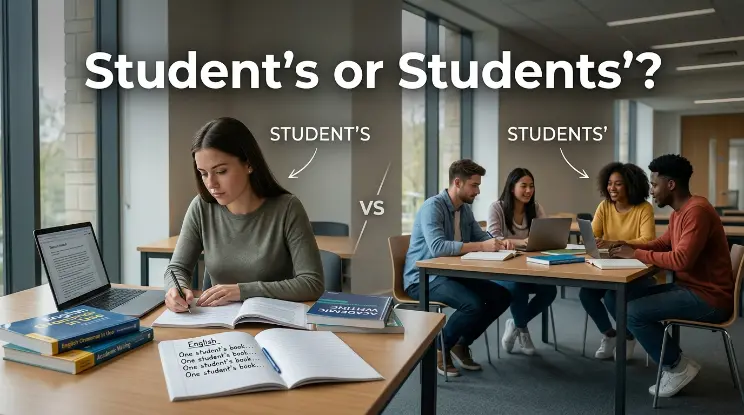
Have you ever typed “student’s lounge” and then paused, finger hovering over the keyboard, wondering if it should actually be “students’ lounge”? 🤔
You’re not alone. This tiny apostrophe causes big headaches for students, teachers, marketers, and even professional writers. One little mark, moved just one letter to the left or right, completely changes the meaning of your sentence.
And spell-check won’t always catch it, because both spellings are technically “correct” just in different contexts!Let’s clear up this confusion once and for all, in plain, simple English. 👇
Quick Answer 📌
“Student’s” (apostrophe before the S) shows something belongs to one student. “Students'” (apostrophe after the S) shows something belongs to more than one student. The apostrophe placement depends entirely on whether you mean singular or plural ownership.
That’s it in a nutshell but let’s dig into the details, examples, and common mistakes so you never mix them up again.
Why Does This Confuse So Many People? 😅

English apostrophes for possession follow a simple rule on paper, but people trip up because:
- Both words sound identical when spoken aloud
- Spell-checkers often don’t flag the “wrong” one
- We rarely think about singular vs. plural before we type
- Many other languages don’t use apostrophes this way at all
The good news? Once you understand the one core rule, you’ll never second-guess yourself again.
Understanding “Student’s” (Singular Possessive) ✅
“Student’s” means something belongs to one student. The apostrophe goes right before the “s.”
Examples:
- The student’s backpack was left in the classroom.
- I graded the student’s essay last night.
- The student’s parents attended the meeting.
- Her student’s enthusiasm for science was inspiring.
- The teacher praised the student’s hard work.
Notice how in every sentence, we’re talking about one specific student who owns or is connected to something (a backpack, an essay, parents, enthusiasm, hard work).
Understanding “Students'” (Plural Possessive) ✅
“Students'” means something belongs to more than one student. Since the plural of “student” is already “students” (ending in s), we simply add the apostrophe after the existing s.
Examples:
- The students’ lounge was recently renovated.
- All the students’ projects were displayed in the hallway.
- The students’ feedback helped improve the course.
- We collected the students’ opinions in a survey.
- The students’ enthusiasm filled the entire auditorium.
Here, we’re talking about a group of students who collectively own or share something.
Comparison Table: Student’s vs Students’ 📊
| Term | Apostrophe Position | Meaning | Example Sentence |
| Student’s | Before the “s” | Belongs to one student | The student’s laptop crashed during the exam. |
| Students’ | After the “s” | Belongs to multiple students | The students’ laptops were collected before the test. |
| Students | No apostrophe | Simple plural (no possession) | The students arrived early today. |
💡 Key takeaway: If there’s no ownership involved, don’t use an apostrophe at all!
Common Mistakes to Avoid ❌
Here are the slip-ups people make most often:
- Using “students” when you mean possession
- ❌ The students grades improved.
- ✅ The students’ grades improved.
- Using “student’s” for a group
- ❌ All the student’s assignments are due Friday. (implies one student owning all assignments)
- ✅ All the students’ assignments are due Friday.
- Adding an apostrophe when there’s no possession at all
- ❌ The student’s are waiting outside.
- ✅ The students are waiting outside.
- Confusing it’s/its style errors remembering that apostrophes show possession OR contraction, never just plurals.
Memory Trick 🧠
Here’s a simple mnemonic to lock this in forever:
“One student, one apostrophe before the S. Many students, apostrophe after the S because they already have their S!”
Or picture it this way: the apostrophe is like a little flag 🚩 planted right after the owner’s name ends.
- One owner → “student” + ‘s → student’s
- Many owners → “students” + ‘ → students’
Real-Life Examples From Everyday Writing 📝
In Emails:
“Please find attached the student’s report card for this semester.” “We appreciate the students’ patience during the schedule change.”
On Social Media:
“Shoutout to this student’s amazing science fair project! 🔬🏆” “The students’ reactions to the surprise pizza party were priceless 😂🍕”
In News Articles:
“The student’s family has requested privacy during this difficult time.” “The students’ protest drew hundreds of supporters downtown.”
In Academic Writing:
“The student’s thesis explored climate change adaptation strategies.” “The students’ collective research contributed to a published journal article.”
In Everyday Speech:
“Have you seen Emma? That’s her student’s notebook.” “The students’ cafeteria gets really loud during lunch.”
British English vs American English 🇬🇧🇺🇸
Good news here this rule is the same in both British and American English! Apostrophe placement for singular vs. plural possessives doesn’t change across the pond.
However, there are a few style differences worth noting:
| Style Point | British English | American English |
| Possessive apostrophe rule | Same (student’s / students’) | Same (student’s / students’) |
| Collective nouns | Often treated as plural (e.g., “the students’ union are meeting”) | Often treated as singular (e.g., “the students’ union is meeting”) |
| Style guide preference | Oxford style guides emphasize clarity | AP style also emphasizes clarity, similar rules |
So no matter where you’re writing from, the core apostrophe rule stays consistent. ✅
FAQs: People Also Ask 🙋
1. What is the difference between student’s and students’?
“Student’s” refers to something belonging to one student, while “students'” refers to something belonging to multiple students.
2. Is “students” ever correct without an apostrophe?
Yes! Use plain “students” (no apostrophe) when you’re simply referring to more than one student without showing possession e.g., “The students are here.”
3. How do I know when to use an apostrophe with student?
Ask yourself: Does something belong to the student(s)? If yes, use an apostrophe. If you’re just naming a group, skip it.
4. What is the plural possessive rule in English?
For regular plural nouns ending in “s,” simply add an apostrophe after the s (e.g., students’, teachers’, dogs’).
5. Is “students’s” ever correct?
No. Once a plural noun already ends in “s” (like “students”), you don’t add another “s” after the apostrophe. Just add the apostrophe: students’.
6. Does this rule apply to other plural nouns too?
Yes! The same logic applies to words like “teachers’,” “parents’,” “doctors’,” and more.
7. Why is this such a common English mistake?
Because both words sound exactly the same when spoken, the difference only becomes visible in writing which makes it an easy typo to miss.
Final Thoughts: Mastering the Apostrophe 🎯
In conclusion, understanding the difference between Student’s and Students’ is simple once you know you are talking about one student or more than one. Student’s is the possessive form of “student” and shows that something belongs to one student. Students’ is the plural possessive form and shows that something belongs to two or more students.
For example, “The student’s book” refers to one student, while “The students’ books” refers to several students. Remembering this small difference can help you avoid common grammar mistakes in writing, emails, assignments, and everyday communication. Always check the number of students before choosing the correct form.

Sophia Collins is a passionate English grammar writer at GrammBoost.com who loves making the English language simple and easy to understand. She creates clear, beginner-friendly guides on grammar, spelling, word differences, and common language mistakes. Her goal is to help students, writers, and English learners build confidence and improve their writing through practical, easy-to-follow explanations.