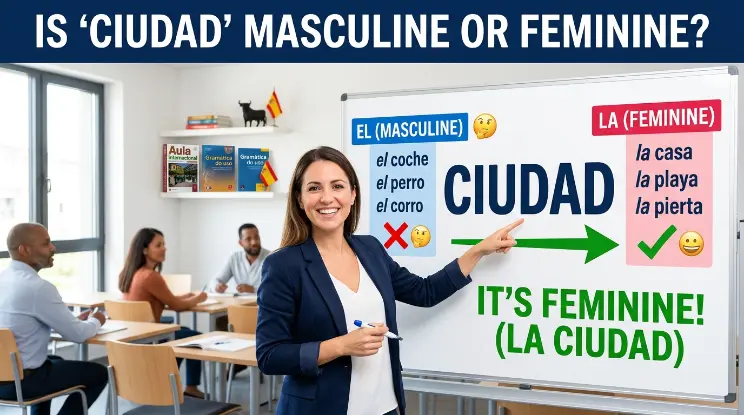
Ever been mid-sentence in Spanish, ready to say “the city,” and suddenly frozen because you couldn’t remember if it’s el ciudad or la ciudad? 😅 You’re definitely not alone.
Spanish noun gender trips up beginners (and even intermediate learners) all the time, and ciudad is one of those words that seems like it should be masculine but isn’t.
If you’ve ever Googled “ciudad gender Spanish” at 11 pm while doing homework, this article is for you. Let’s clear up the confusion once and for all, with simple explanations, real examples, and a few memory tricks to make sure you never mix it up again.
Quick Answer ⚡
“Ciudad” is a feminine noun in Spanish. The correct article is always la ciudad (the city), never el ciudad. Any adjective describing it must also take the feminine form, like la ciudad hermosa (the beautiful city).
Now let’s dig into why that’s the case, and how to avoid similar mistakes with other Spanish nouns.
Why Does Gender Matter in Spanish? 🤔
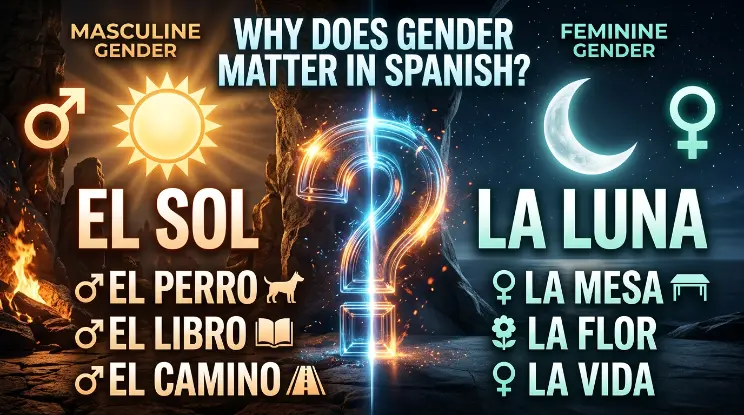
In English, nouns don’t have gender “city,” “book,” and “table” are all just “the.” But in Spanish, every noun is either masculine or feminine, and this affects:
- The article you use (el/la, un/una)
- The adjectives that describe it
- Pronouns that replace it later in a sentence
This is one of the biggest grammar tips for English speakers learning Spanish: you can’t just translate word-for-word you need to learn the gender along with the noun itself.
Breaking Down “Ciudad” 📖
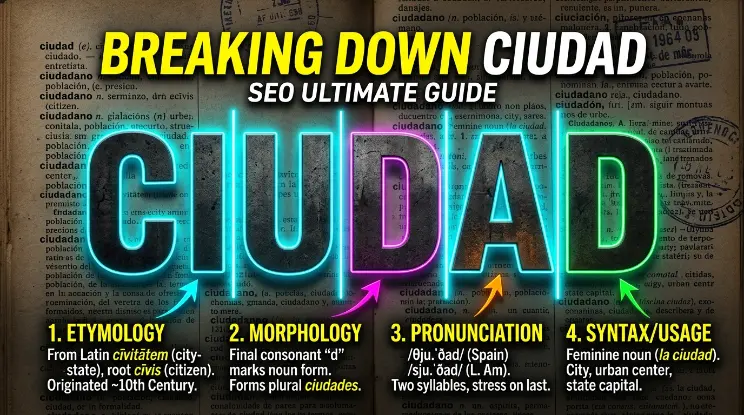
Let’s look at the word itself:
- Ciudad = city (noun)
- Gender: Feminine
- Correct singular article: la ciudad
- Correct plural form: las ciudades (the cities)
- Indefinite article: una ciudad (a city)
Examples in Sentences
- La ciudad de Nueva York es enorme. → The city of New York is huge.
- Visitamos una ciudad muy antigua. → We visited a very old city.
- Las ciudades grandes tienen mucho tráfico. → Big cities have a lot of traffic.
- Me encanta esta ciudad. → I love this city.
- La ciudad está llena de historia. → The city is full of history.
Notice how the adjectives and demonstratives (esta, not este) all match the feminine gender. That agreement is non-negotiable in Spanish grammar it’s part of what makes correct spelling and grammar usage feel natural once you get used to it.
Why Is “Ciudad” Feminine? A Little Language Insight 🔍
Here’s a neat trick: most Spanish nouns ending in “-dad,” “-tad,” “-ción,” “-sión,” and “-umbre” are feminine. This comes from Latin, where these suffixes were tied to feminine grammatical patterns.
- ciudad → la ciudad (city)
- libertad → la libertad (freedom)
- nación → la nación (nation)
- televisión → la televisión (television)
- costumbre → la costumbre (custom)
So once you spot that “-dad” ending, you can almost always bet it’s feminine. This is one of the handiest English usage comparisons for Spanish learners because there’s no equivalent pattern in English but it becomes second nature with practice.
Comparison Table: Masculine vs Feminine Nouns 📊
| Feature | Masculine Nouns | Feminine Nouns (like ciudad) |
| Common endings | -o, -or, -aje, -ma | -a, -dad, -ción, -sión, -umbre |
| Example | el libro (the book) | la ciudad (the city) |
| Article (singular) | el / un | la / una |
| Article (plural) | los / unos | las / unas |
| Adjective agreement | el libro nuevo | la ciudad nueva |
| Memory tip | “O for masculine, oh yes!” | “-Dad words? Definitely feminine!” |
Common Mistakes with “Ciudad” ❌
Even confident Spanish learners slip up sometimes. Here are the most frequent errors:
- ❌ El ciudad es bonito. ✅ La ciudad es bonita. (The city is pretty.)
- ❌ Este ciudad tiene mucha historia. ✅ Esta ciudad tiene mucha historia. (This city has a lot of history.)
- ❌ Un ciudad grande. ✅ Una ciudad grande. (A big city.)
Why These Mistakes Happen
- English influence English speakers default to “the” for everything, so they may guess the wrong gender article.
- Assuming words ending in a consonant are masculine not true in Spanish! Many consonant-ending words, especially “-dad” and “-ción” words, are feminine.
- Mixing up demonstratives este/esta, ese/esa, and aquel/aquella must match gender too.
Memory Trick / Mnemonic 🧠
Here’s a fun way to remember it:
“CiuDAD is a feminine LADY, not a DAD!”
Yes, it’s silly, but it works! The word ciudad even contains “dad,” but don’t let that fool you grammatically, she’s 100% feminine. Picture a woman standing proudly in the middle of a city skyline, and you’ll never confuse it again. 🏙️👩
Another quick trick: “-DAD = feminine, no debate!” Repeat that a few times and it’ll stick.
Real-Life Examples 🌍
Let’s see how “ciudad” shows up in everyday contexts:
📧 In an Email
“Espero que disfrutes tu visita a la ciudad. ¡Avísame si necesitas recomendaciones!” (I hope you enjoy your visit to the city. Let me know if you need recommendations!)
📱 On Social Media
“¡Esta ciudad de noche es mágica! ✨🌃 #Barcelona #ViajesPorEspaña” (This city at night is magical!)
📰 In the News
“La ciudad anunció nuevas medidas para reducir el tráfico.” (The city announced new measures to reduce traffic.)
🎓 In Academic Writing
“La ciudad moderna enfrenta desafíos relacionados con la sostenibilidad urbana.” (The modern city faces challenges related to urban sustainability.)
🗣️ In Everyday Speech
“¿Conoces bien la ciudad?” “Sí, viví aquí toda mi vida.” (“Do you know the city well?” “Yes, I’ve lived here my whole life.”)
British vs American English: Does It Matter Here? 🇬🇧🇺🇸
Since “ciudad” is a Spanish word, English regional differences (British vs American) don’t directly apply to its grammar. However, it’s worth noting:
- In English, “city” is used the same way in both British and American English no gender, no article changes.
- The confusion around ciudad only arises when English speakers (regardless of dialect) apply English grammar habits to Spanish sentences.
- Some Spanish-speaking regions (Spain vs Latin America) may use slightly different vocabulary for related concepts (e.g., “pueblo” vs “ciudad” for smaller towns), but the gender of ciudad remains feminine everywhere Spanish is spoken.
Other Feminine Nouns to Practice With 📝
To reinforce the pattern, here are more feminine nouns ending in similar suffixes:
- la verdad (the truth)
- la amistad (the friendship)
- la oportunidad (the opportunity)
- la universidad (the university)
- la actividad (the activity)
Try making flashcards with these grouping words by ending is one of the fastest grammar tips for mastering Spanish noun gender.
FAQs About “Ciudad” and Spanish Gender 💬
1. Is “ciudad” masculine or feminine in Spanish?
“Ciudad” is feminine. It’s always used with la (the) or una (a), never el or un.
2. Why do words ending in “-dad” tend to be feminine?
This pattern comes from Latin word origins, where such suffixes were historically linked to feminine noun forms. It’s a reliable rule with very few exceptions.
3. What’s the plural of “ciudad”?
The plural is ciudades, and it takes the feminine plural article: las ciudades.
4. Are there exceptions to the “-dad” feminine rule?
Exceptions are extremely rare. Almost all common “-dad” nouns (like ciudad, verdad, libertad) are feminine.
5. How do I know if a Spanish noun is masculine or feminine?
Look at the ending: words ending in -o are usually masculine, and words ending in -a, -dad, -ción, or -sión are usually feminine. Memorizing the noun with its article (la ciudad, not just ciudad) is the best long-term strategy.
6. Does “ciudad” change gender in different Spanish-speaking countries?
No. The gender of “ciudad” is consistent across Spain, Latin America, and all Spanish dialects.
7. What are some other common feminine nouns like “ciudad”?
Words like la verdad (truth), la universidad (university), and la nación (nation) follow the same feminine pattern.
Final Thoughts: Mastering “Ciudad” and Beyond 🎯
In conclusion, “ciudad” is a feminine noun in Spanish. You should use “la ciudad” rather than “el ciudad” when talking about a city. This means adjectives describing ciudad should also agree in the feminine form, such as “la ciudad grande” (the big city) or “la ciudad hermosa” (the beautiful city). Although “ciudad” ends in -d, which may seem confusing to Spanish learners, its gender must be learned as part of the vocabulary. Remembering “la ciudad” is the easiest way to use this word correctly in Spanish sentences and avoid common grammar mistakes.

James Carter is an English language enthusiast and content writer who loves making grammar simple and easy to understand. He creates clear, beginner-friendly guides on spelling, grammar rules, confusing words, and everyday English usage. His goal is to help readers write with confidence through practical examples, easy explanations, and accurate language tips.