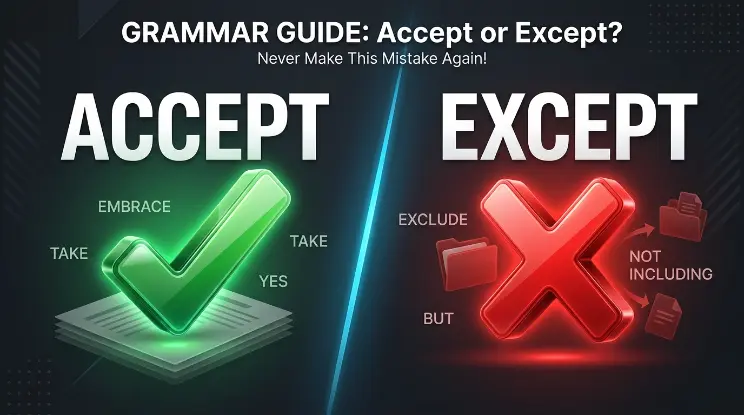
Have you ever stopped while writing a sentence and wondered whether you should use Accept or Except? You are not alone. These two words look and sound quite similar, but they have completely different meanings and uses.
This small difference can easily cause confusion, especially when you are writing emails, school assignments, social media posts, or everyday messages. Accept is usually used when you agree to receive or approve something, such as accepting an invitation, an offer, or an apology.
On the other hand, except means leaving someone or something out of a group or situation. For example, you might say, “I accept your invitation,” but “Everyone came except Ali.” Understanding this difference can make your English clearer and help you avoid common grammar mistakes.
Quick Answer 🎯
Accept is a verb meaning to agree to receive or take something (e.g., “I accept your invitation”). Except is usually a preposition meaning excluding or apart from (e.g., “Everyone came except John”). Different jobs, different words!
Now let’s dig deeper into each word so you never mix them up again.
What Does “Accept” Mean? ✅

Accept is a verb. It means to receive something willingly, to agree to something, or to say yes to an offer, idea, or situation.
Common Meanings of “Accept”:
- To take or receive something offered
- To agree with or believe something
- To approve of or say yes to a proposal
- To tolerate or come to terms with a situation
Examples of “Accept” in a Sentence:
- I accept your apology, no hard feelings. 🙏
- She decided to accept the job offer after thinking it over.
- He couldn’t accept the fact that he lost the match.
- Please accept this gift as a token of our appreciation.
- The company will accept returns within 30 days.
- They accepted the terms and conditions before signing up.
Notice how “accept” always involves agreeing, receiving, or approving something. That’s the key idea to remember.
What Does “Except” Mean? 🚫
Except is mostly used as a preposition (sometimes a conjunction), and it means excluding or not including something.
Common Meanings of “Except”:
- Excluding a specific person, item, or situation
- Used to point out an exception to a general statement
- Occasionally used as a conjunction meaning “only” or “but”
Examples of “Except” in a Sentence:
- Everyone finished the project except Sarah. 😬
- I like all vegetables except broccoli.
- The store is open every day except Sundays.
- Nothing seemed to work, except the last solution we tried.
- All the tickets were sold except for a few in the back row.
- He would have come to the party, except he was feeling sick.
See the pattern? “Except” always leaves something out it’s the “odd one out” word. 🧩
Accept vs Except: Comparison Table 📊
| Feature | Accept ✅ | Except 🚫 |
| Part of Speech | Verb | Preposition (sometimes conjunction) |
| Meaning | To agree to, receive, or approve | To exclude or leave out |
| Function in Sentence | Shows an action | Shows exclusion |
| Example | “I accept your offer.” | “Everyone left except me.” |
| Opposite Meaning | Reject, decline, refuse | Include, involve |
| Common Usage | Emails, agreements, offers | Lists, exceptions, exclusions |
Memory Trick to Never Confuse Them Again 🧠
Here’s a simple mnemonic that beginners love:
Accept = Agree (both start with “A”) Except = Exclude (both start with “Ex”)
Another fun trick:
- Think of “accept” as opening your arms wide to take something in. 🤗
- Think of “except” as pointing a finger and saying, “Not you, except you!” 👉
You can also remember:
- “Except” = “Excludes” (both start with EX)
- “Accept” = “Agrees” (both start with A)
Once this clicks, you’ll never second-guess yourself again!
Common Mistakes People Make ❌
Let’s look at some real mistakes people often make with these words, and how to fix them.
Mistake 1: Using “except” instead of “accept”
- ❌ Wrong: I except your invitation.
- ✅ Correct: I accept your invitation.
Mistake 2: Using “accept” instead of “except”
- ❌ Wrong: Everyone was there accept Tom.
- ✅ Correct: Everyone was there except Tom.
3: Confusing spelling due to similar sounds
Many people mishear these words in speech, especially in fast conversation, leading to spelling errors in writing.
Quick Fix Tip:
Before submitting any email, essay, or message, pause and ask yourself:
- Am I talking about agreeing/receiving something? → Use accept
- Am I talking about leaving something out? → Use except
Real-Life Examples 🌍
📧 In Emails:
“Thank you for the offer. I’m happy to accept the position starting next Monday.”
“All departments submitted their reports except the marketing team.”
📱 On Social Media:
“I finally accepted that not everyone will like my content, and that’s okay.” 💬
“Everything about this vacation was perfect, except the weather.” ☔
📰 In News Headlines:
“Government Accepts New Trade Proposal After Weeks of Negotiation”
“All Flights Delayed Except Those Heading to the Capital”
🎓 In Academic Writing:
“The hypothesis was accepted based on the statistical evidence provided.”
“All variables remained constant except temperature, which was intentionally altered.”
🗣️ In Everyday Speech:
“I’ll accept your apology, but let’s not do this again.”
“I love all seasons except winter it’s just too cold for me.” ❄️
British English vs American English 🇬🇧🇺🇸
Good news: “accept” and “except” are used the same way in both British and American English. There’s no regional difference in meaning or grammar rule here the confusion is purely due to their similar sound and spelling, not dialect.
However, one small usage note:
- In British English, you might see slightly more formal usage of “except” in written contracts and official documents.
- In American English, “except for” is often used more casually in speech, such as “Except for that one thing…”
Either way, the core grammar rule stays the same worldwide. 🌎
Bonus: “Except” as a Conjunction 🔗
While “except” is mostly a preposition, it can sometimes act as a conjunction, meaning “only” or “but.”
Example:
“I would have gone to the concert, except I had no tickets.”
This usage is more common in casual speech and less common in formal writing, so use it carefully in professional documents.
FAQs: People Also Ask 🙋
1. What is the easiest way to remember accept vs except?
Remember: Accept = Agree, Except = Exclude. Both pairs start with the same first letter, making it easy to recall.
2. Is “except” ever used as a verb?
No, “except” is not used as a verb in modern English. It functions as a preposition or conjunction. “Accept,” on the other hand, is always a verb.
3. Can “accept” and “except” ever mean the same thing?
No, they have opposite functions. “Accept” means to include or agree to something, while “except” means to exclude something.
4. Why do people confuse accept and except so often?
Because they sound similar when spoken quickly and share similar spelling patterns, especially the “-cept” ending.
5. Is it “accept for” or “except for”?
It’s always “except for,” not “accept for.” For example: “Everyone left except for me.”
6. What is the noun form of “accept”?
The noun form is “acceptance,” as in “Her acceptance of the offer surprised everyone.”
7. Does British English use “except” differently from American English?
No, both British and American English use “except” and “accept” the same way grammatically. The confusion is universal, not regional.
Final Thoughts: Accept the Difference, Except None! 😄
In conclusion, accept and except may look and sound similar, but they have completely different meanings. Accept is a verb that means to agree to, receive, or approve something, while except is usually used to mean excluding someone or something. Understanding this simple difference can help you avoid common spelling and grammar mistakes in writing and conversation.
Remember: you accept an offer, apology, or invitation, but you except something when you leave it out of a group. With regular practice and attention to context, choosing between accept or except becomes much easier and more natural.

Olivia Bennett is a passionate English grammar writer at GrammBoost.com who loves making grammar simple and easy to understand. She specializes in spelling, word differences, punctuation, and everyday English usage. Through clear explanations and practical examples, Olivia helps students, writers, and professionals write with greater confidence and accuracy.