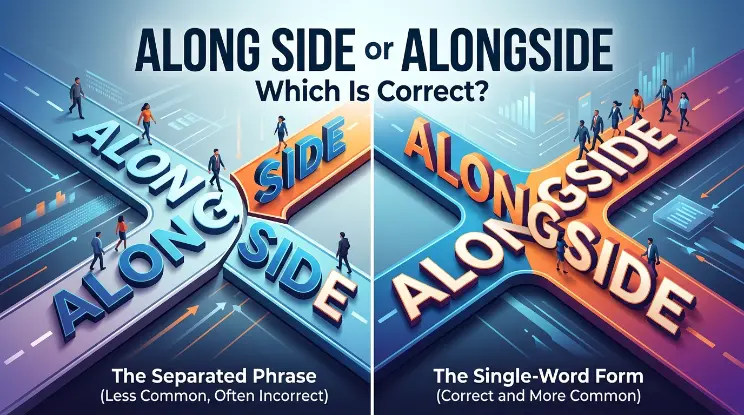
Have you ever paused mid-sentence, wondering if you should write “she worked along side her sister” or “she worked alongside her sister”? 🤯 You’re definitely not alone!
This is one of those sneaky English spelling mistakes that trips up even confident writers. It looks like it could go either way, and spell-checkers don’t always catch it because “along” and “side” are both real words on their own. But when it comes to correct spelling and clear communication, only one version is right in almost every situation.
Let’s clear up the confusion once and for all with simple explanations, real-life examples, and a few memory tricks to help it stick. 🧠
Quick Answer ⚡
“Alongside” (one word) is the correct spelling in modern English. It’s a preposition meaning “next to” or “together with.” The two-word version, “along side,” is generally considered a spelling mistake and should be avoided in almost all writing.
What Does “Alongside” Mean?

Alongside is a preposition (sometimes used as an adverb) that means:
- 🔹 Next to something or someone
- 🔹 At the side of something
- 🔹 Together with, or in addition to
It’s a compound word formed by joining “along” + “side” into a single, unified term and that’s exactly how it should be written: one word, no space.
Examples of “Alongside” in Sentences
- The dog trotted alongside its owner during the morning walk. 🐕
- She parked her car alongside the curb.
- Our team worked alongside the marketing department to launch the new product.
- The ship docked alongside the pier.
- He felt proud standing alongside his colleagues at the award ceremony. 🏆
- New employees are trained alongside experienced staff members.
- The report highlights economic growth alongside rising inflation.
Notice how “alongside” can describe physical position (next to something) or a more abstract relationship (working together, existing together, or happening at the same time).
Is “Along Side” Ever Correct?

Here’s the twist: “along side” (two words) is not considered standard or correct in modern English usage. It’s essentially a common misspelling that happens because people mentally break the compound word into its two original parts.
Think of it like this:
- ❌ Along side Incorrect (a common typo/spelling error)
- ✅ Alongside Correct (standard, accepted spelling)
Some older or very informal texts might occasionally use “along side,” but virtually every modern dictionary, style guide, and grammar authority including Merriam-Webster, Oxford, and Cambridge lists “alongside” as the single accepted spelling.
📌 Bottom line: If you’re writing an email, essay, article, or social media post, always go with alongside.
Comparison Table: Alongside vs Along Side
| Feature | Alongside ✅ | Along Side ❌ |
| Spelling | One word | Two words (incorrect) |
| Part of Speech | Preposition/Adverb | Not standard |
| Dictionary Status | Recognized in all major dictionaries | Not recognized as correct |
| Meaning | Next to, together with | Same intended meaning, but wrong spelling |
| Example | “He walked alongside his friend.” | “He walked along side his friend.” (incorrect) |
| Usage in Formal Writing | Always acceptable | Should be avoided |
| Usage in British English | Alongside | Alongside |
| Usage in American English | Alongside | Alongside |
Why Does This Confusion Happen? 🧐
Understanding why people mix these up can help you remember the correct form.
- Compound word confusion English has tons of compound words (like “into,” “onto,” “upon”) that used to be two separate words but merged over time. “Alongside” followed this same path.
- Visual splitting Because “along” and “side” are both common standalone words, our brains sometimes want to separate them, especially when typing quickly.
- Autocorrect gaps Not all spell-checkers flag “along side” as wrong, since both words are technically valid on their own.
- Regional or informal writing habits Casual texting and social media posts sometimes ignore proper spelling rules altogether.
Memory Trick to Never Get It Wrong Again 🧠✨
Here’s a simple mnemonic to lock this in:
🚗 “A car drives ALONGSIDE another car SIDE by SIDE, joined together, just like the word!”
Since the meaning is about things being joined together in position, the word itself should be joined together too no space!
Another quick trick:
- “Alongside” = “Along” + “Side” = ONE unit, ONE word.
- If you can replace it with “next to” or “beside,” and those are single words, “alongside” should be too.
Real-Life Examples: Where You’ll See “Alongside” Used
📧 In Emails
“Please find the attached proposal alongside the budget report for your review.”
📱 On Social Media
“So proud to be working alongside such a talented team this year! #Grateful #TeamWork”
📰 In News Headlines
“New Policies Announced Alongside Economic Reforms”
🎓 In Academic Writing
“The study examines climate change alongside its socioeconomic impacts on coastal communities.”
💬 In Everyday Speech
“I’ll walk alongside you to the station.”
As you can see, “alongside” fits naturally across formal, casual, professional, and academic contexts which is exactly why getting the spelling right matters so much for clear, credible communication. ✍️
British English vs American English: Any Differences? 🇬🇧🇺🇸
Good news there’s no difference here! Both British and American English agree that “alongside” is the correct, single-word spelling. This is one of those rare grammar rules where the two dialects are in complete harmony. 🤝
| Region | Correct Spelling |
| British English 🇬🇧 | Alongside |
| American English 🇺🇸 | Alongside |
| Australian English 🇦🇺 | Alongside |
| Canadian English 🇨🇦 | Alongside |
So no matter where your audience is located, you’re safe using “alongside” as one word.
Common Mistakes to Avoid 🚫
Here are a few related errors people make alongside (see what we did there? 😉) this one:
- ❌ “Along-side” (with a hyphen) Also incorrect; no hyphen is needed.
- ❌ “Alongside of” Redundant; just use “alongside” without “of.”
- ❌ “She sat alongside of her brother.”
- ✅ “She sat alongside her brother.”
- ❌ “Along side of” Doubly incorrect (wrong spacing + unnecessary “of”).
- ❌ Confusing “alongside” with “along” “Along” often implies movement (walking along the street), while “alongside” implies position beside something.
Quick Reference Table of Mistakes
| Incorrect ❌ | Correct ✅ |
| along side | alongside |
| along-side | alongside |
| alongside of | alongside |
| along side of | alongside |
“Alongside” vs “Along” vs “Beside”: What’s the Difference?
Since these words often get grouped together, here’s a quick breakdown:
| Word | Meaning | Example |
| Alongside | Next to, together with | “She stood alongside her teammates.” |
| Along | Following the length of something; movement | “We walked along the beach.” |
| Beside | Next to (similar to alongside, but simpler) | “He sat beside me.” |
💡 Tip: “Alongside” often carries a slightly more formal or collaborative tone than “beside,” especially in professional or journalistic writing.
FAQs: People Also Ask 🙋♀️
1. Is “alongside” one word or two?
Alongside is always written as one word. “Along side” (two words) is considered incorrect in standard English.
2. Can I use “alongside of” in a sentence?
No, this is redundant. Simply use “alongside” without adding “of.” For example, say “walking alongside her,” not “walking alongside of her.”
3. What is a synonym for “alongside”?
Common synonyms include: beside, next to, adjacent to, together with, in addition to.
4. Is “alongside” formal or informal?
“Alongside” works well in both formal and informal writing, including academic papers, business emails, news articles, and casual conversation.
5. Does British English spell “alongside” differently than American English?
No, both British and American English use the same spelling: alongside (one word).
6. What’s the difference between “along” and “alongside”?
“Along” usually suggests movement or direction (e.g., “walking along the path”), while “alongside” indicates being next to or together with something (e.g., “walking alongside a friend”).
7. Why do people often misspell “alongside” as “along side”?
Because both “along” and “side” are valid standalone words, people sometimes assume they should be separated, especially when typing quickly or without spell-check assistance.
Conclusion: The Key Takeaway 🎯
In conclusion, “alongside” is usually the correct spelling when you mean “next to,” “beside,” or “together with.” For example, “She walked alongside her friend” is correct. “Along side” is generally not used as a standard phrase when expressing this meaning, although the separate words can appear in special contexts where “along” and “side” have their own meanings.
Understanding the difference can help you avoid common spelling and grammar mistakes in everyday writing. When you are unsure, remember that alongside is normally written as one word. Using the correct form makes your sentences clearer, smoother, and more professional.

James Carter is an English language enthusiast and content writer who loves making grammar simple and easy to understand. He creates clear, beginner-friendly guides on spelling, grammar rules, confusing words, and everyday English usage. His goal is to help readers write with confidence through practical examples, easy explanations, and accurate language tips.